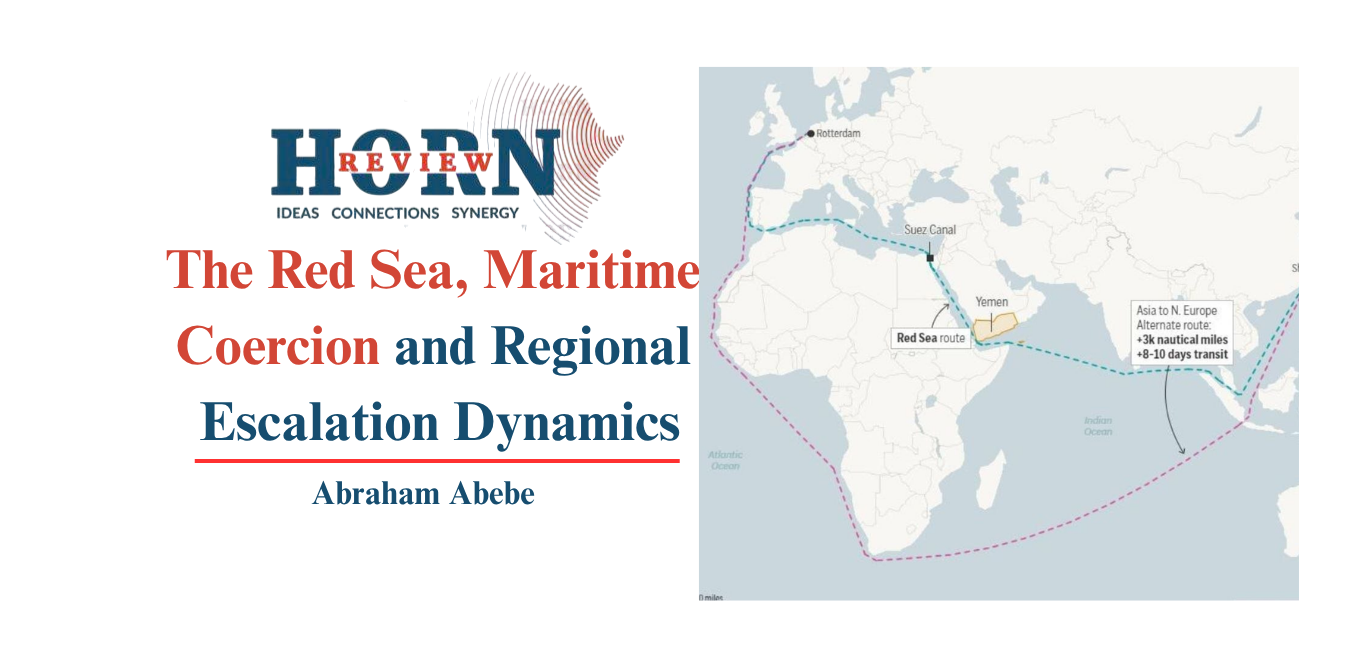
The Red Sea has re-emerged as one of the world’s most strategically contested maritime corridors. Currently, the main challenge is not ongoing maritime violence, but rather strategic uncertainty driven by sporadic escalation and signaling. The Houthis have reinforced this uncertainty by integrating maritime activity into broader regional dynamics linked to Iran-Israel-United States tensions. Reports of limited attacks on commercial vessels in the Gulf of Aden in early June 2026, alongside subsequent warnings directed at Israel-linked shipping, show how calibrated coercion and threat issuance sustain strategic pressure. In this environment, perception of risk has become as consequential as material damage.
This transformation reflects the Red Sea’s evolution into a critical arena where regional rivalries, global trade flows and energy security intersect. As reported, Houthi forces attacked two commercial vessels in the Gulf of Aden on 8 and 9 June, shortly after announcing restrictions on shipping linked to Israel ports. Although limited in scale compared with the sustained maritime campaign of 2024 and early 2025, these incidents marked the resumption of direct attacks following a period of relative operational restraint. Maritime security reporting also indicated heightened alert levels across the southern Red Sea and adjacent waters. On 28 June, the group issued renewed warnings directed at Israel-linked shipping and signalled that United States-associated vessels could also become targets should Washington deepen its military involvement in the regional conflict. Collectively, these developments suggest that the Houthis continue to treat maritime attacks as a coercive instrument, selectively activated to reinforce political messaging and strategic deterrence, rather than as a tool of continuous disruption.
The principal development is therefore not the frequency of attacks, but the conditionality of threat. Houthi maritime activity appears increasingly structured around signalling cycles linked to developments in the wider regional confrontation involving Iran, Israel, and the United States. This pattern suggests a calibrated form of coercion in which limited kinetic action is alternated with the issuance of threats, enabling sustained strategic relevance without the costs of prolonged, high-tempo maritime warfare. The Red Sea in this sense functions less as a theatre of continuous attrition than as a domain of intermittent coercive messaging.
This approach reflects a broader shift in the political economy of maritime insecurity. Historically, insecurity in the Red Sea corridor was driven primarily by Somali piracy and, later, by instability linked to Yemen’s protracted conflict. In the current environment, however, the maritime space is increasingly tied to interstate rivalry and proxy competition. Shipping lanes are no longer shaped solely by coastal instability; they are increasingly affected by escalation dynamics from wider geopolitical theatres. As a result, the Red Sea now functions as a key arena in Middle Eastern strategic competition. Maritime disruption in this region is used deliberately by regional adversaries, global powers, and commercial actors to send political messages and achieve operational objectives.
The recent pattern of Houthi maritime activity challenges simplistic interpretations of the movement as merely an Iranian proxy acting under direct operational control. While extensive Iranian military, technical and intelligence support has significantly enhanced Houthi capabilities, the timing and calibration of maritime attacks suggest that the group retains considerable strategic autonomy. The Houthis do not operate solely as instruments of Iranian policy. Instead, they leverage external support to pursue their own political and military objectives, such as strengthening domestic legitimacy, consolidating territorial control, and increasing leverage in negotiations. While they may occasionally align their operations with Iran’s broader regional strategy, these actions primarily serve the Houthis’ independent interests.
These objectives remain relatively consistent: securing recognition of their de facto governing authority in northern Yemen, reducing external military pressure, and strengthening their position within Iran’s Axis of Resistance. Within this framework, maritime coercion is best understood as a means for extracting political concessions and shaping the course of negotiations, rather than as a goal in itself. Its primary advantage is its adaptability, enabling actors to increase pressure and escalate tensions without engaging in prolonged or direct conflict.
This strategic ambiguity has reshaped commercial behaviour across the global shipping industry. Operators now respond to perceived risk environments as well as actual incidents, adjusting routing decisions, insurance premiums, and security protocols accordingly. In this way, even limited and geographically contained attacks can generate disproportionate economic effects by amplifying uncertainty at a critical global chokepoint.
The broader significance of these developments lies not only in the disruption they generate but also in the persistent strategic uncertainty they sustain. Maritime coercion derives much of its effectiveness from its ability to shape expectations, encouraging commercial actors to make decisions under conditions of enduring ambiguity rather than simply in response to isolated incidents. In this environment, the prospect of renewed attacks may prove almost as influential as their actual occurrence, recalibrating perceptions of risk and reinforcing precautionary behaviour across the shipping industry. Consequently, even limited military activity can achieve a disproportionate strategic effect by influencing global trade patterns without requiring a sustained operational campaign. In this sense, uncertainty itself becomes a source of strategic leverage, amplifying the economic and political consequences of episodic maritime disruption.
For states in the Horn of Africa, particularly Ethiopia, Djibouti and Somalia, the implications of Red Sea insecurity are especially acute given their heavy reliance on the Bab el-Mandeb corridor for external trade. This creates a condition in which regional security developments translate directly into economic exposure, particularly for states whose trade lifelines are concentrated through a limited number of maritime gateways. Within this context, the Horn occupies an asymmetrical position in the evolving Red Sea security architecture. Although it is highly vulnerable to changes in maritime security, it has limited capacity to shape the strategic dynamics that drive escalation. This imbalance creates a fragile equilibrium where deterrence, signalling, and the constant threat of disruption are persistent realities rather than rare exceptions.
Within scenario analysis, the key variable is the threshold at which regional escalation spills over into sustained maritime warfare. A significant deterioration in Iran-Israel or United States-Iran relations could destabilise the current equilibrium in the Red Sea, increasing the likelihood of more frequent and coordinated maritime incidents. Conversely, meaningful de-escalation would depend not only on progress in Yemen but also on a broader easing of tensions involving Iran and its adversaries. Such an outcome, however, remains limited in the near term given entrenched strategic mistrust among key regional and extra-regional actors.
The Red Sea has therefore become a geopolitical flashpoint rather than a traditional maritime corridor. The apparent calm of 2026 should not be mistaken for stability, but understood as a deterrence-induced pause within a broader cycle of episodic escalation. The defining characteristic of the current environment is not sustained maritime conflict, but the tactical use of maritime coercion, where limited kinetic actions and calculated threats are alternated to maintain strategic pressure and signalling effects. As long as this form of coercion serves the political interests of armed actors in the region, underlying vulnerabilities are likely to persist.
Without such partial decoupling, the Red Sea is likely to continue to experience cyclical instability driven more by external conflict dynamics than by internal maritime conditions. For both littoral and inland states, this highlights the need to combine diplomatic engagement with maritime risk management, while acknowledging that lasting stability will require a wider political settlement that extends beyond the maritime domain.
By Abraham Abebe, Researcher, Horn Review