In the turbulent history of Sudanese post independence politics, military takeovers have been a recurring feature, often framed by critics as more than mere domestic power struggles. Among the most persistent narratives is that Egypt, Sudan’s powerful northern neighbor, has played a covert hand in engineering or enabling coups to safeguard its strategic interests, particularly control over the Nile waters and a pliable regime in Khartoum. A pattern of ideological affinity, intelligence coordination, personal ties, and hydro-political leverage emerges clearly from the historical record, especially in the landmark coups of May 25, 1969, and October 25, 2021.
This dynamic reflects deeper structural asymmetries: Egypt’s overwhelming dependence on the Nile has consistently driven it to assert dominance over Sudan rather than pursue equitable partnership. Historical and cultural ties, often invoked by Cairo, have frequently served as justification for interference rather than genuine cooperation. Egypt has also shown a clear preference for compliant, military-led regimes in Khartoum, viewing them as more predictable and easier to influence than independent civilian governments. While Sudanese internal divisions, economic crises, and elite rivalries remain important, they have often been exploited and amplified by successive regimes in Cairo. Understanding this external amplification of internal divisions is key to explaining Sudan’s persistent instability and the trajectory toward its current civil war.
On May 25, 1969, Colonel Gaafar Nimeiry and a group of “Free Officers”, explicitly modeled on Egypt’s 1952 Nasserist revolutionaries, seized power in a bloodless coup. They overthrew the fragile civilian government of President Ismail al-Azhari and Prime Minister Muhammad Ahmad Mahgoub, citing political paralysis, economic stagnation, the absence of a permanent constitution, and unresolved southern tensions.
Nimeiry’s regime quickly embraced Nasserist pan-Arabism, state socialism, nationalizations, and close ties with Egypt and Libya. The Revolutionary Command Council mirrored Nasser’s model. Egypt promptly recognized the new government, and ideological bonds deepened. During the 1971 communist counter-coup attempt, Egyptian support helped Nimeiry regain control. Later efforts at “integration” treated Sudan as a potential agricultural hinterland for Egypt.
The coup arose from Sudanese officers addressing genuine domestic failures, preempting rival plots by communists and others. Nimeiry had a history of involvement in earlier conspiracies. However, the ideological inspiration was unmistakable, and Egypt capitalized effectively on the outcome. Military regimes in Khartoum had already proven more amenable to Egyptian interests: the 1958 coup by General Ibrahim Abboud facilitated the pivotal 1959 Nile Waters Agreement, which allocated the vast majority of the river’s flow, 55.5 billion cubic meters annually to Egypt versus 18.5 billion to Sudan, solidifying downstream dominance while sidelining Sudanese experts’ concerns about future needs. Egypt’s ideological, political, and strategic influence shaped both the context of the 1969 coup and the trajectory of the regime that followed. Viewing Sudan as part of a unified “Nile Valley,” Cairo embedded its interests deeply in Sudan’s politics, turning it into a space divided between pro-unity and pro-independence forces. Crucially, this influence extended into the military, where Egyptian training, doctrine, and Arab nationalist networks fostered pro-Cairo orientations within the officer corps prior to the coup.
When Gaafar Nimeiri seized power in 1969, his regime aligned with Gamal Abdel Nasser’s Arab socialism, adopting anti-Western rhetoric, strengthening ties with the Soviet bloc, and coordinating closely with Egypt. While not directly imposed, this alignment reflected the prior ideological penetration of Nasserism within Sudan’s military elite.
By the early 1970s, relations peaked, culminating in the 1976 Joint Defence Agreement that institutionalized shared security. Although the coup was domestically driven, Egypt’s pre-existing influence,especially within the military, shaped both its environment and its aftermath, pulling Sudan firmly into Cairo’s strategic orbit.
The evidence of Egyptian involvement grows substantially stronger with the October 25, 2021, coup led by General Abdel Fattah al-Burhan. Amid mounting tensions between the military and the civilian transitional government led by Prime Minister Abdalla Hamdok, following the 2019 ouster of Omar al-Bashir, Burhan dissolved the cabinet, arrested Hamdok, and seized power, derailing Sudan’s fragile democratic experiment.
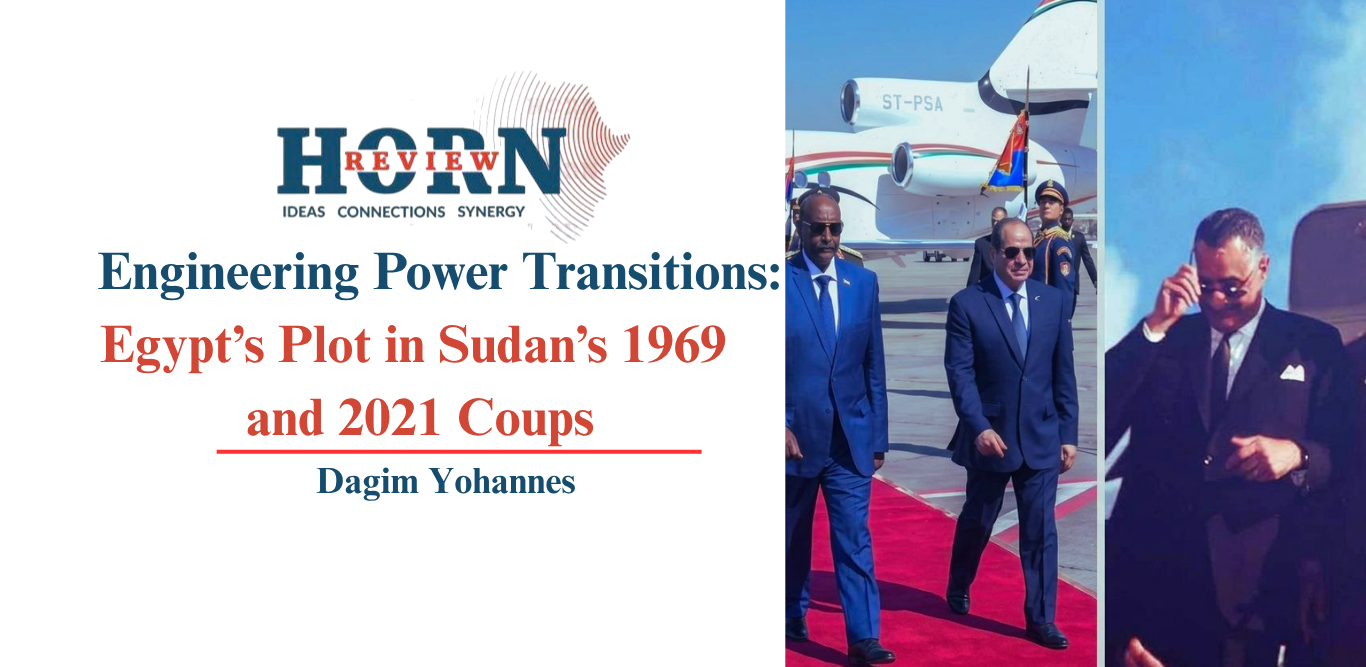
Reporting’s make clear Cairo’s pre-coup coordination. Egyptian intelligence chief Abbas Kamel met Burhan in Khartoum, reportedly telling him that “Hamdok must leave,” citing the prime minister’s perceived openness to Ethiopia on the Grand Ethiopian Renaissance Dam (GERD) and reluctance to deepen certain alignments. The night before the coup, Burhan made a secret visit to Cairo to secure President Abdel Fattah el-Sisi’s backing. Egypt notably refrained from condemning the takeover, unlike initial statements from Saudi Arabia, the UAE, the US, and UK and actively lobbied regionally to legitimize Burhan’s position.
Burhan’s personal ties to Egypt run deep: he trained at Egyptian military academies alongside Sisi’s cohort. The Sudanese Armed Forces (SAF) maintain longstanding institutional links with Cairo, including joint exercises. In contrast, Rapid Support Forces (RSF) leader Mohamed Hamdan Dagalo (Hemedti) cultivated stronger Gulf ties. Post-coup, Egypt continued backing the SAF, including during the 2023 outbreak of full-scale civil war between the SAF and RSF. Egypt’s motives are pragmatic and existential: securing its southern border, countering Islamist influences, maintaining Nile flow amid upstream challenges with the GERD, and favoring military “stability” over the uncertainties of civilian rule that might renegotiate water shares or align differently with the region.
At the heart of Egypt-Sudan relations lies the Nile, Egypt’s so-called lifeblood. The 1959 Agreement, enabled by a military regime in Khartoum, codified a division heavily favoring Egypt. Civilian governments have sometimes pushed back or explored broader riparian cooperation; military ones have tended toward compliance. Egyptian concerns about Sudanese agricultural expansion or upstream alliances are longstanding, with reports of efforts to stymie projects perceived as threats.
This hydro-hegemony, combined with border dispute of the Halayeb Triangle, fosters Sudanese nationalist resentment. Critics see a pattern of dependency: Egypt cultivating military allies who prioritize Cairo’s interests, treating Sudan as a strategic buffer rather than a fully sovereign peer.
Sudan’s coups are not solely foreign-driven. Deep domestic factors, elite power struggles, economic crises, ethnic/regional divides, and military grievances, provide the fuel. But external actors have meddled extensively. Framed as survival imperatives, Egypt’s actions often obscure a calculated strategy of regional dominance that borders on neo-imperialism.
As Sudan descends deeper into a devastating civil war, Egypt’s continued backing of the SAF reinforces a long-standing pattern of external interference that has consistently undermined Sudan’s political autonomy. Rather than stabilizing its neighbor, Cairo’s involvement has often entrenched military dominance, exacerbated internal fractures, and prolonged cycles of authoritarian rule. While nationalist claims of “Egyptian plots” may at times appear overstated, they reflect legitimate concerns about a persistent strategy of influence that has repeatedly prioritized Egypt’s strategic interests over Sudan’s sovereignty.
A more critical reading reveals not just influence, but a deliberate exploitation of Sudan’s internal weaknesses. Egypt has systematically leveraged political divisions, economic fragility, and elite rivalries to shape outcomes in its favor, often at the expense of genuine democratic transition. In this light, calls for nuance should not obscure accountability. Sudanese leaders bear responsibility, but their agency has been continually constrained and distorted by external pressure.
Achieving true stability will require dismantling this entrenched pattern of interference, addressing inequities surrounding the Nile, recalibrating regional alignments, and establishing authentic civilian-military balance free from foreign patronage. Without confronting Cairo’s destabilizing role, Sudan risks remaining trapped in a recurring cycle of militarized governance sustained from beyond its borders. Sudan’s independence, though formally secured, continues to be eroded under the persistent shadow of its powerful northern neighbor.
By Dagim Yohannes, Researcher, Horn Review