Few relationships in the Horn of Africa carry as much weight and complexity as the one between Ethiopia and Sudan. These two nations share a long land border, a common river system and centuries of intertwined history. When Sudan has entered periods of major political upheaval or armed conflict, Ethiopia has rarely remained a distant observer. From Haile Selassie’s peace efforts in Addis Ababa during the negotiations that led to the 1972 settlement to Abiy Ahmed’s journey to Port Sudan during the 2023 civil war, Ethiopia has inserted itself into Sudan’s peace processes repeatedly and consistently across different eras and different governments. This engagement reflects not only neighbor concern but an effort enmeshed in the understanding that Sudan’s peace is peace for the entire Horn while Sudan’s collapse inflicts damage upon all.
Sudan is a country with a long history of war yet paradoxically it is also a country that knows negotiation intimately. Nearly all of Sudan’s wars have ended through negotiated settlements from the 1972 Addis Ababa Agreement to the 2005 Comprehensive Peace Agreement. The current warring remain the exception. They have not sat down talked properly or resolved their differences. This failure stems partly from the involvement of external actors with competing agendas and from the fact that the conflict has transcended politics into the economic realm where control over resources has become inseparable from the means to wage war. However through each phase of Sudan’s history Ethiopia has remained present at the negotiating table.
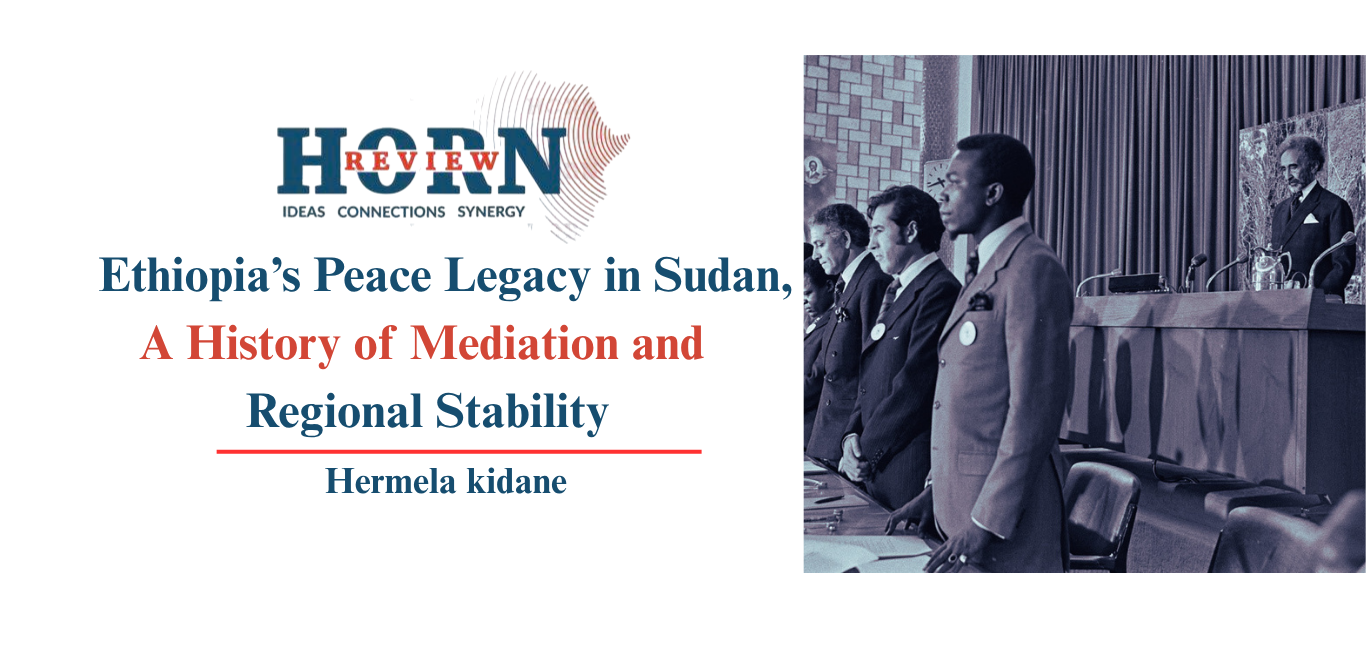
The foundation of Ethiopia’s peace legacy in Sudan was laid during the reign of Emperor Haile Selassie. Sudan’s first civil war lasting from 1955 to 1972 reflected deep political regional and identity based divisions between the central government in Khartoum and armed movements in the south. By the early 1970s both President Jaafar Nimeirys government and the Anya Nya movement had reached a point of exhaustion with neither side able to secure a decisive military outcome. This stalemate created the political conditions for negotiations and it was Haile Selassie who offered Addis Ababa as the site for peace talks. More critically he personally guaranteed the safety of southern rebel fighters a commitment that proved essential to bringing them to the table at all.
The Anya Nya rebels refused to sign any agreement until Selassie made that personal pledge a testament to the trust Ethiopia commanded at the time. While the negotiations were formally moderated by the All Africa Conference of Churches and the World Council of Churches Ethiopia provided the physical space the moral authority and the head of state whose word made the deal real. The agreement signed on February 27, 1972 ended seventeen years of fighting granted the south regional autonomy and integrated former rebel fighters into the national army. Sudans National Unity Day observed on March 27 marks its ratification. Though the peace unraveled in 1983 when Nimeiry violated its terms the 1972 agreement stands as the first defining moment in Ethiopia’s role as a peacemaker in Sudan.
The period between 1983 and 1991 saw a symmetry of interference with each state backing the other’s armed opposition. Yet even during the Derg era, the understanding that stability along their shared frontier served mutual interests never fully disappeared. Crucially the Derg actively brought Sudanese parties to the negotiating table most notably by hosting talks between the Sudanese government and the SPLM/A in Addis Ababa in the late 1980s using its diplomatic influence to bridge initial divides and prioritizing a negotiated ceasefire over ideological rivalries.
This peace focused engagement though intermittent laid the groundwork for later multilateral efforts. Ethiopia a founding member of IGAD and one of its most consistent driving forces made Addis Ababa a central gathering point for negotiations between Khartoum and the SPLM throughout the 1990s and early 2000s. During the Meles Zenawi period this wasn’t distant diplomacy it was hands on driven by a clear understanding that Sudan’s stability and Ethiopia’s own wellbeing were deeply connected. Quiet, persistent engagement produced results that louder approaches couldn’t contributing institutionally and diplomatically to talks that ultimately culminated in the 2005 Comprehensive Peace Agreement ending 21 years of civil war. That chapter showed what’s possible when Ethiopia leans in with purpose and that same spirit, adapted to today’s realities is still worth reaching for.
When South Sudan became independent on July 9, 2011 one major question remained unresolved. Abyei the oil rich disputed territory on the border between the two Sudan’s had been promised a referendum that never materialized. Instead Sudanese Armed Forces troops occupied Abyei in May 2011 displacing tens of thousands of civilians and raising the threat of renewed conflict just as independence was being celebrated. A deal to demilitarize Abyei was brokered in Addis Ababa on June 20, 2011 and the United Nations Security Council responded by establishing the United Nations Interim Security Force for Abyei universally known as UNISFA.
What made UNISFA extraordinary was its composition. Ethiopia was not only the largest contributor of troops for most of the missions first decade Ethiopia was the only contributor. Both Sudan and South Sudan had specifically requested Ethiopian forces a remarkable diplomatic achievement reflecting that two rival states at the point of potential conflict agreed upon Ethiopia as the one country they would both accept as a neutral peacekeeping presence. Ethiopian troops served in Abyei for over a decade protecting civilians monitoring the buffer zone and preventing the kind of escalation that could have reignited war between Sudan and South Sudan.
The most dramatic single act of Ethiopian mediation in Sudan’s modern history came in June 2019. Following the removal of Omar al Bashir after months of mass protests Sudan found itself in a dangerous standoff between the Transitional Military Council and the civilian opposition coalition that had driven the uprising. After a violent crackdown on protesters in Khartoum triggered regional condemnation and Sudan’s suspension from the African Union.
Prime Minister Abiy Ahmed arrived in the capital on June 7, 2019. He put forward a concrete framework for a fifteen member transitional council consisting of eight civilians and seven military officers to lead Sudan toward democratic elections. The civilian opposition accepted Ethiopia’s mediation under certain conditions and Ethiopia designated an ambassador as special envoy to continue the process alongside an African Union representative. While the mediation did not resolve the crisis immediately the Ethiopian initiative created a framework that combined with African Union pressure eventually produced a breakthrough. By August 2019 the military and civilian coalition had signed a power sharing deal establishing a three year Sovereign Council and a civilian led cabinet. That stability proved fragile undone by General al Burhans coup in October 2021 but the 2019 intervention demonstrated Ethiopias willingness to act decisively at moments of maximum danger.
The current civil war has tested Ethiopia’s capacity for mediation. IGAD responded by adopting a mediation roadmap and forming a Quartet composed of Djibouti, Ethiopia, Kenya and South Sudan with Ethiopia later hosting the Quartet’s first meeting in Addis Ababa. Abiy Ahmed traveled to Port Sudan on July 9 2019 becoming the first foreign head of government to visit the de facto wartime capital since the war began. The visit was striking represented a continuation of Ethiopia’s commitment to finding sustainable solutions for Sudan’s stability even as the obstacles to mediation have grown more formidable.
Tracing the Ethiopian peace legacy in Sudan from Haile Selassie through the Derg, the Meles Zenawi government and into the Abiy Ahmed era reveals a consistent pattern of engagement fixed in both interest and genuine peacemaking. Ethiopia has always viewed relations with its neighbors through a clear security lens the long and largely unsettled border makes regional stability a shared necessity. Since Sudan’s transition toward independence in the early 1950s, developments inside Sudan have remained a matter of close attention for Ethiopia. however interest has never negated genuine achievement. Time and again, Ethiopia has brought Sudanese parties to the negotiating table, creating space for dialogue even when agreement proved elusive. When South Sudan chose separation, Ethiopia had already worked tirelessly to encourage both sides to negotiate a different outcome. Ethiopia has never abandoned the effort a persistence that reflects both prudent diplomacy and a deeply held commitment to regional peace.
For Ethiopia, silence simply wasn’t an option. History already shows that when this country stepped forward, it became a quiet but decisive force for peace in Sudan. That role wasn’t accidental it was earned through steady, patient diplomacy. Sudan’s collapse wouldn’t stop at its borders. Refugees would flow outward, armed groups would find new presence and the entire Horn would feel the weight of another broken state. Ethiopia understands this better than most. Peace in Sudan isn’t charity its survival, shared and unavoidable.
By Hermela kidane, Researcher, Horn Review