Strategic convergence in the Horn of Africa is too often misread through the narrow grammar of formal alliances, as though coordination must announce itself through treaties, communiqués, or institutional architectures. Yet the region’s contemporary political field resists such linear interpretation. What is taking shape instead is a more diffuse but structurally coherent pattern of alignment – one that operates through overlapping strategic anxieties, persistent geopolitical axes, and the anticipatory construction of narratives that render future actions legible before they occur. Across this system, a dominant organizing logic is increasingly visible: the sustained interaction between Ethiopia’s rising strategic centrality and the long-standing regional alignments that seek to constrain, redirect, or pre-empt its trajectory. This is not episodic coordination but a durable geopolitical structure. Egypt and Eritrea constitute a historically embedded strategic axis shaped by converging interests on the Red Sea and the Nile basin. Sudan’s military establishment, particularly the Sudanese Armed Forces (SAF), functions within this same system as a critical corridor of geographic and logistical permeability. Together, these elements form an interconnected pressure environment that consistently orients itself toward Ethiopia as the central node of regional recalibration.
Within this architecture, the internal restructuring of the Tigray People’s Liberation Front must be understood as more than organizational adjustment. It is a political act embedded in a wider field of external perception and regional calculation. In the Horn of Africa, political restructuring is never purely internal; it is read externally as signaling, positioning, and anticipation of future alignments. The result is that domestic political shifts immediately acquire regional strategic meaning. Ethiopia’s internal political geography is similarly structured by fragmentation across multiple theaters. Arms circulation and material flows are reported across porous borderlands with Eritrea and Sudan and through internal frontiers spanning northern Tigray, western Oromia, and parts of the Amhara region. Within this landscape, armed formations such as TPLF-aligned elements, Fano networks in Gojam, and the Oromo Liberation Army in parts of Wollega appear as differentiated but interconnected nodes within a broader conflict ecology. While operational details vary, their cumulative effect is to produce a multi-front pressure system that strains state capacity and amplifies vulnerability during moments of national transition.
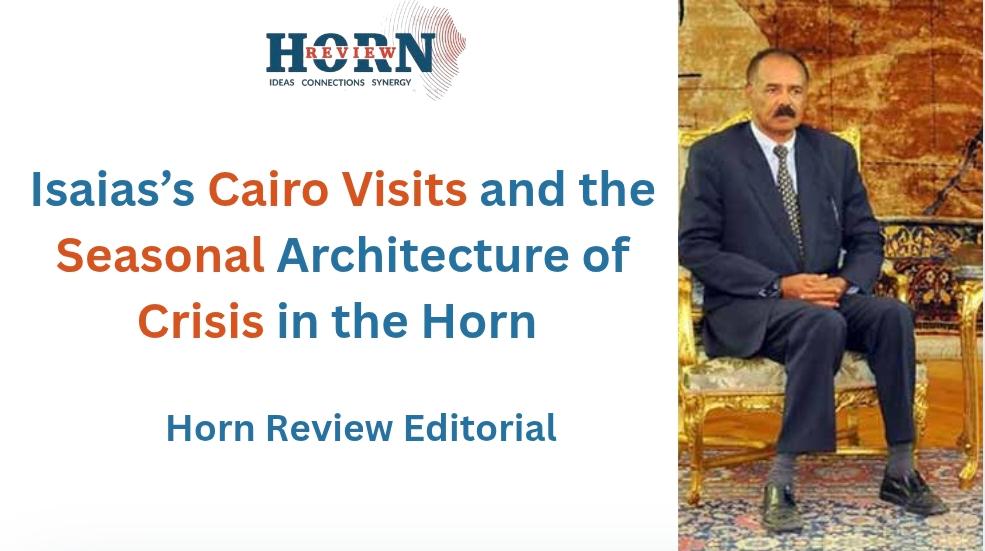
Eritrea’s role within this system must be understood in structural rather than episodic terms. Its economic constraints and logistical limitations preclude sustained autonomous projection across multiple Ethiopian theaters. Its strategic relevance instead derives from positional alignment within a broader regional axis, historically anchored in its long-standing geopolitical convergence with Egypt. This Egypt–Eritrea axis is not a recent formation but an enduring structural alignment shaped by shared interests in Red Sea security governance and Nile hydropolitics. This alignment has been reinforced through sustained high-level diplomatic engagement in the post-Pretoria period. Since the 2022 settlement in Ethiopia, Eritrea’s presidential-level engagements with Cairo – recorded in 2024, 2025, and again in 2026 – reflect not isolated diplomatic encounters but a consistent pattern of strategic coordination at the highest level. These are reinforced by continuous ministerial exchanges and trilateral formats that periodically incorporate additional Red Sea and Horn actors. The significance of this pattern lies not in frequency alone, but in its persistence across Ethiopia’s post-conflict recalibration period, signaling continuity in a long-standing regional axis rather than episodic alignment. This axis intersects directly with Egypt’s enduring strategic preoccupation: the Nile basin and Ethiopia’s Grand Ethiopian Renaissance Dam (GERD). The hydropolitical dimension is not abstract; it is structurally embedded in seasonal cycles. The period between June and September, when the Nile’s rains enable GERD reservoir filling, constitutes a recurring window of strategic sensitivity. During this phase, Ethiopia’s infrastructural assertion, domestic political consolidation, and external diplomatic exposure converge simultaneously. It is within this same window that regional tensions consistently intensify.
This recurrence is not accidental. Since 2018, Ethiopia’s political and security crises have repeatedly clustered around the June onset period. The attempted assassination of the Prime Minister, Abiy Ahmed, in Addis Ababa marked the initial rupture of this pattern, followed by successive cycles of insurgent escalation, political instability, and coordinated pressure across multiple regions. The significance of this pattern lies in its structural repetition: June is not simply a calendar month but a recurring phase of heightened systemic vulnerability. Such vulnerability emerges from the convergence of three interlocking cycles. The hydrological cycle of the Nile and GERD filling season (June–September), the internal political cycle of elections and post-election consolidation, and the conflict activation cycle across Ethiopia’s fragmented security landscape. When these cycles overlap, they produce a structurally amplified environment in which internal fragmentation and external alignment reinforce one another.
Within this temporal structure, Ethiopia’s conflict dynamics have undergone a clear shift. Earlier escalation phases were oriented toward disrupting electoral processes and preventing political transition. The current phase is directed at a different objective: weakening post-election consolidation and undermining the stabilization of governing authority after elections have occurred. This shift reflects a recalibration of strategy within the broader pressure system. These pressures manifest across multiple internal theaters simultaneously. In Oromia, insurgent activity persists in fragmented and mobile forms. In Amhara, armed mobilization continues to operate outside centralized command structures. In Tigray, post-war political restructuring remains entangled in broader regional calculations. These dynamics do not operate independently; they form a composite pressure field that converges during Ethiopia’s most structurally sensitive periods.
The Sudanese Armed Forces (SAF) occupy a critical position within this system as a corridor of strategic permeability. Sudan’s internal fragmentation does not eliminate its geopolitical function; rather, it enhances its role as an intermediary space through which regional influence, logistical flows, and diplomatic signaling are filtered. SAF’s significance lies not in unified strategic intent but in its control over a fragmented but geographically pivotal zone linking the Red Sea, the Horn of Africa, and the Sahel. This makes Sudan a structural enabler within the broader regional system rather than a singular directional actor. Egypt’s role remains structurally central within this configuration. Its long-standing engagement with Nile hydropolitics and its strategic orientation toward Red Sea security place it at the core of the regional alignment structure. Through its enduring axis with Eritrea and its sustained diplomatic engagement across the Horn, Egypt operates as a stabilizing pole within a wider convergence system oriented around Ethiopia’s strategic position.
Most importantly, these material dynamics are inseparable from narrative production. Allegations of arms flows, claims of proxy activation, and competing accounts of responsibility circulate within an informational ecosystem where interpretation often precedes verification. In this environment, narrative does not follow events; it structures their intelligibility in advance. Through repetition, temporal alignment, and strategic framing, these narratives establish anticipatory frameworks within which future developments are already rendered legible. When escalation occurs, it appears not as rupture but as confirmation of a pre-structured interpretive field. This is the operational logic of pre-narrated crisis. The result is a convergence system that operates without formal coordination but produces coordinated effects. Actor alignment, temporal synchronization, and narrative reinforcement collectively generate a narrowing of Ethiopia’s strategic space at precisely those moments when its internal and infrastructural vulnerabilities are most exposed.
Ethiopia’s position within this system is not peripheral but central. It is the principal site around which these converging pressures organize themselves. Its demographic scale, infrastructural ambition, and geopolitical positioning ensure that regional alignments continuously recalibrate in relation to its internal cycles. The strategic implication is therefore clear. Ethiopia’s challenge is not only to manage internal fragmentation but to assert control over the timing and external amplification of its vulnerability cycles. This requires integrating hydropolitical strategy, Red Sea access policy, and internal security consolidation into a unified strategic doctrine capable of decoupling domestic transitions from external synchronization effects. In the Horn of Africa, instability is not episodic. It is structured, cyclical, and increasingly synchronized across domains. The question is not whether convergence exists, but whether Ethiopia can shift from being its central reference point to being the actor that defines its boundaries. If legitimacy is increasingly pre-narrated, then political rupture will often appear not as discontinuity but as confirmation. In such a system, power is defined not only by the capacity to act, but by the capacity to structure the interpretive conditions under which action becomes inevitable, intelligible, or contested. In this landscape, strategy and narrative are no longer separable domains. They are the same field expressed in different forms.
By Horn Review Editorial