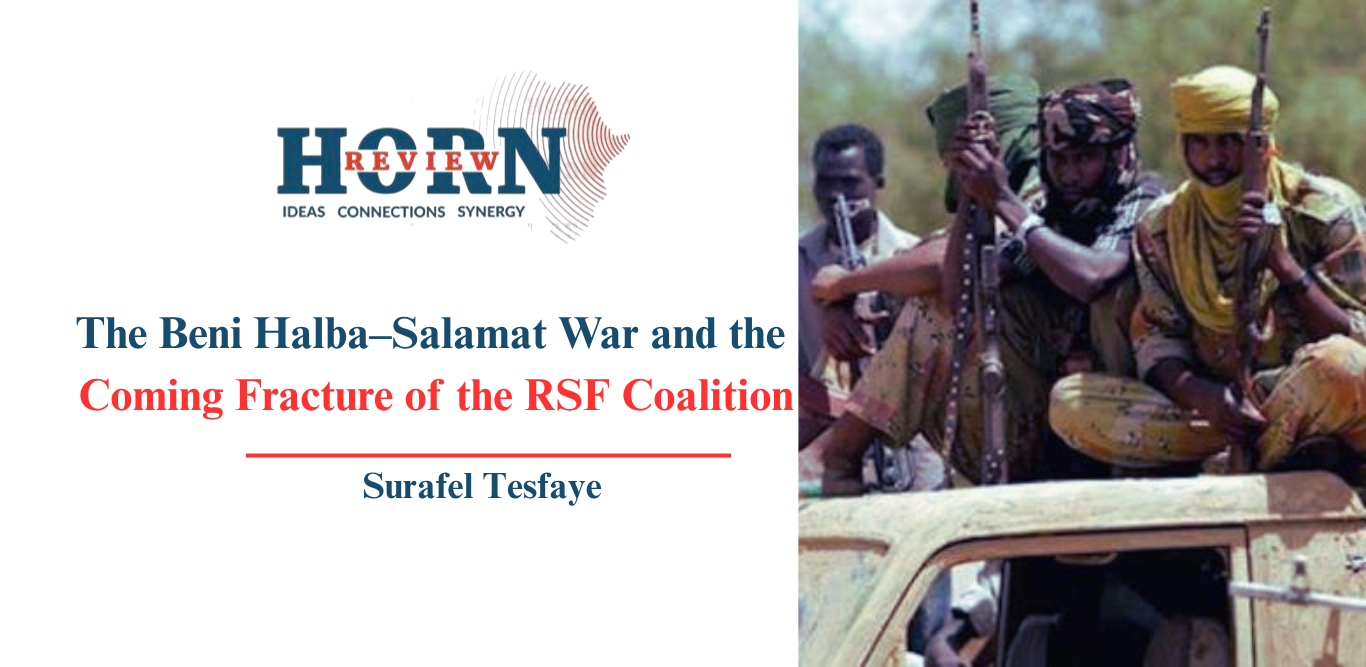
The violence that erupted in South Darfur in late May 2026 was not, by its first appearance, unprecedented. A herder was killed in the Al‑Juraif area. Within days, retaliatory attacks spread to Kubum, Wastani, and Mirkindi. On May 30, an assault on a water collection point near Kubum left more than fifty people dead and sent thousands of civilians fleeing toward Edd Al Fursan. Entire villages burned. Homes were reduced to rubble. But to treat this as just another tribal clash in a region long accustomed to bloodshed would be a strategic error. The fighting between the Beni Halba and Salamat is not a relapse into old patterns. It is a fracture in the very coalition that has sustained the Rapid Support Forces throughout Sudan’s civil war, and it exposes the growing fragility of the RSF’s authority across Darfur.
To understand why this particular conflict matters far beyond its immediate death toll, one must go back to the land. The Beni Halba are among South Darfur’s historically established tribes. Under the Hakura customary land tenure system, they hold recognized rights to large territories, including the areas around Kubum and Edd Al Fursan. The Salamat, whose tribal roots stretch across the border into Chad, settled more recently in parts of Central and South Darfur. They do not possess the same traditional entitlements. For decades, this imbalance has fueled competition over grazing routes, water access, and political representation.
But the Hakura system is not a static legal relic. Its benefits shift entirely depending on whether the RSF or the Sudanese Armed Forces holds power in Darfur. Under SAF control, the Beni Halba benefit significantly. The SAF recognizes the historical, pre-war colonial and state borders, which means the Beni Halba retain official Hakura over the Kubum locality, known as Dar Beni Halba. Under an SAF‑backed system, the Salamat would be legally forced back into their status as “guests” or tenants. They would have to pay traditional grazing taxes to Beni Halba leaders and would have no right to claim independent land or local leadership within Beni Halba territory. Under RSF control, however, the Salamat benefit. The RSF’s political project in Darfur relies on mobilizing landless Arab migrant tribes like the Salamat by promising to permanently dismantle the Hakura system. Under the RSF, the Salamat use their heavily armed paramilitary factions to physically redraw boundaries. They stop paying land‑use fees, seize fertile grazing lands by force, and establish their own administrative zones on historically Beni Halba land. In short, the SAF represents the rule of law that protects the Beni Halba’s historical landlord status, while the RSF represents a revolutionary upheaval that allows the Salamat to take that land and strip the Beni Halba of their traditional authority.
When Sudan’s civil war broke out, both tribes formally aligned themselves with the RSF. Each supplied thousands of fighters who served in RSF campaigns across the country. Many of those fighters have since returned to Darfur, bringing back RSF‑issued vehicles, weapons, and advanced military equipment. But this alignment was always conditional. The Salamat saw the RSF as their vehicle to destroy the Hakura system and claim land ownership. The Beni Halba, by contrast, joined the RSF out of wartime necessity, knowing that their true interests lay with the SAF’s legal framework. That contradiction has now exploded into open fighting.
What was once a localized land dispute has therefore transformed into an intra‑coalition armed conflict fought with the very assets the RSF distributed to secure tribal loyalty. This is the first sign of a deeper contradiction: the RSF depends on Arab tribal communities for manpower, logistics, and local administration, yet when those communities turn their weapons on each other, the movement finds itself powerless to intervene.
The RSF has tried before to contain Beni Halba–Salamat violence. In late 2025, deputy commander Abdelrahim Dagalo personally traveled to South Darfur and forced both sides to sign a reconciliation agreement. At the time, the RSF presented this deal as evidence that it could impose order. But the agreement collapsed within months. The underlying disputes over land, political representation, and resource access were never resolved. More critically, the RSF’s ability to enforce a lasting settlement was always constrained by a fundamental dilemma: any punitive action against one tribe risks alienating its fighters at a moment when the RSF is still fighting a national war against the SAF. The organization cannot afford to lose either the Beni Halba or the Salamat. That dependency, which once seemed a source of strength, has become a strategic vulnerability.
Now, with the fighting resumed and escalating, the region’s political leaders have issued public statements. Pro‑SAF Darfur Governor Minni Arko Minnawi called for a ceasefire and accused the RSF of fueling tribal divisions. Pro‑RSF administrator Al‑Hadi Idris likewise appealed for calm. Neither man has any real power on the ground. The tribes ignore Idris, and Minnawi commands no forces in RSF‑held South Darfur. Yet both chose to speak. Their interventions are not naive attempts at verbal peacemaking. They are preemptive political maneuvers driven by a shared recognition of the catastrophic domino effect this tribal war could trigger on the wider frontline.
Considering the logic. The RSF’s entire army is built out of Arab tribal militias like the Beni Halba and Salamat. If Idris cannot stop the fighting, the RSF risks losing control over one or both tribes entirely. If the Beni Halba come to believe that the RSF leadership favors the Salamat, they will defect to the SAF all together to protect their Hakura land. That is not speculation; it is a calculation that both Minnawi and the SAF leadership have already made. Minnawi’s statement is a deliberate political wedge. By branding the RSF a “criminal militia” that is “tearing the social fabric apart,” he is speaking directly to disgruntled tribal elders. He is signaling that if the Beni Halba or Salamat feel abandoned by the RSF, the official Sudanese government stands ready to legally guarantee their land rights forever. The SAF would approach the aggrieved tribe with a simple offer: the RSF is using you as expendable infantry; defect to us, and your Hakura will be protected.
This creates a critical political trap for Al‑Hadi Idris and his parallel administration in Nyala. If Idris favors the Beni Halba to preserve traditional stability, the Salamat will feel betrayed. They could turn their weapons directly against the RSF command in South Darfur, causing a localized rebellion. If Idris favors the Salamat or allows them to defeat the Beni Halba by force, he officially pushes the entire Beni Halba tribe straight into the arms of the SAF. Idris cannot take a hard stance, which makes him look weak. As both tribes realize that the RSF central command is too paralyzed to intervene, they ignore his administrative peace statements entirely. If this deadlock continues, the SAF will successfully open a massive counter‑offensive corridor in South Darfur by simply arming the aggrieved Beni Halba.
Al‑Hadi Idris understands this threat perfectly. His current approach attempts to replicate the same pacification technique that Abdelrahim Dagalo used successfully in late 2025. But the operational environment has changed. Under the severe constraints of the ongoing war, the RSF can no longer easily dispatch high‑profile military leaders to mediate in Darfur. Senior commanders are occupied elsewhere. Idris is therefore left with political statements as his primary instrument. If the situation escalates beyond this point, the entire region will descend into further chaos, and the RSF will face an internal rebellion within its own tribal base.
This dependency has left the RSF in a dangerous deadlock. Minnawi wants the violence to stop but lacks access to the territory. The RSF has access but cannot punish either side without alienating valuable fighters. Every previous peace agreement remains vulnerable to collapse. Beyond the immediate crisis, however, the fighting exposes a deeper transformation across Darfur. Local actors are no longer looking to formal institutions, state authorities, or even military organizations to settle disputes. Instead, heavily armed communities pursue their own interests through force. The Beni Halba–Salamat war is therefore not just a land dispute. It is part of a broader fragmentation of authority, where local power centers become increasingly autonomous and resistant to external control. The old architecture that divided the region into Arabs versus non‑Arabs is being replaced by a chaotic patchwork of intra‑Arab fractures, localized resource wars, and collapsing traditional mediation systems.
For the RSF, this trend is ominous. The movement’s strength has always rested on its ability to unite diverse tribal constituencies under a single command. The fighting in South Darfur suggests that this cohesion is becoming unsustainable. Tribal identities, historical grievances, and competition over grazing land and water are overriding military discipline and political loyalty. Similar dynamics have already contributed to internal tensions and high‑profile defections elsewhere within the RSF network, including among Mahamid commanders in North Darfur.
The immediate question is no longer whether the Beni Halba–Salamat conflict can be quickly contained. All indicators point to its continuation and probable expansion, as cycles of retaliation deepen and more communities are drawn in. The critical question is whether external actors will exploit this instability. The Sudanese Armed Forces possess a clear strategic interest in weakening RSF influence in Darfur. The growing divisions among RSF‑aligned tribes present a tangible opportunity. Whether through local tribal alliances, political engagement with disaffected elders, or indirect logistical support to one side, any attempt to capitalize on these fractures would further destabilize an already volatile region.
What began as the killing of a herder has evolved into a strategic inflection point. The conflict between the Beni Halba and Salamat might not be limited to a peripheral tribal dispute. It reflects the progressive weakening of central authority, the militarization of local resource competition, and the gradual fragmentation of the coalition upon which RSF power in Darfur depends. As long as these underlying dynamics remain unaddressed, South Darfur will continue to be one of the most unstable fronts in Sudan’s wider civil war, with the potential to reshape the balance of power across the entire western theater.
By Surafel Tesfaye, Researcher, Horn Review