
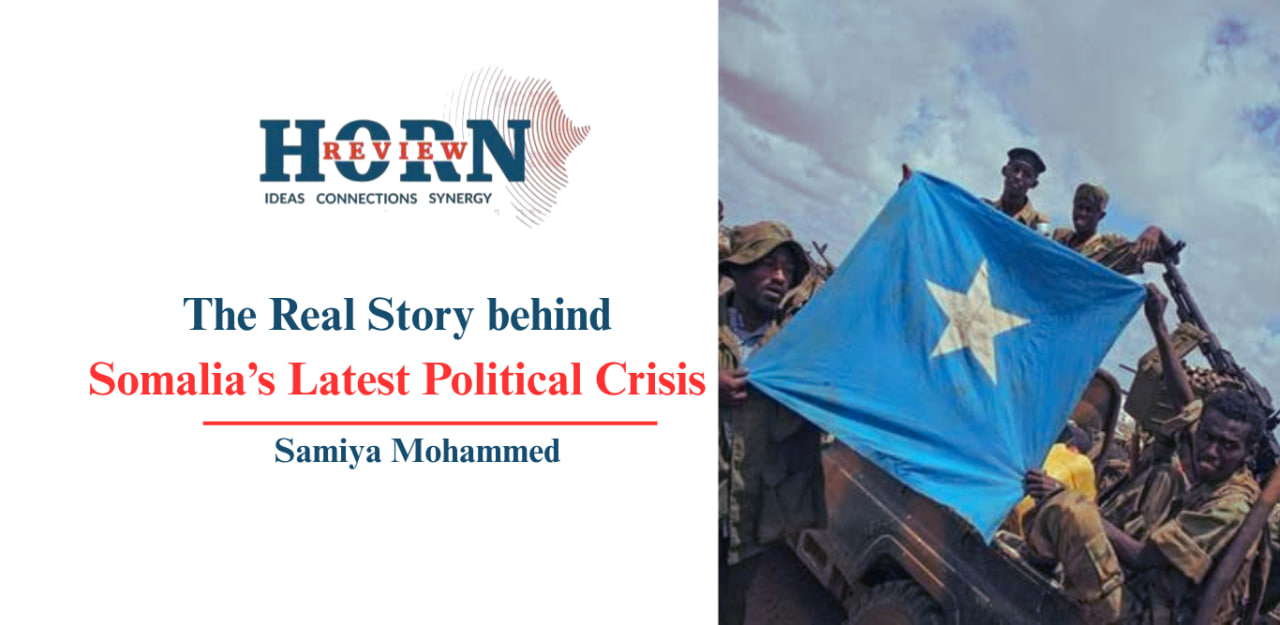
The Real Story behind Somalia’s Latest Political Crisis
Structural Constraints, Political Contestation and the Limits of Democratic Transition
Reports of gunfire in Mogadishu and allegations by former Prime Minister Hassan Ali Khaire that government forces targeted his residence ahead of planned anti government demonstrations disputes over presidential mandate extensions and growing tensions between federal and regional political actors have all contributed to a sense of politics of status quo. For many the immediate temptation is to interpret the latest crisis through the figurative perspective of individual leaders, personalities or political ambitions however by doing so risks missing a deeper and more important reality.
What Somalia is experiencing today is not simply the result of one administration, one president, one opposition coalition or one political dispute but rather it is the latest manifestation of a recurring structural pattern that has shaped Somali politics for more than two decades. Since the re establishment of the Somali state through the post conflict political settlement process in the early 2000s, political transitions have repeatedly been defined by mandate disputes, elite power struggles, delayed electoral processes, constitutional ambiguities, federal regional confrontations and periodic security crises. The current tensions are therefore not an exception to Somalia’s political road. They are part of a cycle that has repeatedly came to light whenever major questions of political authority, representation and state building come to the forefront.
The importance of the current crisis lies not only in what it reveals about the immediate political environment but also in what it tells us about the unfinished nature of Somalia’s state building project. The controversy surrounding electoral reforms and presidential mandates highlights a fundamental challenge that Somali politics has yet to resolve which the gap between democratic aspirations and institutional realities is. The current debate is the question of electoral transformation. President Hassan Sheikh Mohamud has advocated moving Somalia away from the indirect electoral model toward a system based on universal suffrage commonly referred to as one person, one vote. In principle this objective enjoys broad appeal. Few would dispute that a functioning democracy ultimately requires citizens to directly choose their representatives rather than relying on indirect selection mechanisms. Direct elections are often viewed as essential to political legitimacy, accountability and democratic development. However, the challenge facing Somalia is that democratic elections are institutional systems. Sustainable one person one vote elections require security, administrative capacity, trusted electoral bodies, agreed constitutional rules, voter registration systems, dispute resolution mechanisms, political consensus and broad acceptance by competing political actors. These foundations remain incomplete in Somalia. If major political actors reject the process before voting even begins, elections risk becoming catalysts for instability rather than instruments of democratic consolidation.
This dilemma is not new. Somalia’s political history since 2000 demonstrates a consistent pattern. Multiple electoral cycles have been conducted through indirect mechanisms based on the 4.5 clan-sharing formulas in which clan elders and delegates select members of parliament who subsequently elect the president. While this arrangement has often been criticized for entrenching elite bargaining, corruption, and clan based politics, it came as a practical compromise in a country recovering from state collapse and prolonged conflict. The indirect system was never intended to be a permanent democratic model. It was designed as a transitional structure capable of providing political inclusion and relative stability while stronger institutions developed and so far the transition has repeatedly stalled. Elections in 2012, 2016, and 2021–2022 were all seen by delays, prolonged negotiations, accusations of vote buying, disputes among political stakeholders and intervention by international partners seeking to prevent complete political breakdown. None of these electoral cycles presented smooth institutional transitions. Each required intense bargaining among political elites and often came dangerously close to triggering wider instability.
The present crisis fits squarely within this established pattern. Disagreements over presidential mandates, accusations of unconstitutional power extensions, opposition mobilization, regional resistance and confrontations in Mogadishu are not unprecedented developments. They are recurring features of a political system that has not yet established universally accepted mechanisms for managing political competition. Mandate disputes have become especially common. Governments frequently seek constitutional interpretations, amendments or extensions that opponents view as illegitimate. Opposition groups in turn often characterize such efforts as attempts to undermine democratic governance and centralize power. As a result political disagreements often spill from formal institutions and into the streets, the security sector and clan based political mobilization. What should be legal or constitutional disputes become security crises. Political competition becomes increasingly securitized, creating conditions in which demonstrations, political meetings and electoral disagreements carry the risk of violent escalation.
The recent reports of gunfire in Mogadishu and allegations by opposition figures therefore reflect a structural weakness rather than an isolated incident and whether responsibility ultimately lies with particular actors. However the larger importance lies in the fact that Somalia continues to experience political conflicts through security confrontations rather than through fully trusted institutional mechanisms. Federal-regional tensions further complicate this picture. The relationship between Mogadishu and federal member states has remained one of the most persistent sources of political instability since the adoption of the Provisional Constitution in 2012. Questions regarding the distribution of power between the federal government and regional administrations remain unresolved. Disputes involving Puntland, Jubaland and other regional actors have repeatedly demonstrated the absence of a settled constitutional consensus regarding federalism.
The consequence is a cycle in which every major reform effort becomes a source of confrontation. Efforts to strengthen central institutions generate regional resistance. Attempts to revise electoral arrangements provoke opposition mobilization. Constitutional ambiguities invite competing interpretations. Political disputes become security challenges. International mediation becomes necessary. Temporary compromises are reached. Then the cycle begins again. This pattern points toward a fundamental conclusion in which Somalia’s political difficulties are primarily structural rather than personal.
Certainly leadership decisions matter. Presidents, prime ministers, opposition figures and regional leaders all bear responsibility for their actions. However focusing exclusively on individuals obscures the deeper institutional conditions that repeatedly produce similar outcomes regardless of who occupies office. The recurring nature of these crises suggests that the underlying problem is within the political system itself. The hybrid governance model that has come since the early 2000s has achieved certain important objectives. It has facilitated inclusion among competing clans and political constituencies. It has provided mechanisms for power sharing. It has helped prevent the complete exclusion of major groups from political processes. In a post conflict environment, these achievements should not be underestimated.
At the same time the system has generated dysfunctions. It has strengthened the influence of political intermediaries and clan elites. It has encouraged transactional bargaining rather than programmatic politics. It has created multiple veto points capable of blocking reforms. It has weakened institutional accountability. Most importantly, it has made political legitimacy dependent on elite negotiations rather than on universally accepted democratic procedures. The result is a political order that often prioritizes short term stability over long term institutional development. While this approach may prevent immediate collapse, it also reproduces many of the conditions that generate future crises.
The debate over one person one vote elections must therefore be approached with realism rather than slogans. Advocating direct elections is not inherently problematic. On the contrary, it reflects an aspiration shared by many Somalis who seek a more democratic political system. The challenge lies in recognizing that democratic outcomes cannot be separated from institutional foundations. Without broad political consensus, trusted electoral institutions, effective security arrangements, nationwide administrative capacity,reliable voter registration systems and constitutional clarity, attempts to rapidly implement one person one vote elections risk producing unintended consequences.
This does not mean Somalia should abandon democratic reform. It means democratic reform must be accompanied by state building. The sequencing matters. Institutions must be developed alongside electoral expansion rather than after it. Somalia’s current crisis therefore illustrates the consequences of attempting to resolve deeply institutional questions through political confrontation rather than through agreed structures. The recurring pattern of mandate disputes, delayed elections, elite rivalries, regional resistance, and periodic violence is unlikely to disappear simply because leadership changes hands. The persistence of these problems across multiple administrations demonstrates that they are in structural weaknesses rather than individual personalities.
Democracy is not created by declaration alone. It requires foundations capable of sustaining political competition without threatening national cohesion. The lesson of Somalia’s past two decades is every attempt at reform that lacks broad consensus risks reproducing the very crisis it seeks to overcome. Unless the country addresses the institutional foundations of governance alongside electoral reform, the cycle of contested mandates, political brink and unstable transitions is likely to continue. The challenge facing Somalia is therefore not simply choosing between indirect elections and one person one vote.
By Samiya Mohammed, Researcher, Horn Review

RELATED
Posts
21
Sep
Egypt’s Policy Thinking Toward Ethiopia: How Cairo’s Institutions Read Ethiopia?
Egypt’s policy thinking toward Ethiopia has evolved from a primarily...
21
Sep
Sudan’s Rejection of War with Ethiopia Despite Hardline Voices in Khartoum
The closed door meeting in Djibouti in early May...
21
Sep
Somalia’s Informal Economy in U.S. Security and Financial Policy
In various settings, the line between formal and informal economic...
21
Sep
Security Dependencies and Al Shabaab’s Dominance
The Federal Government of Somalia exists in a condition that...
19
Sep
Eritrea’s Sanctions Expired, Not Formally Lifted
The U.S. sanctions on several Eritrean entities and individuals did...
16
Sep
Why Eritrea Turned from Engaging Somaliland in 2019 to Opposing It Today
In March 2019 Eritrean Foreign Minister Osman Saleh accompanied by...
16
Sep
Ethiopia and the U.S. After the War on Terror: Within a New Arc of Terrorism
The War on Terror began as a direct response to...
16
Sep
Why the Abraham Accords Will Not Expand Yet
The claim that Israel is unlikely to find an...
16
Sep
The Real Houthi Weapon Was Mobilization, Not Missiles
Fatima Abo Alasrar frames the Houthi ground strategy as...
16
Sep
The Houthis Reached Zuqar Island: Can Eritrea Be a Neutral Observer?
The island of Zuqar sits in the southern Red Sea,...