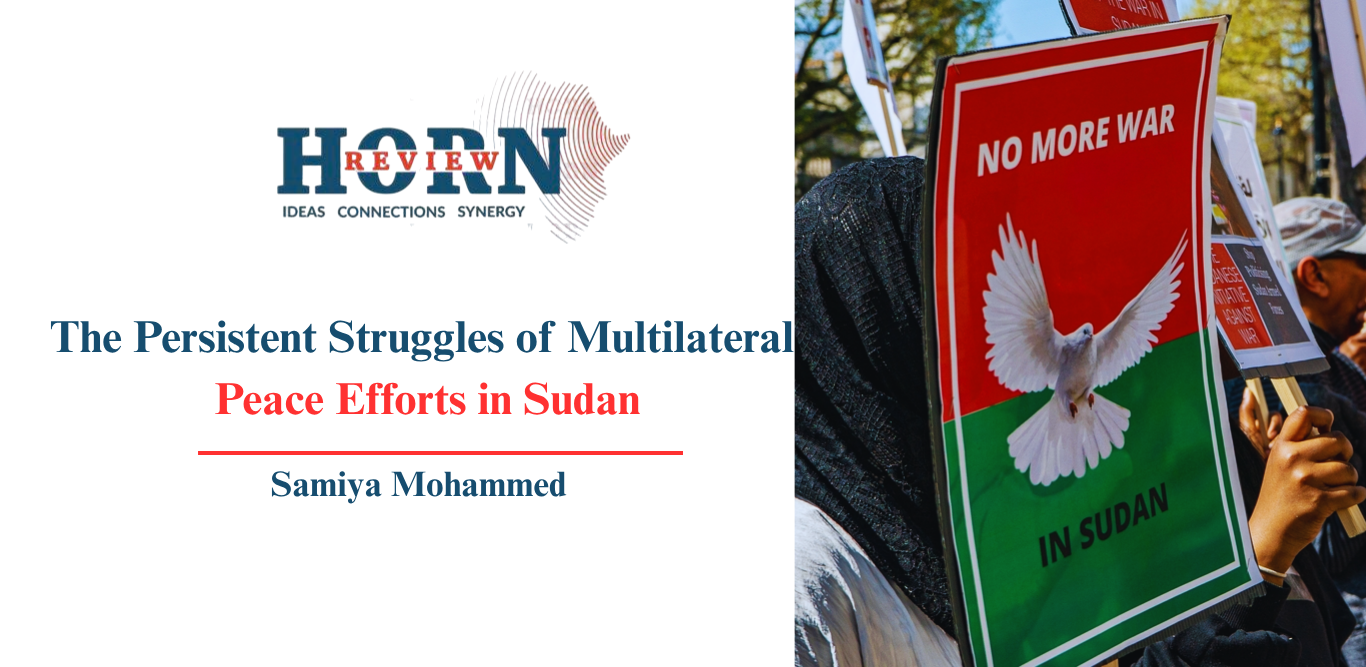
Efforts to resolve Sudan’s conflict have converged around a set of multilateral initiatives that despite their shared objective of halting hostilities and restoring a civilian led political order remain fundamentally segmented. This disintegration stems from a more structural divergence which is a fundamental asymmetry in how different international actors confer legitimacy upon the peace process itself. This asymmetry when coupled with the widely acknowledged but rarely resolved challenge of military integration composes the central reason why successive peace efforts have struggled to achieve durable results. This results questions in which process is legitimate and on what grounds
The first track which has gained diplomatic momentum prioritizes the rapid cessation of hostilities and the imposition of a top down political timeline. This track is by its focus on external leverage and its willingness to engage directly with the two principal combatants the Sudanese Armed Forces and the Rapid Support Forces as equally necessary interlocutors and its assumption that if sufficiently pressured can be guided toward a transition that excludes them from long term political dominance. The second track emphasizes procedural inclusivity, African led mediation norms and the imperative of inserting any security arrangement within a political consensus that includes civilian actors, resistance committees and historically marginalized political forces. This latter track tends to view the warring parties not as neutral partners but as obstacles to be managed through a wider societal compact.
On the surface these two tracks appear complementary. One focuses on the mechanics of a ceasefire while the other on the politics of a transition. In practice however they embody irreconcilable notions of legitimacy. The former track derives its legitimacy from efficacy and external consensus and it is legitimate because it can mobilize material pressure, coordinate sanctions and recognition and produce a signed roadmap. The latter track derives its legitimacy from representativeness and local ownership and it is legitimate because it reflects the voices of those who have suffered the conflict most directly and because it operates under the normative authority of regionally rooted institutions. Neither claim is inherently invalid. However the failure to adjudicate between them or to integrate them into a single, coherent framework has produced a peace process that is simultaneously over determined and under legitimized. Overdetermined because too many actors claim the authority to mediate. Underlegitimized because no single process commands the full confidence of both the warring parties and the Sudanese populace.
This legitimacy asymmetry manifests most acutely in the question of military integration. Nearly every major peace proposal since the conflict escalated has included as a technical necessity, some provision for merging the SAF and RSF into a single professional national army. On paper integration is the only feasible pathway to a stable post conflict order that two parallel armed forces cannot coexist indefinitely within one state without reproducing the very conditions that led to war. However the feasibility of integration is inversely related to the legitimacy of the process designed to implement it. When integration is pursued through a process that the combatants perceive as legitimate that is one that guarantees their organizational interests, command structures and patron networks, it becomes politically unacceptable to the civilian population and to regional actors who demand accountability for wartime atrocities. When integration is pursued through a process that civilians and regional bodies perceive as legitimate that is one that subordinates military restructuring to transitional justice and civilian oversight it becomes militarily unenforceable as the combatants will either stall or defect. Thus the very question of whether integration is feasible cannot be separated from the question of who defines legitimacy.
The historical record from Sudan’s previous peace processes confirms this diagnosis. Earlier agreements that attempted to integrate armed movements into state institutions foundered not because the technical details of integration were impossible to design but because the legitimacy of the process was disputed from the outset. When one party to the negotiation believes the mediating body lacks authority and another party believes the mediating body is illegitimately excluding key stakeholders, the resulting text becomes a weapon rather than a settlement and each side interprets its provisions selectively and implementation stalls. The current multilateral acts for all its diplomatic energy has reproduced this exact activity. It is logical, sequential and normatively coherent and its legitimacy remains contested not because its content is flawed but because the process that produced it is perceived asymmetrically.
This is not to argue that one multilateral configuration is inherently more legitimate than another. Legitimacy in peace making is not an intrinsic property but a relational one. It is conferred by the perception of fairness, the track record of mediators, the inclusion of affected constituencies and the alignment between proposed outcomes and local political realities.
What follows from this diagnosis is not despair but a redefinition of the problem. The central obstacle to peace in Sudan is not a lack of international will or a shortage of roadmaps. It is the absence of a mechanism capable of integrating two incommensurable legitimacy claims into a single, balanced political process. Such a mechanism would not require one track to subordinate itself to the other.
The question posed at the outset which process is legitimate is misleading when asked as an either or proposition. Neither the external, ceasefire focused track nor the regional inclusion focused track possesses sufficient legitimacy alone. The former has leverage but lacks local buy in; and the latter has normative authority but lacks enforcement capacity. The reason peace efforts have struggled is not that one configuration is wrong and the other right. It is that the multilateral system has yet to invent a political technology capable of holding these two legitimacy claims in productive tension. Until that integration occurs not just of armed forces but of legitimacy frameworks Sudan will remain trapped in a familiar cycle, externally brokered agreements that cannot be implemented and locally driven processes that cannot be enforced. The feasibility of peace rests on the feasibility of this deeper integration. And that more than any single roadmap or ceasefire is the unfinished work of the present moment.
By Samiya Mohammed, Researcher, Horn Review