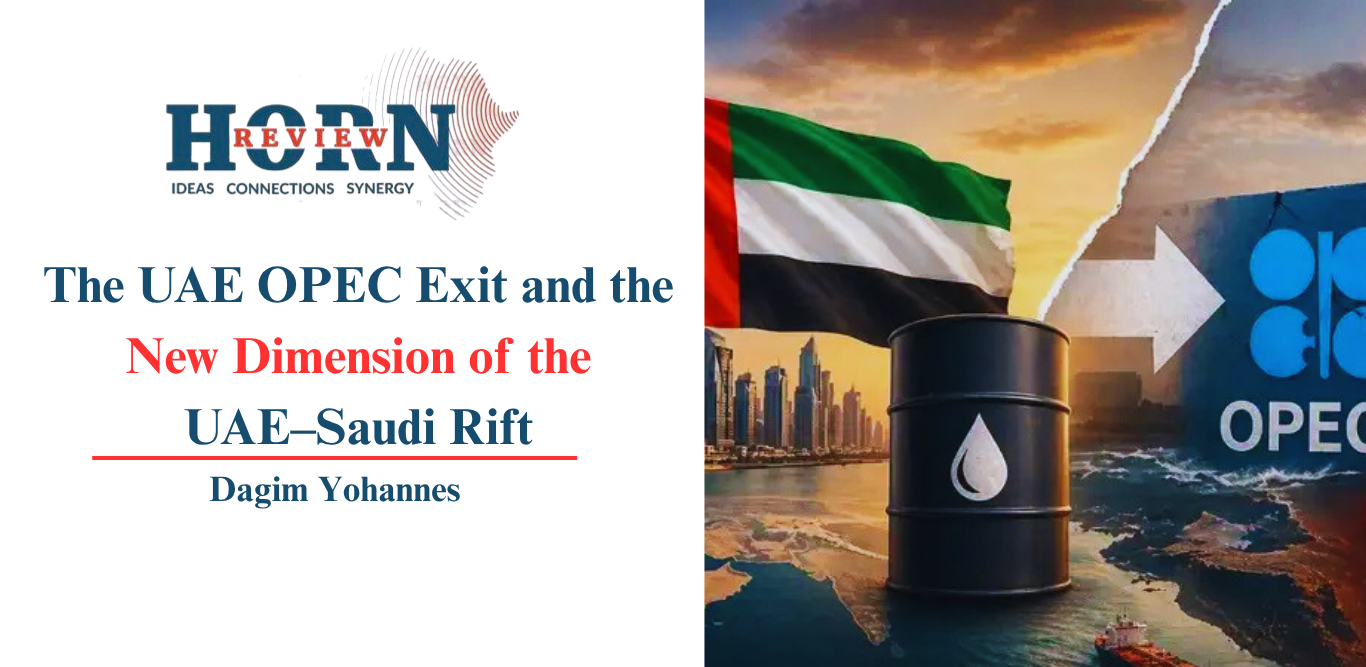
The war involving the United States and Iran was widely expected to reinforce cohesion among Gulf states, reviving a shared security imperative that would temporarily suppress underlying tensions. Historically, external pressures have often pushed the Gulf monarchies to present unity, even when deeper divergences persist beneath the surface. Yet instead of consolidating alignment, this moment has exposed its fragility, revealing that Gulf cohesion has long masked unresolved strategic differences between the United Arab Emirates and Saudi Arabia over energy governance, regional influence, and economic strategy. The global energy order is not simply evolving. It is fragmenting under competing national strategies, shifting demand horizons, and weakening institutional cohesion in global oil markets. Within this transition, the United Arab Emirates withdrawal from OPEC and OPEC+, effective May 1, 2026, is not an isolated decision. It is a calculated geopolitical move that signals the reopening and intensification of a structural rift between the United Arab Emirates and Saudi Arabia over the future architecture of Gulf power.
What distinguishes this moment from previous disagreements is not merely the policy outcome, but the manner in which it unfolded. The decision was taken without prior consultation with Riyadh, signaling a clear departure from established norms of Gulf coordination. In a region where alignment has traditionally been managed through quiet negotiation and hierarchical deference, such a move carries diplomatic weight. It reflects not just autonomy, but a willingness to bypass Saudi Arabia’s role as the central convening authority within energy governance. The official rationale advanced by the UAE emphasizes sovereignty, flexibility, and long-term energy planning. Yet this framing conceals a deeper structural contradiction. The UAE’s expanding production capacity, driven by sustained investments through the Abu Dhabi National Oil Company, has increasingly come into tension with OPEC+ quota restrictions. A state that has built the infrastructure to significantly scale output finds itself constrained by a system designed to limit production in order to stabilize prices.
This contradiction has accumulated over time. Repeated quota disputes revealed a growing dissatisfaction with an institutional framework that increasingly mirrors Saudi Arabia’s strategic priorities. OPEC’s logic of price defense through disciplined supply management aligns closely with Riyadh’s fiscal requirements and long-term economic transformation agenda. For the UAE, however, this model imposes a structural cost by limiting its ability to fully utilize its competitive advantages. In response, the UAE has gravitated toward a volume-driven strategy that prioritizes market share expansion over price stabilization. This approach is rooted in a distinct reading of the global energy trajectory. Rather than relying on prolonged price control through coordinated scarcity, it assumes that the remaining window of strong hydrocarbon demand must be aggressively monetized. The objective is not merely to participate in the market, but to capture it while structural demand persists. This divergence is fundamentally temporal. Saudi Arabia’s strategy depends on sustaining elevated oil prices to finance long-term domestic transformation. The UAE, by contrast, is compressing its timeline, accelerating output and diversification simultaneously. These are not complementary strategies. They are competing for responses to the same global transition.
It is at this intersection that divergence hardens into rivalry.
The UAE’s exit from OPEC is not simply a reaction to constraints. It is a deliberate step toward reclaiming full control over how it deploys its production capacity. By stepping outside the quota system, Abu Dhabi gains the ability to respond directly to market conditions, adjust output independently, and leverage its spare capacity without institutional limitation. In doing so, it removes one of the core assumptions that has long underpinned Gulf energy politics: that production decisions remain anchored in Riyadh’s coordinating role.
The implications of this shift extend beyond oil markets. They strike at the foundation of Saudi Arabia’s position as the de facto leader of OPEC and, more broadly, as the central organizing power within the Gulf. The erosion of this role is not abrupt, but cumulative. Each act of independent positioning by the UAE reduces the gravitational pull of Saudi-led structures. This pattern is visible across multiple domains. Divergent approaches to regional conflicts, particularly in Yemen, differing calibrations in engagement with Iran, and growing competition over strategic corridors in the Red Sea and the Horn of Africa all point toward a broader decoupling of strategic alignment. The exit from OPEC is therefore not an isolated event. It is the institutional manifestation of deeper geopolitical repositioning.
Timing further amplifies the significance of the move. It unfolds amid persistent instability and risks to energy transit routes through the Strait of Hormuz, conditions that already inject volatility into global markets. In such an environment, structural shifts can be absorbed without immediate disruption, allowing long-term repositioning to occur under the cover of short-term uncertainty. The consequences for OPEC are immediate and structural. The departure of a major producer with substantial spare capacity weakens the organization’s ability to enforce discipline and manage supply effectively. More critically, it undermines the perception of unity that has historically amplified its influence. What emerges is not simply a weaker cartel, but a more fragmented system in which national strategies increasingly override collective commitments.
For global markets, this introduces a new dynamic. The UAE’s ability to expand production independently creates downward pressure on prices during periods of surplus, while simultaneously increasing volatility in times of geopolitical disruption. Major importers such as China and India stand to benefit from greater flexibility, but the broader system becomes less predictable. At a deeper level, this transformation reflects a redefinition of energy geopolitics itself. Oil is no longer governed primarily by coordinated scarcity and centralized authority. It is increasingly shaped by competitive state behavior, where production decisions are instruments of strategy rather than components of collective management.
Within this emerging order, the UAE is positioning itself as a state that prioritizes autonomy over alignment. Institutional frameworks are no longer treated as binding structures, but as optional platforms whose relevance is contingent on national interest. This marks a shift toward a more fluid and assertive form of statecraft, in which flexibility becomes a primary source of power. For Saudi Arabia, the challenge is structural. The weakening of OPEC cohesion limits its capacity to shape global markets through coordinated action, while the rise of independent producers complicates efforts to sustain price stability. More importantly, it signals a gradual erosion of its centrality within the Gulf’s political and economic order.
The UAE–Saudi relationship is therefore entering a new phase. It is no longer defined by implicit hierarchy or automatic alignment, but by a quiet yet consequential contest over influence, authority, and the future direction of regional order. Cooperation persists, but it is increasingly conditional. Beneath it lies a growing rivalry that is expressed not through open confrontation, but through strategic divergence and institutional disengagement. The UAExit is not simply about oil. It is about authority. It marks the transition from a Gulf order organized around centralized leadership to one defined by distributed power and competitive autonomy. In doing so, it transforms the UAE–Saudi relationship from one of structured coordination into one of embedded and enduring rivalry.
By Dagim Yohannes, Researcher, Horn Review