
Elite Rivalry, War Economies, and the Limits of International Mediation in Sudan
Sudan’s civil war, now entering its fourth year since April 2023, has resisted every mediation effort directed at it from the Jeddah talks of 2023 to the Third International Sudan Conference held in Berlin on 15 April 2026. Five mutually reinforcing dynamics prevent a durable settlement: zero-sum elite competition between the Sudanese Armed Forces (SAF) and the Rapid Support Forces (RSF); a self-financing war economy centred on illicit gold revenue; deep ethnic and communal fractures, fragmented external proxy agendas; and an elite-centric international mediation architecture that systematically excludes civilian agency. The Berlin conference produced a notable, if fragile, step forward by foregrounding Sudanese civilian actors for the first time.
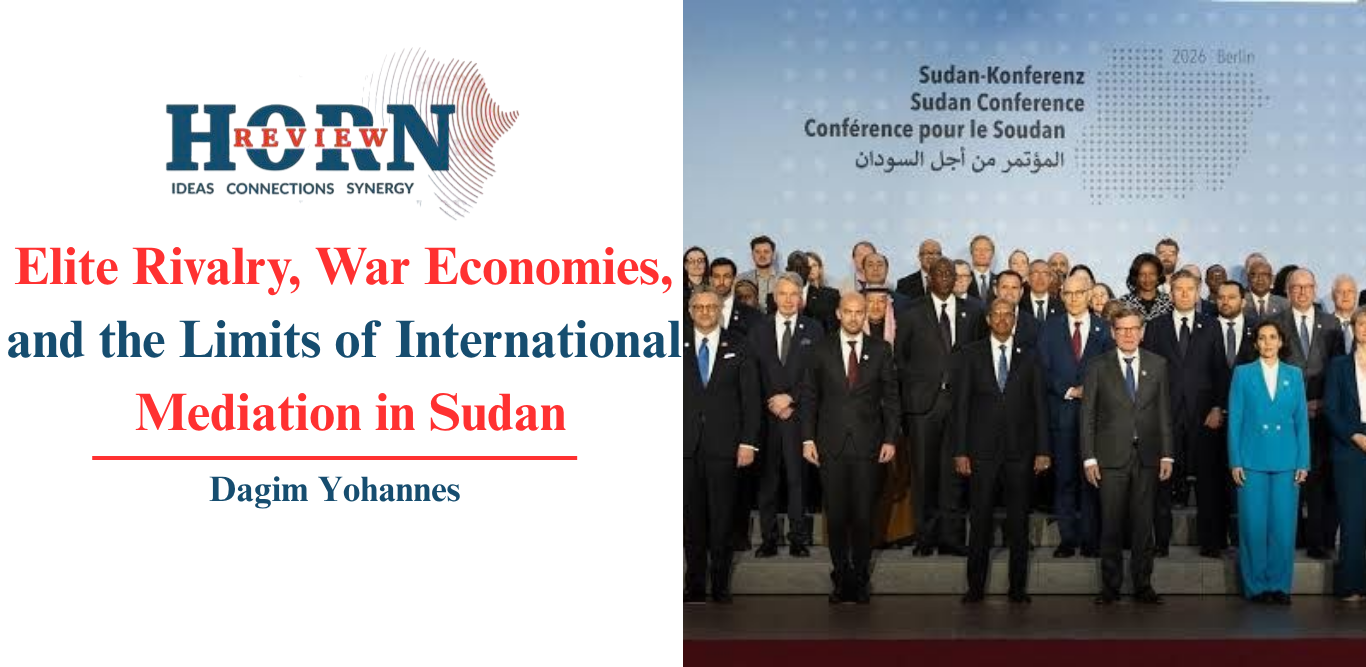
On 15 April 2026 the third anniversary of the outbreak of hostilities foreign ministers from over fifty states gathered at the German Foreign Office in Berlin for the Third International Sudan Conference, the latest in an annual series following Paris in 2024 and London in 2025. The UN’s most senior humanitarian official told the assembled diplomats that Sudan had become “an atrocities laboratory,” citing the siege of El Fasher, the systematic denial of food as a weapon of war, the deployment of sexual violence at scale, and drone strikes that had killed seven hundred civilians in the first months of 2026 alone. Countries pledged over one billion US dollars in humanitarian assistance. The conference concluded. The war continued. That sequence of urgent international gathering, solemn communiqué, unchanged battlefield reality has now repeated three times. It is not a coincidence. It reflects structural features of the conflict that incremental diplomacy cannot address. The argument advanced here is that peace will remain elusive for as long as international efforts treat Sudan’s crisis as a communication problem between two commanders, rather than as the product of intersecting political, economic, ethnic, and geopolitical systems that each independently incentivise continued violence.
The conflict originated in a power struggle between two former allies who jointly removed the previous authoritarian government in 2019 and subsequently derailed Sudan’s civilian transition through the 2021 coup. Disputes over the timeline for RSF integration into the national army and the structure of civilian oversight triggered open warfare in April 2023. The escalation to full-scale conflict, however, reflected not merely a breakdown in negotiations but the irreconcilable institutional interests of the two factions. The SAF carries the institutional identity of the Sudanese state and regards the RSF as a predatory extra-constitutional force whose dissolution is a precondition for restoring central governance. The RSF, for its part, evolved from a paramilitary militia into a hybrid organisation with cross-border economic networks and political ambitions that predate the war; integration on terms that do not preserve its command autonomy and economic position represents, from its own logic, institutional elimination rather than compromise.
This mutual framing as existential adversaries produces a structural pathology in negotiations: neither party enters talks to reach a settlement. Scholarship on Sudan’s earlier peace agreements has shown that they were typically signed by military actors with no genuine interest in addressing the underlying causes of conflict, laying foundations for subsequent war rather than resolving it. Battlefield momentum governs behaviour accordingly. Whichever faction is advancing treats diplomatic engagement as a pause for rearmament rather than a pathway to resolution, a dynamic visible in the collapse of the 2023 Jeddah ceasefire within days of its announcement. By April 2026, the military situation had settled into a grinding impasse without resolution in sight. The SAF recaptured Khartoum and, in early 2026, broke the RSF’s long-running sieges of key cities in the Kordofan region. The RSF, however, halted SAF advances in North Kordofan, retained control of West Kordofan, and consolidated its grip on Darfur following the fall of El Fasher in late 2025. Neither party has a credible path to military victory, yet neither has shown genuine willingness to accept the terms the other could agree to.
Compounding this political impasse is the war economy that both factions have constructed. Sudan holds one of Africa’s largest gold reserves, and since 2023 the control and export of gold has provided both sides with hard currency for weapons, logistics, and patronage networks that largely bypass international sanctions. The RSF’s gold operations in Darfur and Kordofan flow through Chad, Libya, and the Central African Republic to refining hubs, most prominently in the Gulf through informal channels involving artisanal miners, tribal intermediaries, and private aviation that are substantially sanctions-resistant. The SAF maintains a parallel architecture through military-linked commercial entities controlling eastern mining concessions. Both factions therefore possess the financial capacity to wage war indefinitely without relying on state budgets or external aid. Any ceasefire agreement that leaves this economic architecture intact provides both sides with the resources to re-arm and resume hostilities, a pattern visible in previous Sudanese peace processes.
The conflict’s ethnic and communal dimensions add a further layer that national-level mediation has consistently failed to engage. In Darfur, alleged RSF operations against non-Arab communities have followed patterns of ethnic targeting that extend the atrocities of 2003–2009 . The fall of El Fasher in late 2025 was accompanied by mass killings, systematic sexual violence, and the destruction of civilian infrastructure. A 2025 UN fact-finding mission concluded that these actions bore the hallmarks of genocide, with coordinated targeting demonstrating intent to destroy protected groups. As recently as April 2026, NGOs reported thousands of civilians, including hundreds of women and children detained in RSF-run facilities under conditions involving torture and ethnically motivated killings. Below these headline atrocities lie layered communal grievances: longstanding land tenure disputes, revenge cycles from prior Darfur conflicts, and the systematic marginalisation of Sudan’s periphery that no national agreement has yet addressed.
Sudan’s civil war has simultaneously become an arena for competing regional interests that independently sustain the conflict. One of the Gulf states has been consistently identified by UN investigators and independent researchers as providing the RSF with arms, logistical support, and a gold export infrastructure, allegations it denies. Its strategic interests are nonetheless transparent: the RSF represents a partner for Red Sea security operations, a counterweight to Egyptian influence, and a gateway to Sudanese resource wealth. Egypt backs the SAF, driven by Nile water security concerns and the imperative of a stable, aligned government in Khartoum. Other regional actors have supplied the SAF through channels that bypass formal oversight. Crucially, in 2025–2026 the Saudi-UAE bilateral relationship deteriorated to a point where what had been nominally aligned mediation has become an active proxy competition, with both gulf countries alleged support for the warring sides , which they deny. The net effect is a conflict in which every military equilibrium is underwritten by an external patron, making unilateral de-escalation strategically untenable.
This proxy entanglement has compounded the structural failures of the mediation architecture itself. The proliferation of parallel tracks, the Jeddah process, the Quadrilateral Initiative, IGAD, the AU roadmap, the Quintet’s civilian consultations, and the Berlin process has not increased international leverage. It has reduced it. Multiple competing tracks allow both parties to participate selectively, extract concessions, and exit without consequence when negotiations become constraining. The Quad’s ceasefire roadmap, advanced since September 2025, was rejected by the SAF partly on the alleged grounds that one of its members is simultaneously a primary financial backer of the RSF, a structural contradiction that no amount of diplomatic formulation can resolve. In the absence of a unified contact group with agreed red lines and credible enforcement authority, ceasefire commitments carry no binding weight, and a culture of impunity prevails in which neither military actors nor their external backers face meaningful accountability for violations.
The Third Berlin International Sudan Conference was, by design and by the acknowledgement of its organisers, not a peace conference. Neither SAF nor RSF leadership was present, a deliberate choice reflecting the international community’s refusal to legitimize commanders facing credible war crimes allegations and. Sudan’s army-appointed prime minister dismissed the conference from Khartoum as irrelevant; the RSF parallel administration in Nyala similarly rejected it. Both parties, for once, agreed that a conference about ending a war that excluded those conducting it could not end the war, a criticism that identifies the format’s central structural limitation, even if it is advanced by parties with no credible commitment to peace themselves. Against this constraint, Berlin’s explicit objectives were more modest. On humanitarian funding, countries pledged over one billion US dollars against an annual need of 2.2 billion, a gap that remains substantial but represents a more successful pledging outcome than previous conferences. The Berlin Principles, co-signed by 55 states and organisations, articulated a framework for a civilian-led transitional process, an end to external support enabling the conflict, and unhindered humanitarian access. Critically, the conference convened Sudanese civilian actors from across the fractured political spectrum including representatives of the Emergency Response Rooms that have kept basic services functioning in communities abandoned by both factions under AU-led auspices to begin discussing the architecture of a post-war transition. The resulting joint statement was the first document of the war to which politicians from Sudan’s rival civilian factions had collectively put their names.
The significance of the civilian joint statement should not be overstated, but neither should it be dismissed. For three years, Sudan’s civil and political forces fractured along lines defined by proximity to one armed faction or the other. A cross-factional civilian document however preliminary seeds a political track that mediators have previously lacked. Whether it becomes the foundation of a transitional framework or remains a symbolic gesture depends on what follows: specifically, whether the international community provides institutional support, financial backing, and diplomatic recognition sufficient to give the civilian track independent weight relative to the military actors. Sudan’s earlier failed agreements consistently show that civilian governance arrangements without enforcement mechanisms, resource support, or genuine political commitment from external actors do not survive contact with the incentives of armed groups. The same risk applies here.The Berlin Principles’ call for an end to external support enabling the conflict is the document’s most important and most tested commitment. The Gulf state consistently identified as the RSF’s primary external backer co-signed those principles in Berlin. The United States co-hosted the conference while maintaining close relationships with the Gulf states its own officials acknowledge are the primary arms suppliers to both sides. Enforcing the Berlin Principles against conference co-signatories is the test of whether the document has substantive content. Based on the pattern of the previous two conferences, there is no strong reason to expect that test to be applied. Sustainable peace in Sudan requires simultaneous progress across four dimensions, none of which can substitute for the others. The first is disruption of the war economy. Transparency requirements on Sudanese gold imports through FATF processes, EU due diligence regulation, or direct bilateral pressure on the primary destination state would substantially reduce the RSF’s financial capacity without requiring military intervention and would begin to shift the economic calculus from profitable attrition toward negotiated settlement. This is the most actionable lever available to external actors and the one most consistently avoided. The second is consolidation of the mediation architecture. The multiplicity of competing tracks must be rationalised into a unified international contact group with shared red lines and credible enforcement authority. The present arrangement allows indefinite forum-shopping and treats the Saudi-UAE proxy competition as a private bilateral matter rather than a structural obstacle to peace. The Quad’s ceasefire initiative and the AU roadmap need to be reconciled, and the Gulf states’ divergent interests need to be managed openly rather than obscured by joint co-hosting arrangements that mask fundamental disagreement. The third dimension is civilian primacy.
The joint statement produced in Berlin requires institutional follow-through: diplomatic recognition of the civilian track, financial support for civilian administration in areas where state structures have collapsed, and sustained technical assistance for the community networks that have kept civil society functional through three years of war. A peace process design consistently shows that agreements reached without representative civilian participation lack the legitimacy to survive implementation, particularly in contexts of mass atrocity where affected communities have strong reasons to reject settlements negotiated over their heads. The fourth dimension is transitional justice. Any settlement that does not include credible accountability mechanisms for the mass atrocity in Darfur will lack the legitimacy of the communities that experienced those atrocities, making local-level implementation impossible. An ICC referral currently blocked at the Security Council by permanent members with interests in the conflict remains the appropriate instrument. Below the national level, land dispute resolution mechanisms and community-level reconciliation processes in Darfur and Kordofan are prerequisites for durable local ceasefires that could support, rather than undermine, a national settlement.
Three years into what has become the world’s largest humanitarian crisis, 33.7 million people in need of assistance, famine confirmed across multiple regions, over 150,000 dead, Sudan’s war persists not because peace is impossible but because the structural conditions for a durable settlement have not been created. The Berlin conference was the most substantive international engagement with the conflict to date, particularly in foregrounding civilian agency and producing the first cross-factional civilian statement of the war. These are necessary but insufficient steps. The war economy remains intact. External proxy support continues. The mediation architecture remains fragmented. Transitional justice is deferred. Sudan’s conflict cycles consistently point to the same underlying dynamic: agreements that nominally end the wars are designed by elites whose interests the wars serve, within an international framework that prioritises diplomatic process over political accountability. The Berlin Principles, if enforced particularly on arms flows, gold networks, and external support would represent a departure from that pattern. Whether they will be enforced against the co-signatories who benefit from the conflict’s continuation is the question on which the utility of the entire Berlin process depends. The human cost of diplomatic caution has now accumulated to a scale that demands a substantively different answer than the two preceding conferences produced.
By Dagim Yohannes, Researcher, Horn Review

RELATED
Posts
8
Oct
The Makkah Pact and the Limits of Collective Defence
The Makkah Joint Defence Agreement rests on an ambitious...
28
Sep
Saudi-led Multinational Maritime Defence Coalition and the Changing Security of Bab el-Mandeb
On 2 September, the Saudi-led Multinational Maritime Defence Coalition...
28
Sep
The AI Disinformation War in the Horn and the Economics of Digital Conflict
In September, Marc Owen Jones, an Associate Professor of...
24
Sep
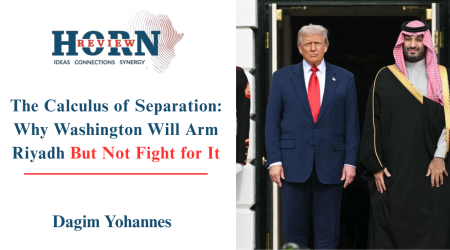
The Calculus of Separation: Why Washington Will Arm Riyadh But Not Fight for It
The episode reveals a distinction in the U.S.-Saudi security relationship...
21
Sep
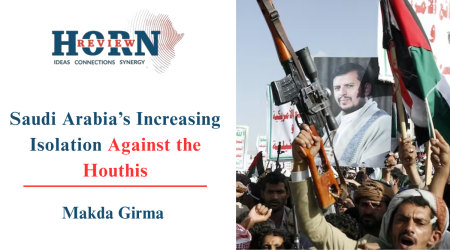
Saudi Arabia’s Increasing Isolation Against the Houthis
Saudi Arabia’s renewed confrontation with Yemen’s Houthis has exposed how...
21
Sep
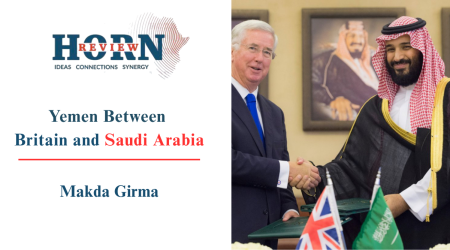
Yemen Between Britain and Saudi Arabia
The Houthi advance along Yemen’s Red Sea coast has exposed...
21
Sep
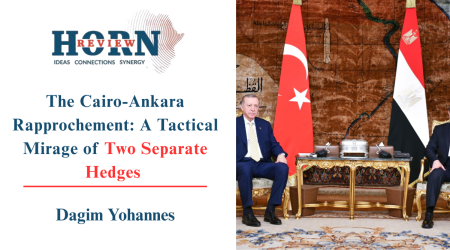
The Cairo-Ankara Rapprochement: A Tactical Mirage of Two Separate Hedges
The recent run of headlines out of Cairo and Ankara,...
20
Sep
The African Union Was Designed to Stand Outside Sudan's War
Every time Sudan's war comes up in public discussion, mentioning...
2
Sep
A Decade of Saudi Miscalculation in Yemen
On March 26, 2015, Mohammed bin Salman, then a thirty-year-old...
31
Aug
Mahamat Déby or Burhan: Who Can Win the US?
On August 20, 2026, Sudanese warplanes and drones pursued a...