As Ethiopia pivots toward a new economic horizon, the escalating fragility and politicization of global maritime corridors have transformed the nation’s landlocked status from a logistical hurdle into a core strategic imperative. For an economy tethered to volatile sea routes and a high-density port network, these structural shifts necessitate an innovative, forward-thinking overhaul of our trade architecture to ensure national resilience in an era of unprecedented disruption.
What makes Ethiopia’s situation unusual is not just its geography, but the direction of its economic reorientation. Over the past decade, Ethiopia has steadily expanded its commercial and diplomatic engagement toward East and Southeast Asia. China has become a central pillar of infrastructure financing, industrial development, and manufacturing transfer. Malaysia and Indonesia are emerging partners in trade, logistics cooperation, and consumer imports within broader ASEAN linkages. This eastward pivot is reshaping Ethiopia’s external economy in ways that bind it more closely to the Indo-Pacific maritime system.
At the same time, the maritime corridors that connect Ethiopia to the world are under growing stress. The Strait of Hormuz, the Bab el-Mandeb, and the Strait of Malacca now form an interconnected chain of vulnerability that is increasingly shaping global trade flows. Ethiopia sits at the receiving end of this chain.
The volatility surrounding the Strait of Hormuz and the Bab el-Mandeb serves as a direct transmission mechanism for inflationary pressure on the Ethiopian economy, specifically through the destabilization of petroleum imports and essential maritime logistics. As shipping lines reroute to avoid regional conflict and Houthi activity, the resulting surge in insurance premiums and transport overheads creates a fiscal bottleneck that manifests as supply chain uncertainty and elevated domestic fuel costs. To mitigate these shocks, Ethiopia must move beyond reactive measures, optimizing its trade corridors to ensure that regional maritime disruptions do not compromise the structural integrity of the national growth trajectory.
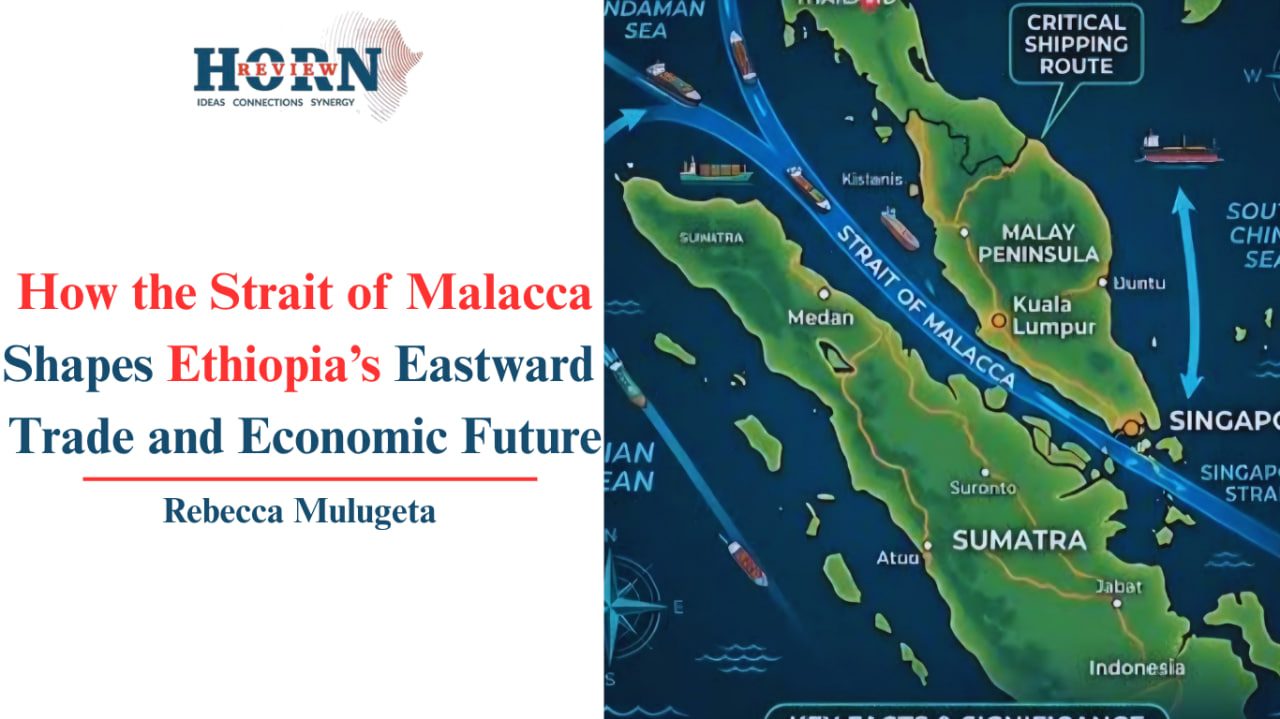
These two chokepoints are already enough to place Ethiopia under persistent external pressure. But the emerging relevance of the Strait of Malacca adds a third layer to this fragile system. The Strait of Malacca, located between Malaysia and Indonesia, is one of the most important maritime passages in the world. It connects the Indian Ocean with the Pacific Ocean and serves as the shortest shipping route between energy suppliers in the Middle East and major Asian consumers such as China, Japan, and South Korea. A significant portion of global trade, including energy shipments and manufactured goods, passes through this narrow corridor.
If Malacca were to face disruption, the consequences would not remain confined to Southeast Asia. They would cascade through the entire global trade network, including Ethiopia’s emerging economic partners and supply chains.
To understand why this matters for Ethiopia, one must follow the logic of interdependence. Ethiopia’s increasing engagement with China, Malaysia, and Indonesia is not symbolic diplomacy. It is embedded in physical trade flows. China supplies machinery, infrastructure components, industrial inputs, and financing for large-scale projects. Malaysia and Indonesia contribute consumer goods, agricultural imports, palm oil products, and emerging manufacturing cooperation.
These relationships depend on the stability of East Asian production and shipping networks. And those networks depend heavily on the Strait of Malacca. If Malacca is disrupted, the impact does not remain at the point of disruption. It spreads outward through delayed production, higher shipping costs, and constrained export capacity in East Asia. These effects then transmit into Africa through trade and investment channels.
For Ethiopia, the most immediate consequence would be increased import costs. Products imported from China and Southeast Asia would likely become more expensive because of extended shipping distances, higher insurance charges, and disruptions in logistics.
The second effect would stem from shifts in China’s economic behavior. Given its heavy reliance on the Strait of Malacca for energy imports and export flows, any disruption in this route would increase China’s domestic costs and could constrain its overseas investment capacity. For Ethiopia, this may result in slower infrastructure financing, delays in the expansion of industrial parks, and a weakening of momentum in manufacturing partnerships.
Malacca is a central node in global oil shipping routes. A disruption here, combined with instability in Hormuz and Bab el-Mandeb, would create simultaneous pressure on three major global chokepoints. This would push global oil prices upward sharply. Ethiopia, already vulnerable due to its near-total dependence on imported fuel, would experience immediate inflationary pressure across transport, agriculture, and industry.
What makes this situation particularly serious is that these chokepoints are not independent variables. They are interconnected parts of a single global system. Hormuz affects the starting point of energy flows. Bab el-Mandeb affects the transition into African and European routes. Malacca affects the Asian end of the global supply chain. Disruption at any one point is manageable. Disruption across multiple points becomes systemic.
Ethiopia is therefore facing a layered vulnerability structure. The first layer is direct energy exposure through Hormuz. The second is logistical exposure through Bab el-Mandeb. The third is industrial and trade exposure through Malacca-linked Asian supply chains. Together, these layers create a cumulative risk environment where external shocks reinforce each other rather than remaining isolated.
This is already visible in Ethiopia’s current economic conditions. Fuel price volatility is increasingly influenced by external geopolitical events. Import costs fluctuate due to global shipping instability. Inflation is partly imported through supply chain disruptions. These patterns will intensify if maritime chokepoint instability continues to escalate.
Diversification does not eliminate risk; it merely redistributes it. Ethiopia is shifting from concentrated regional exposure toward more widely distributed global vulnerabilities. The key challenge is not reversing this transition, but managing its consequences effectively.
Ethiopia’s response, therefore, must operate on multiple levels simultaneously. At the energy level, reducing dependence on imported petroleum becomes essential. Ethiopia’s exposure to Hormuz and global oil pricing makes energy security a central economic issue, not just a sectoral concern. Expanding hydropower capacity, investing in renewable energy, and gradually transitioning toward electric transport systems would reduce sensitivity to external shocks.
At the diplomatic level, Ethiopia must increasingly recognize that maritime security is not external to its interests. Even as a landlocked country, its economic survival depends on the stability of global sea lanes. Engagement in regional discussions on Red Sea security, Indian Ocean cooperation, and Indo-Pacific economic stability is becoming strategically relevant.
The Strait of Malacca, in this context, represents a distant but powerful amplifier of Ethiopia’s economic vulnerability. It is not part of Ethiopia’s immediate geography, but it is part of its economic reality. If it were to be disrupted while Hormuz and Bab el-Mandeb are already under stress, the result would not be a regional crisis. It would be a global supply chain shock with direct consequences for import-dependent economies like Ethiopia.
Ethiopia’s future economic stability will not depend solely on securing access to ports in the Horn of Africa. It will depend on its ability to navigate a global system where maritime chokepoints define the rhythm of trade, energy flows, and investment cycles.
In this emerging world, geography is no longer just about proximity. It is about connectivity through vulnerable corridors. And Ethiopia, increasingly linked to Asia’s industrial and commercial systems, finds itself indirectly tied to the stability of waters it will never physically reach but cannot economically ignore.
The Strait of Malacca, like Hormuz and Bab el-Mandeb, is therefore not just a maritime passage. It is part of the architecture of Ethiopia’s economy. And understanding this architecture is becoming essential for shaping the country’s long-term economic resilience in a world defined by uncertainty, fragmentation, and interconnected risk.
By Rebeca Mulugeta, Researcher, Horn Review