
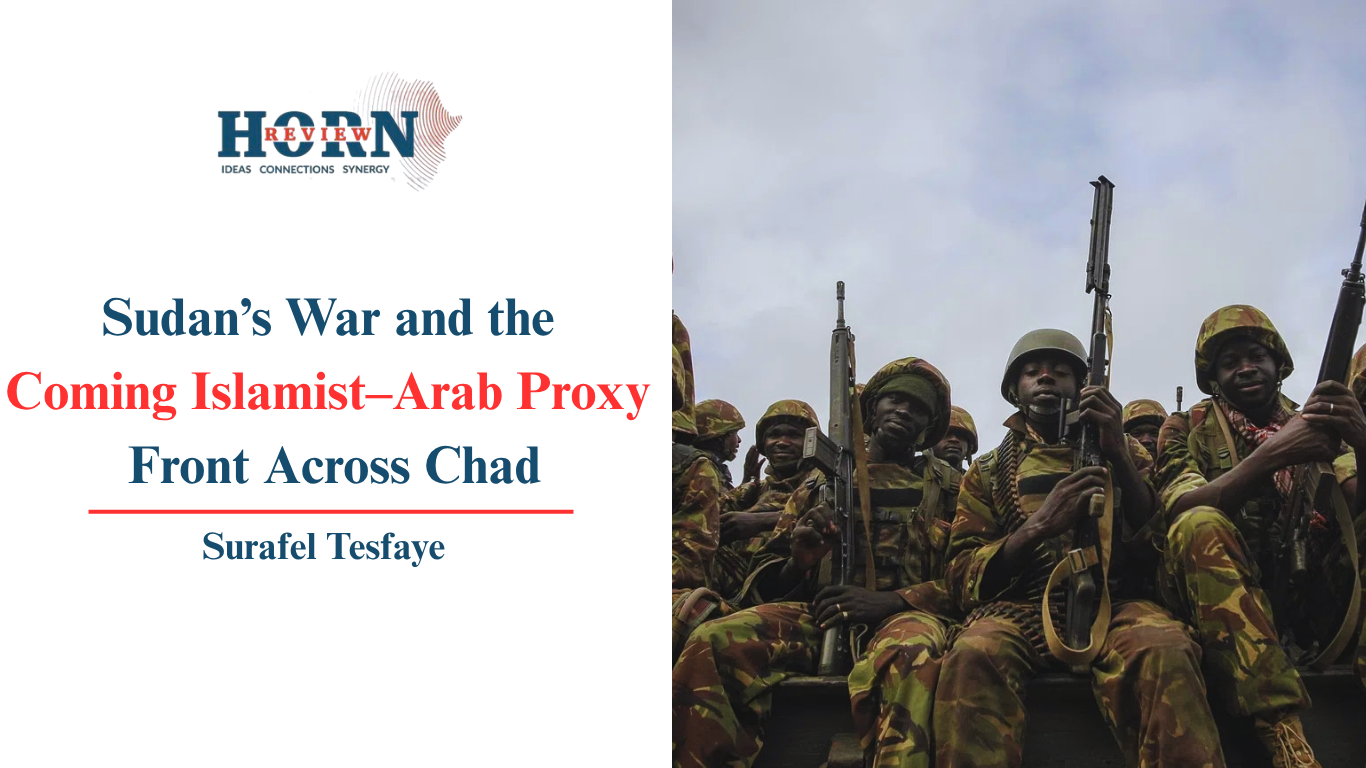
Sudan’s War and the Coming Islamist–Arab Proxy Front Across Chad
The war in Sudan is no longer evolving only through territorial offensives or military stalemate. It is gradually mutating into something far more dangerous: a transnational conflict structured around competing mobilization systems that extend beyond Sudan’s borders and deep into the Sahel. What initially began in April 2023 as a violent power struggle between Abdel Fattah al-Burhan’s Sudanese Armed Forces (SAF) and Mohamed Hamdan Dagalo’s Rapid Support Forces (RSF) is increasingly taking on the characteristics of a regionalized ideological and ethnic confrontation stretching from Darfur into Chad, Niger, Libya, and potentially beyond. The battlefield itself is changing. So too are the actors sustaining it.
While the use of irregular militias has long been embedded in Sudanese statecraft and in the broader security landscape of the Sahelian warfare, the present configuration is distinct in both scale and structure. The RSF’s expanding recruitment includes the vast sociopolitical corridors (Sahelian Arab Belt) stretching across Chad, Niger, southern Libya, and western Sudan which reflects the convergence of several forces that have been building for decades: the militarization of tribal structures under successive Sudanese regimes, the collapse of state authority across the Sahel, the spread of war economies sustained through smuggling and gold networks, and the growing availability of unemployed armed youth moving through ungoverned desert corridors. In doing so, the current war accelerated a process that had already been incubating across the region and exposed the depth of these interstate tribal ties in ways that were previously underestimated or poorly studied.
One of the clearest signs of this transformation has been the visible arrival of Arab tribal fighters from neighboring Sahelian states into the Sudanese theater. Reports, battlefield footage, and local testimonies increasingly point toward armed recruits crossing from Chad, Niger, and Libya to fight alongside the RSF. The accurate example can be Hussein Alamin Shosho, a Chadian leader affiliated with the Oppressed Struggle Movement, publicly recorded himself in Khartoum declaring support for Hemedti as a fellow Arab leader. That incident mattered because it showed that the RSF is no longer mobilizing solely through Sudanese state structures or from Sudanese territory. It is recruiting through a broader transnational Arab solidarity embedded within the Sahelian pastoral belt.
This phenomenon cannot be understood merely through the language of mercenarism. The fighters entering Sudan are not exclusively driven by ideology, identity, or even by simple financial incentives. Mostly their mobilization emerges from a deeper regional crisis shaped by economic abandonment, environmental decline, and the erosion of state authority. Across the vast desert space extending from Mali and Niger to Darfur and western Sudan, enormous territories remain weakly governed or entirely outside effective state control. Desertification, resource competition, livestock displacement, and the collapse of local economies have intensified mobility across tribal lines. In many of these areas, armed networks provide the only functioning structure of income, security, and identity. As scholars such as Anne Clunan and Harold Trinkunas, have argued, non-state armed actors often emerge to fill governance vacuums left by weak or collapsing states, developing their own forms of legitimacy, organizational coherence, and social protection that the formal state has long since abandoned.
Even though the contemporary interstate dimensions of Arab militia networks in the Sahel has been given a little attention, Yet the Sudan war has exposed how deeply interconnected these tribal military structures have become. The same patterns visible today around the RSF can also be traced in Libya’s civil conflict, in northern Chad, and in parts of Niger where armed Arab factions increasingly operate through kinship loyalties that transcend formal borders. Tribal affiliation now functions as an operational military infrastructure. Fighters move through social geography rather than national geography.
In this context, the RSF has steadily transformed itself from a Sudanese paramilitary organization into something far more regional in character. While its original recruitment base remained rooted in Darfur’s Arab communities, the war pushed the organization toward a wider Sahelian recruitment strategy. Longstanding trade routes, cross-border clan ties, and militarized labor systems allowed the RSF to draw manpower from communities already accustomed to conflict economies. For many recruits, joining the RSF is not an ideological commitment rather it’s an economic survival strategy. Others entered through kinship obligations or tribal alliances that had been cultivated over years of regional conflict.
The structural shift alters the very nature of the war. The RSF is no longer merely a domestic insurgent force contesting power inside Sudan. It increasingly resembles a transnational armed coalition whose logistical depth extends into the Sahel itself. This expansion helps explain how Hemedti has continued claiming large-scale force generation despite suffering battlefield attrition and high-level defections. If even part of his claims regarding troop expansion are accurate, such growth is mathematically difficult to sustain through Sudanese recruitment alone and through active war. The organization’s manpower reservoir now depends heavily on what could be described as a Sahelian Arab conveyor belt stretching through Chad, Libya, and Niger.
At the same time, this expansion has produced internal strains inside the RSF itself. As the organization absorbs larger numbers of loosely coordinated tribal fighters and foreign recruits, centralized command cohesion becomes harder to maintain. The conventional command structure that once allowed the RSF to operate as a disciplined paramilitary force is increasingly under pressure from defections, battlefield losses, and fragmented local commanders. In response, Hemedti appears to be shifting from a centralized military hierarchy toward a decentralized coalition model built around clan loyalties and transactional militia relationships.
That adaptation may provide short-term battlefield manpower, but it also weakens unified operational control. Informal cross-border militias do not always obey centralized command structures. Their loyalties are often tied to local tribal leaders, financial incentives, or regional power brokers rather than institutional military discipline. This creates the risk of uncontrolled incursions across borders, especially into eastern Chad where many RSF supply routes and recruitment pipelines remain active. The danger is that Sudan’s war ceases to be geographically containable.
It is precisely this evolution that appears to be shaping the strategic thinking inside the SAF. Burhan and the military leadership increasingly recognize that they are confronting not simply a Sudanese rival force, but a wider transnational Arab military ecosystem rooted in the Sahel. The SAF’s conventional infantry structure is poorly suited to this type of fluid desert warfare. Bureaucratic military formations struggle against highly mobile tribal networks operating across open terrain with flexible logistics and regional social depth.
This partly explains Burhan’s controversial decision to re-embed previously purged Islamist factions and militia networks back into the military apparatus. What initially appeared to many observers as a purely domestic political compromise may in fact reflect a broader strategic recalculation. The SAF increasingly appears to believe that if the RSF can weaponize transnational ethnic solidarity across the Sahel, then the army may eventually need to weaponize transnational ideological networks in response.
That calculation already shows in Hemedti’s rhetoric. His repeated insistence that he is fighting a “Muslim Brotherhood network stretching from the Sahel to the Red Sea” is not simply propaganda designed for foreign audiences. It reflects an emerging strategic concern within the RSF leadership itself. The RSF increasingly understands that Burhan’s reliance on reactivated Islamist networks could eventually evolve beyond Sudan’s borders and produce a wider anti-RSF ideological front extending deep into the Sahel.
To sanitize the growing influx of foreign Arab fighters for international audiences, Hemedti increasingly frames the war as an existential counterterrorism crusade against regional Islamism. In doing so, he attempts to present the RSF not as an ethnically driven transnational militia coalition, but as a stabilizing force resisting Islamist expansion across the region. Yet behind this rhetoric lies a deeper recognition that the SAF may be preparing a different kind of war.
The historical depth of what Burhan is reconstructing matters enormously here and has gone largely unexamined. The Kezan networks and factions such as the Al-Baraa Ibn Malik Brigade are not new actors improvised for a wartime emergency. They carry institutional memory and operational relationships build across decade’s relationships whose origins run directly back to the 1990s, when Hassan al Turbi made Khartoum the ideological capital of transactional Islamist movements across Africa and Middle East. Through his popular Arab and Islamic congress, Turabi assembled Islamist currents from Algeria, Egypt, Eritrea, and beyond under a single political roof and for a period hosted Osama bin laden himself on Sudanese soil, that network never fully dissolved after Turabis falling out with al Bashir. It fragmented, adapted, and survived underground through the political turbulence of the 2000s, through the post 2019 transitions, and into the present war. The Islamist brigades now being reintegrated into the SAF carry those decade’s old transnational connection with them. Their reactivation hands Burhan a deniable instrument with genuinely cross border reach one that no formal diplomatic record would trace back to GHQ Khartoum.
For Burhan, this creates a strategic option that conventional warfare alone cannot deliver. The SAF does not need direct formal coordination with Sahelian jihadist organizations such as JNIM or ISIS-Sahel. The intermediary mechanisms already exist through the domestic Islamist actors being folded back into Sudan’s military environment, providing plausible deniability internationally while allowing ideological and operational overlap to develop informally on the ground. The strategic logic simple. If Islamist factions begin targeting RSF logistical corridors and Arab militia routes across Chad and Niger, Hemedti faces pressure not only inside Sudan but across the wider Sahelian rear network sustaining his forces. Arab tribal militias and Sahelian jihadist factions already compete within overlapping geographic and economic spaces over smuggling corridors, over recruits drawn from the same marginalized populations, over identical desert routes. Friction between them would fracture precisely the ecosystem on which the RSF’s transnational expansion depends.
In this light, the SAF’s growing Islamist alignment may represent more than an ideological revival or a domestic political concession. It may constitute the army’s emerging asymmetric doctrine for western Sudan unable to defeat the RSF through conventional offensives in Darfur, the SAF instead seeks to ignite pressure deeper inside the RSF’s transnational support environment by allowing Islamist militancy to expand against the Arab militia structures linked to Hemedti across the Sahel.
All of these trajectories converge on a single point: Chad. Eastern Chad is not a peripheral spillover zone it is the fault line where the RSF’s Arab tribal recruitment network and the SAF’s reconstituted Islamist infrastructure are already beginning to overlap. The country sits simultaneously between Zaghawa military elites, Arab tribal movements, refugee-driven instability, and armed opposition groups operating across Libya, Darfur, and northern Chad. That is not fragility in the ordinary sense. It is a state holding together multiple live pressures that Sudan’s war is now directly aggravating. President Mahamat Déby’s government lacks the institutional depth to seal its eastern frontier against armed penetration from any direction, and the competing forces now converging on that frontier are pulling in opposite directions at once. If the conflict continues deepening along both ethnic and ideological lines simultaneously, Chad will not simply absorb spillover. It will become the next primary theater.
That danger is compounded by the fact that refugee camps across the border zone are already transforming from humanitarian spaces into militarized political environments. Armed recruitment networks operate within displacement corridors. Rebel movements that historically exploited Sudanese crises to challenge authority inside Chad may once again find fertile ground amid the present instability. If Arab militias, Sahelian Islamist factions, Sudanese Islamist networks, and transnational tribal structures begin intersecting within eastern Chad, the Déby government could face simultaneous pressure from multiple directions a convergence it has neither the military capacity nor the political cohesion to manage.
That pressure sharpens further if Déby is perceived internally as incapable of blocking either Arab expansionism or Islamist infiltration across his eastern frontier. Under those conditions, Chad’s own balance between military elites, tribal constituencies, and armed networks could begin cracking from within. The conflict would no longer spill across borders. It would begin reorganizing political authority throughout the Sahelian belt itself.
Two trajectories now appear credible. The first emerges from a relative SAF recovery backed by Islamist-aligned mobilization and renewed Zaghawa cooperation across Sudan and Chad an outcome that revives older patterns of proxy confrontation involving Chadian rebel movements, Sudanese Islamists, and regional security rivalries stretching back decades. The second, and perhaps the more probable, is the gradual fragmentation of Sudan into parallel political-military zones. The RSF has already begun building proto-state institutions across territories under its control. If those structures consolidate while the SAF deepens its dependence on Islamist military networks, Sudan evolves into a bifurcated conflict system with no recoverable center of gravity and no clear external lever capable of reversing it.
At that point, Sudan’s conflict loses its national character entirely. The RSF has built a transnational military structure grounded in Arab tribal solidarity and regional war economies. The SAF, in turn, is reconstructing an ideological counter-structure through the reintegration of Islamist networks purged from the state apparatus but never fully dismantled. What emerges from this trajectory is not simply a Sudanese civil war grinding toward exhaustion it is the opening of a wider Sahelian contest between competing transnational orders, one that once fully formed will not be confined to any single country’s borders.
If this continues at its current pace, the war will no longer be defined by the struggle for Khartoum or control over Sudanese state institutions. It will become a contest between trans-Sahelian Islamism and transnational Arab militia networks, with Chad as the most exposed fault line connecting both worlds and the least equipped to survive that position.
By Surafel Tesfaye, Researcher, Horn Review

RELATED
Posts
19
Sep
Eritrea’s Sanctions Expired, Not Formally Lifted
The U.S. sanctions on several Eritrean entities and individuals did...
16
Sep
Why Eritrea Turned from Engaging Somaliland in 2019 to Opposing It Today
In March 2019 Eritrean Foreign Minister Osman Saleh accompanied by...
16
Sep
Ethiopia and the U.S. After the War on Terror: Within a New Arc of Terrorism
The War on Terror began as a direct response to...
16
Sep
Why the Abraham Accords Will Not Expand Yet
The claim that Israel is unlikely to find an...
16
Sep
The Real Houthi Weapon Was Mobilization, Not Missiles
Fatima Abo Alasrar frames the Houthi ground strategy as...
16
Sep
The Houthis Reached Zuqar Island: Can Eritrea Be a Neutral Observer?
The island of Zuqar sits in the southern Red Sea,...
15
Sep
What the UN’s Darfur Sanctions Rollover Reveals About the Next Phase of Sudan’s War
On paper, Resolution 2828 is a housekeeping measure. It...
14
Sep
Eritrea Can’t Secure the Red Sea. Here Is Why
When Saudi Arabia formed a coalition of states in...
14
Sep
Shadow Competition in the Horn, Saudi Training and Emirati Surveillance
The Horn is experiencing a shift in the character of...
14
Sep
Egypt's Rafale Rush Is What's Left After Washington Closed the Other Doors
Egypt is nearing a new deal with French company...