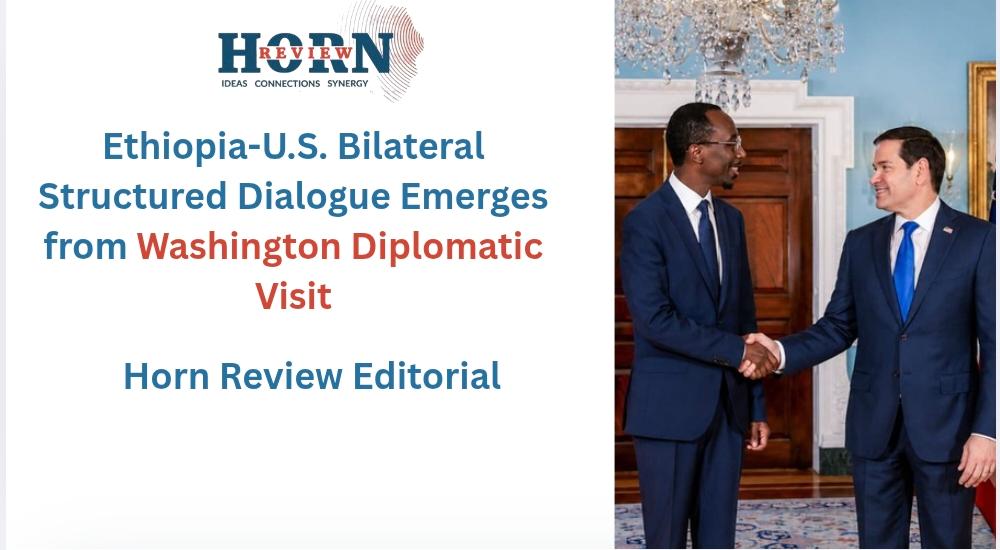
Ethiopia–U.S. Structured Dialogue Emerges from Washington Diplomatic Visit
The visit of Ethiopia’s Foreign Minister, Gedion Timothewos, to Washington, D.C. and his engagement with Secretary Marco Rubio represents a strategically significant diplomatic inflection point in the evolving relationship between Ethiopia and the United States. The signing of the Bilateral Structured Dialogue (BSD) Framework reflects a broader process of institutional recalibration following a period of strain, regional instability, and shifting global alignments. Formally structured around economic cooperation, security collaboration, and regional stability, the BSD Framework is designed to transition bilateral relations from ad hoc interaction to sustained, predictable coordination. Its significance lies not only in its thematic pillars but in its function as an organizing mechanism linking diplomatic, security, and economic engagement within a single institutional architecture.
The composition of the Ethiopian delegation underscores the expanded strategic scope of the engagement and reflects a deliberate whole-of-government approach. Alongside the Foreign Minister, Ambassador Redwan Hussien participated in high-level meetings in his capacity as Director General of the National Intelligence and Security Service (NISS), underscoring the centrality of security and intelligence considerations within the dialogue. The minister was also joined by Ambassador Zerihun Abebe, Director General of African Affairs at the ministry, whose portfolio includes Sudan, Egypt and Nile Basin negotiations, alongside other senior Ministry of Foreign Affairs officials. Beyond Secretary Rubio and other U.S. counterparts at the State Department, the delegation engaged Massad Boulos, who serves as Senior Advisor to President Donald Trump on Arab and African Affairs – holding consultations that were broad in scope and strategic in orientation. Public statements indicate that the overall agenda of engagement encompassed the Nile dispute and the Grand Ethiopian Renaissance Dam, conflict dynamics in Sudan, Red Sea maritime security, and bilateral economic and investment cooperation.
The breadth of representation and the scope of discussions indicate that the BSD functions not as a narrowly defined diplomatic exchange, but as an integrated diplomatic–security platform that institutionalizes coordination across political, intelligence, and economic domains within a wider regional strategic context. The return to structured ministerial engagement in Washington also carries institutional significance. It reflects a reactivation of Foreign Minister–level diplomacy after a period in which bilateral engagement was largely conducted through multilateral summits or crisis-driven exchanges, suggesting a deliberate effort to restore continuity in high-level diplomatic channels. This shift follows a period of pronounced strain in Ethiopia–U.S. relations. While the post-2018 reform agenda under Abiy Ahmed initially generated strong international support, the internal conflict that emerged in 2020 produced a sharp divergence in strategic outlook. Ethiopia prioritized territorial integrity and state stability, while U.S. policy approaches were perceived in Addis Ababa as overly normative and at times coercive, particularly in their treatment of domestic political and security dynamics. These tensions are best understood within a longer historical trajectory marked by discontinuity.
Ethiopia’s alignment with Western security structures during the Cold War, the rupture following the 1974 revolution, and the post-1991 reconstruction of relations around counterterrorism and state-building all underscore the cyclical nature of the bilateral relationship. The contemporary phase of engagement cannot be understood in isolation from the regional environment in which it is embedded. The Red Sea corridor and the Nile basin have evolved into a single strategic space characterized by overlapping crises, fluid alignments, and interdependent security dynamics. From an Ethiopian analytical perspective, this constitutes a Red Sea–Horn security complex defined by competitive interdependence under conditions of fragmented sovereignty. Within this system, the Ethiopia–Egypt relationship represents a central axis of geopolitical tension. The dispute over the Nile, particularly the Grand Ethiopian Renaissance Dam, reflects a structural contradiction between upstream developmental sovereignty and downstream security imperatives.
The engagement between Egypt and the United States under President Abdel Fattah el-Sisi and President Donald Trump illustrates a phase of transactional diplomacy in which Washington intermittently attempted to position itself as a mediator in the Nile dispute while maintaining strategic alignment with Cairo. This was most visibly manifested in the 2019–2020 U.S.-brokered negotiations over the Grand Ethiopian Renaissance Dam (GERD), facilitated under the Trump administration and anchored in Washington’s broader effort to stabilize Egyptian–Ethiopian tensions.
The mediation process, formally involving the World Bank and the United States as conveners, ultimately collapsed prior to final signature, primarily due to fundamental divergences in framing the legal and hydropolitical architecture of the agreement. Egypt sought a binding arrangement that would impose enforceable constraints on filling and operation of the dam, while Ethiopia rejected provisions it viewed as incompatible with sovereign control over its natural resources and its developmental trajectory. Ethiopia’s withdrawal from the final stage of the agreement was followed by strong political criticism from Washington, including President Trump’s public remarks suggesting Egyptian vulnerability – an episode that further complicated perceptions of U.S. neutrality in Addis Ababa. In the broader historical arc, Ethiopia’s non-acceptance of renewed Trump-era mediation overtures – including more recent informal signals encouraging a return to U.S.-led facilitation – reflects a sustained strategic caution shaped by that earlier experience. From an Ethiopian standpoint, the collapse of the 2020 talks reinforced the perception that externally driven frameworks risk privileging downstream security narratives over upstream developmental sovereignty, particularly when mediation is not perceived as evenly balanced.
Within this context, the current Ethiopia–U.S. Structured Dialogue Framework introduces a qualitatively different institutional environment for engagement. Unlike the earlier episodic mediation model, the Structured Dialogue establishes a standing, multi-pillar mechanism that situates the GERD within a broader matrix of economic cooperation, security coordination, and regional stability. This shift is analytically significant: it moves the Nile question away from ad hoc crisis mediation toward sustained diplomatic management embedded in a wider bilateral and regional architecture. If effectively operationalized, this framework could alter the future trajectory of GERD-related diplomacy by reducing reliance on external crisis arbitration and instead embedding discussions within a structured, continuous engagement process. Rather than episodic attempts at high-stakes mediation, the emerging format suggests a gradual normalization of technical and political consultations under a broader Ethiopia–U.S. institutional umbrella, potentially lowering the volatility that has characterized previous negotiation cycles while not resolving the underlying structural divergence between upstream and downstream strategic imperatives.
In this context, the emerging Ethiopia–U.S. Structured Dialogue Framework introduces an additional layer of external structuring pressure on the Ethiopia–Eritrea relationship, even if it is not explicitly framed as such. By institutionalizing regularized engagement between Ethiopia and the United States across security, intelligence, and regional stability domains, the framework indirectly reopens channels through which Eritrea-related dynamics are interpreted, monitored, and potentially recalibrated within U.S. policy formulation. The participation of security leadership within the Ethiopian delegation further signals that the Ethiopia–U.S. relationship is no longer confined to conventional diplomacy, but increasingly incorporates regional security architecture considerations in which Eritrea is an implicit variable.
For Eritrea, this does not constitute direct exclusion or confrontation, but rather a gradual repositioning of the diplomatic environment in which its external relations are assessed. The United States’ cautious engagement with Eritrea is therefore likely to remain conditioned by its evolving assessment of Ethiopia’s internal stability, the trajectory of Ethiopia–U.S. strategic cooperation, and the broader security configuration of the Red Sea–Horn system. In effect, the Structured Dialogue does not redefine Ethiopia–Eritrea relations directly, but it alters the diplomatic ecosystem within which those relations are interpreted, potentially reinforcing Ethiopia’s position as the primary interlocutor in regional security discussions involving the Horn of Africa. At a systemic level, this creates a subtle but important asymmetry: Ethiopia’s institutionalized engagement with Washington strengthens its role as a central node in regional security dialogue, while Eritrea remains engaged through more limited and episodic channels. This divergence does not determine outcomes, but it shapes the diplomatic bandwidth available to each actor within the evolving Red Sea–Horn security architecture.
The conflict in Sudan further intensifies this already fragile regional environment. Beyond repeated and unsubstantiated allegations by the Sudanese Armed Forces regarding Ethiopian involvement, the crisis has direct and material implications for Ethiopia’s border security architecture, refugee flows, and its strategic interface with the Red Sea corridor. It also reinforces the extent to which Sudan’s instability is no longer an isolated internal conflict but part of a wider regional security environment in which Ethiopia is directly affected. Within this context, Ethiopia–U.S. Structured Dialogue does not assign Ethiopia a formal mediating role in Sudan’s peace process, nor does it alter the existing configuration of external diplomatic initiatives. However, it does strengthen the institutional channel through which Sudan-related assessments, security concerns, and regional stability considerations are communicated between Addis Ababa and Washington. This increases the weight of Ethiopia’s perspective in consultations that inform external engagement on Sudan, particularly given Ethiopia’s geographic proximity and direct exposure to the conflict’s spillover effects. At the same time, Ethiopia’s position remains structurally constrained by the nature of the Sudanese crisis itself, which is characterized by fragmented authority and competing internal and external actors. As a result, Ethiopia’s role in Sudan peace efforts continues to be shaped primarily by proximity and impact rather than formal mediation authority. The Structured Dialogue therefore does not transform Ethiopia into a designated mediator, but it does embed Sudan more firmly within a regularized Ethiopia–U.S. strategic consultation framework, where its implications for regional stability can be addressed in a more systematic and continuous manner.
The interconnected nature of these dynamics underscores that the Horn of Africa can no longer be analytically approached as a collection of discrete bilateral relationships. Rather, it functions as a structurally integrated regional security system in which Ethiopia, Eritrea, Sudan, and neighboring actors are mutually constitutive in their threat perceptions and strategic calculations. Within this configuration, external powers engage not as system architects but as selective participants, operating through issue-specific interventions, episodic diplomacy, and narrowly defined security and economic frameworks rather than comprehensive regional ordering strategies. The Ethiopia–United States Bilateral Structured Dialogue (BSD) Framework emerges within this context as an institutional response to systemic fragmentation. By linking economic engagement, security cooperation, and regional coordination, it reflects an attempt to manage interdependence rather than resolve underlying structural tensions that characterize the regional system.
In economic terms, Ethiopia’s engagement with the United States reflects a strategy of diversification and gradual integration into global value chains while preserving domestic policy space for developmental priorities. This trajectory unfolds within a competitive international environment shaped by major external actors, including China, whose economic presence in the Horn of Africa has expanded significantly and continues to influence infrastructure, trade, and investment patterns. In security terms, Ethiopia continues to function as a central actor in regional counterterrorism and peacekeeping architectures, particularly in relation to instability in Somalia. At the same time, evolving global dynamics require calibrated engagement across multiple external partnerships, reinforcing the need for strategic balancing rather than exclusive alignment.
The evolving United States approach – engaging Ethiopia through structured dialogue, maintaining alignment with Egypt, cautiously recalibrating engagement with Eritrea, and responding to instability in Sudan – reflects a broader transition away from attempts at comprehensive regional ordering toward selective stabilization within a fragmented security environment. From an Ethiopian strategic perspective, the emerging regional order is increasingly shaped by multipolar competition, the growing centrality of infrastructure and resource geopolitics, and the heightened importance of state resilience under conditions of regional volatility. In this context, Ethiopia’s foreign policy is oriented toward diversification and strategic hedging, aimed at preserving sovereignty while expanding external cooperation opportunities. Now therefore, the Ethiopia–U.S. relationship is entering a phase characterized by structured pragmatism and managed interdependence. The Bilateral Structured Dialogue (BSD) Framework reflects both the possibilities and constraints of this phase: it provides an institutional mechanism for sustained coordination across economic, security, and regional issues, while operating within a wider regional system defined by persistent uncertainty and structurally unresolved tensions.
By Horn Review Editorial

RELATED
Posts
7
Sep
Abiy Ahmed and the Remaking of the Ethiopian State
Blen Mamo
The political trajectory of Abiy Ahmed cannot be adequately...
3
Sep
Is Ethiopia Ready for a Presidential System?
By Blen Mamo
Ethiopia has spent much of its modern political...

28
Aug
Ethiopia-U.S. Strategic Defense Partnership
The recalibration of United States–Ethiopia relations recently reflects a deeper...
20
Aug
Eritrea’s Buffer Zone Politics from Eastern Sudan to Ethiopia's Tigray
The most consequential development in the Horn of Africa may...
14
Aug
Ethiopia’s Withdrawal from Burhakaba and What Comes Next for Al-Shabaab?
The recent handover of the Burhakaba forward operating base...

13
Aug
What Another War Against Ethiopia Could Mean for Eritrea’s Future
Another Ethiopia–Eritrea war would not be a replay of 1998....