The Middle East is being reshaped by a war that has, in the space of weeks, overturned assumptions that regional analysts had treated as settled. The United States and Israel launched a campaign targeting Iran’s military and nuclear infrastructure, and while that campaign has inflicted significant damage, a definitive achievement of its war aims in full appears unlikely. What is emerging instead is a weakened but battle-hardened Iran, one that has demonstrated both a capacity for sustained retaliation and a willingness to absorb attacks in pursuit of its strategic objectives. The most probable trajectory, as the conflict moves through its current phase, is Iranian adaptation rather than Iranian collapse, with Tehran recalibrating its posture toward a longer confrontation and the Gulf states facing a more immediate and acute security threat than they have contended with in recent memory.
The war has also produced a secondary effect that carries its own significance. The rapid securitisation of the Gulf’s political environment. Capitals that had, over the preceding years, channelled considerable energy and resources into projecting influence abroad, into the Horn of Africa, the Levant, and across the broader Muslim world, now find themselves operating under conditions of direct threat. The prevailing assumption among analysts has been that this securitised environment will produce a Gulf retreat from external ambitions, as resources are redirected inward and risk tolerance narrows. That assumption deserves scrutiny. The Gulf’s strategic interest in the Horn of Africa is structural, rooted in overlapping security dependencies, long-term economic calculations, and access to land and resources that Gulf capitals have spent years positioning themselves to secure. How the terms of that engagement will shift matters more than whether the Gulf will remain engaged. For Addis Ababa, the answer to that question may contain a significant opportunity.
To understand the contours of that opportunity, it is necessary to go back to the war’s trajectory and what it has revealed about Iranian strategy. The principal theatre of the conflict was initially mainland Iran, where American and Israeli strikes have been conducted. Iran’s most consequential battlefield success, however, has been elsewhere: in its sustained bombing campaign against Gulf states and, critically, its hold on the Strait of Hormuz. The logic underpinning Tehran’s posture is one of horizontal expansion. Facing direct military pressure on its territory, Iran’s calculus appears oriented toward widening the geographic scope of the conflict, imposing costs across multiple fronts simultaneously, and sustaining pressure on the United States, Israel, and the Gulf monarchies through the threat of economic and logistical disruption. The Red Sea, as an extension of that strategic geography, now figures prominently in this calculus. A look at Iranian intentions point to the possibility of Tehran seeking to re-establish a presence along the Red Sea littoral, whether through obstructing shipping lanes or securing forward positions capable of projecting threat. Eritrea and war thorn Sudan, both of which carry longstanding ties with Tehran, emerge naturally in this analysis as potential conduits.
Eritrea’s position in the current alignment deserves particular attention. Asmara has historically oscillated between Iran and Israel, maintaining a degree of strategic ambiguity that served its interests across different phases of regional competition. That ambiguity appears to have resolved, at least for now, in Tehran’s direction. President Isaias Afewerki has been openly critical of Israel, a posture shaped in no small part by his perception of Tel Aviv as a partner and enabler of Addis Ababa, the power whose trajectory he is actively working to constrain. Eritrea’s alignment with Iran is therefore simultaneously regional and deeply personal to the logic of the Eritrean leadership. It is also strategically significant; Asmara’s position on the Red Sea coast, and its existing relationship with the Sudanese Armed Forces (SAF), makes it a plausible node in any Iranian attempt to extend its conflict architecture southward.
It is within this shifting threat landscape that the Gulf’s internal dynamics have been dramatically reordered. For much of the preceding months, the rivalry between Riyadh and Abu Dhabi had emerged as a defining fault line in the Horn of Africa’s external relations, with each capital pursuing a distinct set of interests that placed them on opposing sides of several regional contests. The immediate trigger for the rupture, according to reporting by the New York Times, was Saudi Crown Prince Mohammed bin Salman’s request to the Trump administration to impose sanctions on the United Arab Emirates over its alleged support for the Rapid Support Forces (RSF) in Sudan. The dispute deepened from there, drawing in competing alignments across the Horn and shaping the foreign policy calculus of every capital with a stake in the region.
The Iranian campaign against Gulf infrastructure appears to have fundamentally altered that calculus. When Tehran launched its retaliatory bombing campaign against Gulf states, the UAE, Saudi Arabia, Qatar, and others found themselves simultaneously absorbing Iranian pressure. The shared threat has proved a more powerful forcing mechanism than the accumulated grievances of the bilateral dispute. The phone call between Mohammed bin Salman and Emirati President Mohammed bin Zayed in late February, the first substantive conversation between the two leaders since the fallout deepened, signals the beginnings of a rapprochement. It does not resolve the underlying competition, but it suggests that both capitals have concluded, at least for now, that the threat from Tehran renders their quarrel a secondary concern.
The consequences for their respective postures in the Horn of Africa are already beginning to emerge. Saudi Arabia’s suspension of a reported $1.5 billion military agreement that would have facilitated arms transfers from Pakistan to the Sudanese Armed Forces, including fighter aircraft, is perhaps the most concrete signal of Riyadh’s recalibration. Whether the suspension reflects a broader strategic reassessment of Riyadh’s Sudan policy, a reallocation of resources toward the immediate Gulf security environment, or discomfort with the deepening SAF-Tehran alignment is difficult to determine with certainty; the most plausible reading is that all three factors are operative. What the suspension does indicate is that Riyadh is returning to the more cautious, mediation-oriented Sudan posture it held before the rivalry with Abu Dhabi hardened its position. That return, in turn, softens one of the principal fault lines between Riyadh and Addis Ababa.
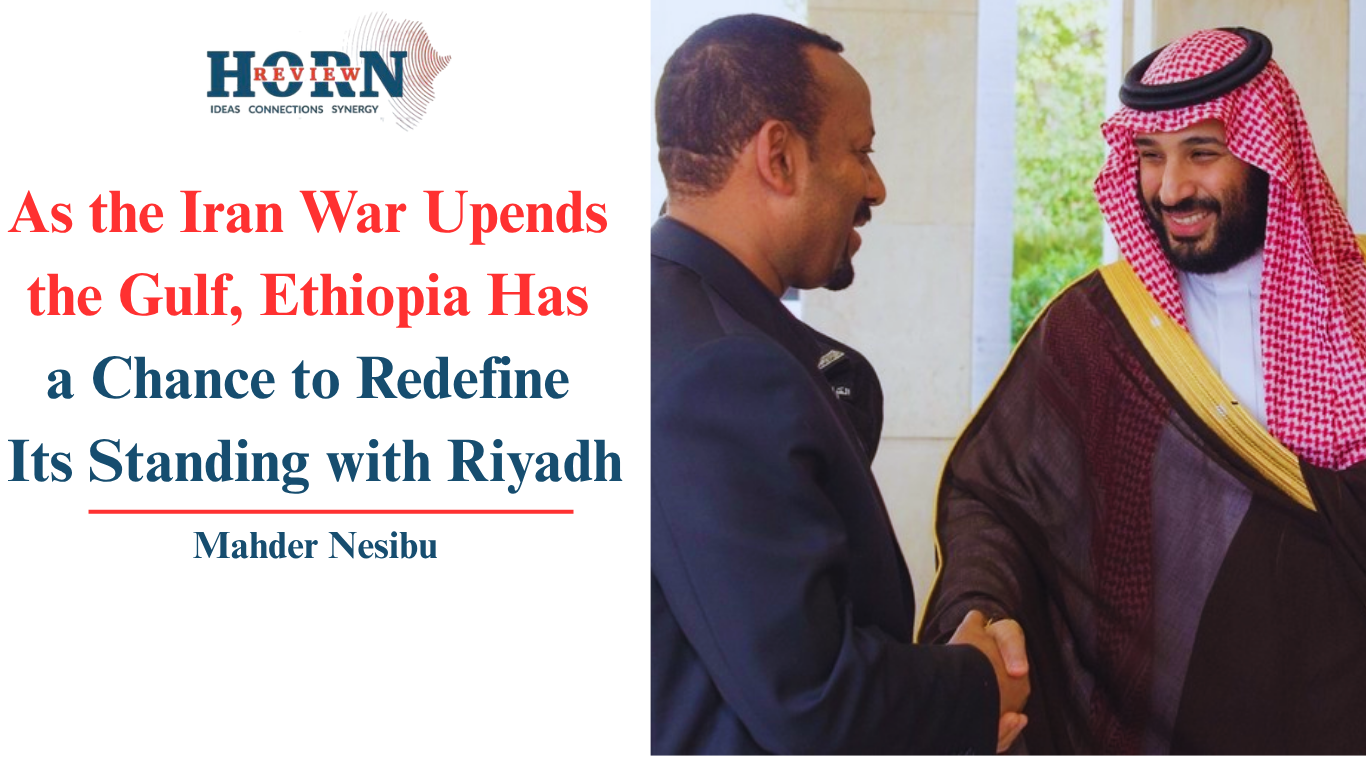
Saudi Arabia’s enduring interest in Ethiopia is well established. The kingdom’s economic footprint in the country is substantial, built through years of investment and underscored by Riyadh’s role as the broker of the 2018 Eritrea-Ethiopia rapprochement, the landmark accord that briefly ended decades of hostility between the two neighbours. The recent dispatch of the head of the Saudi Fund for Development to Addis Ababa for reported discussions on enhanced development cooperation confirms that Riyadh’s economic engagement with Ethiopia is being actively tended.
The political relationship, however, has been more complicated. Saudi Arabia’s courtship of Asmara, particularly during the height of its rivalry with the UAE was driven by a strategy of positioning against Abu Dhabi’s alignment with Addis Ababa, and reinforcing its support for the Sudanese Armed Forces, with whom Eritrea is firmly aligned with. As that rivalry softens, so does the strategic rationale for maintaining an Eritrea posture that sits in tension with Riyadh’s deeper interests in Ethiopia.
Should Eritrea consolidate its alignment with Iran and emerge as an asset for Tehran in the Red Sea’s evolving security architecture, that process of Saudi recalibration may accelerate considerably. An Asmara perceived as a conduit for Iranian strategic depth along the Red Sea littoral is one that Riyadh cannot regard with equanimity, given the kingdom’s own stake in Red Sea stability. Diplomats in Addis Ababa appear well-positioned to capitalise on this shift. Ethiopia has cultivated a model of accumulating partnerships across competing powers, maintaining a strategic relationship with Turkiye while sustaining strong ties with Israel, two states that regard each other with considerable wariness. Bringing Riyadh into a substantive alignment would extend that model into the Gulf in ways that have thus far proved elusive.
The stakes of such an alignment extend well beyond the bilateral. Addis Ababa’s most pressing strategic objective is recovering a foothold on the Red Sea, a goal that has underpinned much of its regional diplomacy and which carries both economic and security dimensions.
The UAE has thus far been the most forthcoming regional partner on this question, offering support that reflects its own interest in Ethiopian stability and its significant economic presence in the country. Should Saudi Arabia conclude that a Red Sea access arrangement for Ethiopia serves regional stability and, by extension, its own security interests, Addis Ababa would gain a weight of support for its position that has previously been absent.
The broader picture points in a complementary direction. The Iran war is accelerating a convergence between Saudi Arabia, the UAE, and Israel. A consolidated Israel-UAE-Saudi security architecture, shaped by a common Iranian threat, would represent a fundamental reordering of Middle Eastern politics. Ethiopia’s ability to maintain working relationships across all three of these capitals simultaneously, a posture it has invested considerable diplomatic capital in constructing, positions it to benefit from that convergence. The opportunity carries no guarantees, and the regional situation remains sufficiently volatile that its terms may shift considerably. What the current moment offers is a window, and Addis Ababa has both the relationships and the strategic rationale to capitalize on it.
By Mahder Nesibu, Researcher, Horn Review