
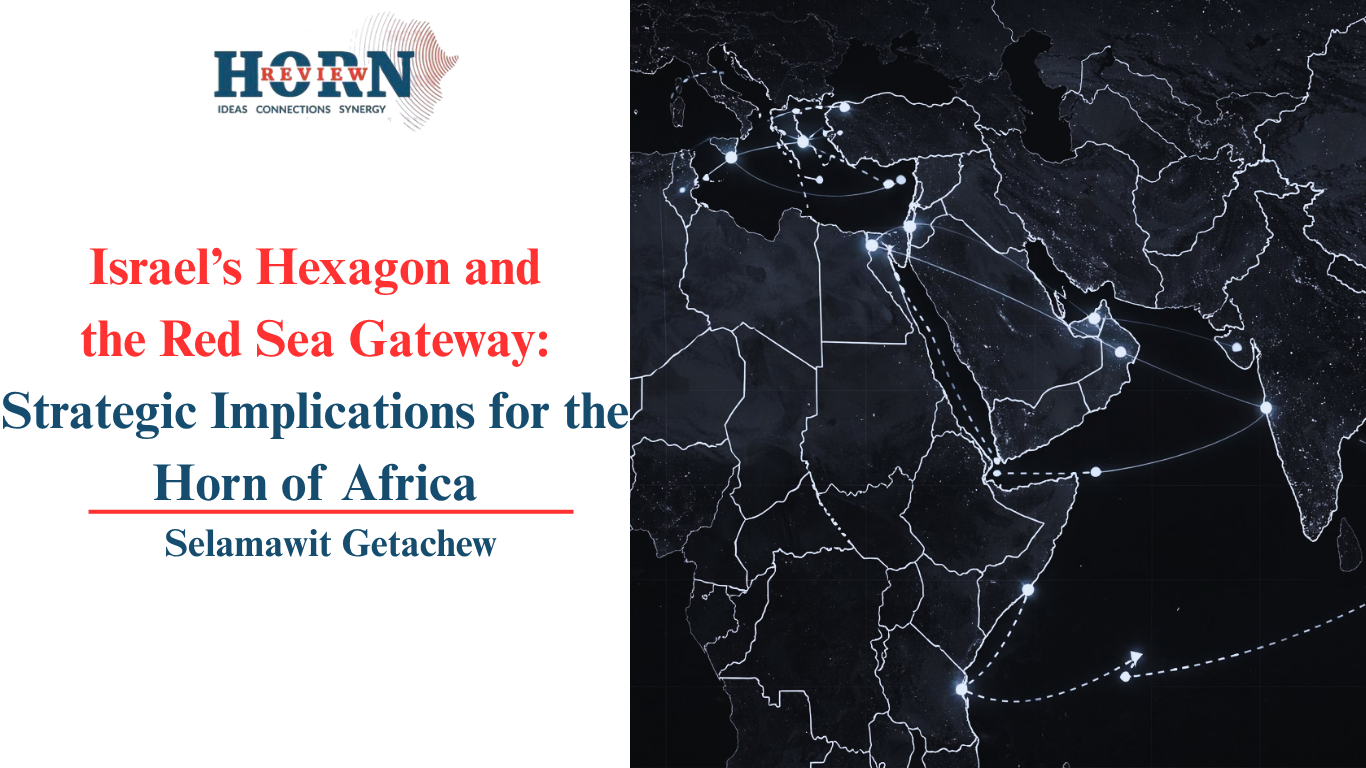
Israel’s Hexagon and the Red Sea Gateway: Strategic Implications for the Horn of Africa
Across the Eastern Mediterranean, the Gulf, and the Red Sea corridor, regional security structures are gradually shifting toward flexible strategic networks designed to absorb geopolitical shocks. Within this evolving strategic environment, a concept articulated by Benjamin Netanyahu reflects an attempt to reorganize Israel’s regional through distributed partnerships architecture described as the “Hexagon.” States to construct distributed partnerships linking maritime security, infrastructure development, intelligence cooperation, and technological integration.
The Hexagon concept entered public discourse in early 2026, when Netanyahu announced Israel’s intent to form an ‘axis of countries that see eye-to-eye.” In the same remarks he argued that such a framework would counter two perceived adversarial formations: a “radical Shiite axis,” referring primarily to Iran and its regional proxies, and what he described as an “emerging radical Sunni axis.” Although Netanyahu did not identify the specific members of this Sunni alignment, the language reflected Israeli concerns that new regional alignment might emerge established during the previous decade. In its broadest formulation, the Hexagon encompasses Israel, Greece, Cyprus, India, and unspecified Arab and African states reflecting a networked rather than bloc-based geopolitical order.
In practice, the Hexagon appears less like a conventional alliance than a networked security architecture. Unlike treaty organizations such as the North Atlantic Treaty Organization, the framework relies on interconnected partnerships rather than binding collective defense commitments. Within such systems, influence is distributed across multiple nodes. If one partnership weakens or hedges, others compensate through alternative channels of cooperation. Within this, Israel functions as a central connector linking Mediterranean partners with states extending toward the Gulf and the Indo-Pacific.
A major institutional foundation for this emerging architecture emerged through the normalization agreements collectively known as the Abraham Accords. Signed in 2020 between Israel and several Arab states, including the United Arab Emirates, Bahrain, and Morocco. The accords opened channels for Israeli technology, intelligence cooperation, and defense systems to integrate into Gulf economic and security networks that had previously remained politically inaccessible. Over time, normalization expanded beyond diplomatic symbolism into deeper structural collaboration, including intelligence sharing, and infrastructure investment. One demonstration of this transformation appeared in 2024 when Morocco acquired Israeli reconnaissance satellite capabilities, strengthening its independent surveillance capacity along its borders and the Western Sahara region. Such cooperation embedded long-term strategic relationships between Israeli defense industries and North African security institutions.
The Mediterranean dimension of this network rests on trilateral cooperation linking Israel with Greece and Cyprus. Since the mid-2010s these states have expanded coordination in offshore gas exploration, naval exercises, and air-defense planning across the Eastern Mediterranean. Greek procurement of Israeli rocket and surveillance technologies has further reinforced this alignment, connecting Mediterranean energy infrastructure with broader regional defense cooperation.
Another major node within the emerging structure lies in India. India’s dependence on Gulf energy imports and its expanding technological partnership with Israel extend the network beyond the Middle East toward the Indo-Pacific. At the same time New Delhi maintains pragmatic engagement with Iran through the development of Chabahar Port, which provides India with strategic access to Afghanistan and Central Asia while bypassing Pakistan. Within the geometry envisioned in the Hexagon concept, India therefore functions less as an ideological ally than as a strategic bridge linking Mediterranean security arrangements with Indian Ocean trade routes, particularly through initiatives such as the India-Middle East-Europe Economic Corridor(IMEC).
The drivers behind this evolving architecture are rooted partly in the conflicts that reshaped the Middle East during 2024 and 2025. Israeli military operations weakened several components of Iran’s regional proxy network known as the resistance axis operating across Lebanon, Syria, Iraq, Gaza, and Yemen. While attacks on international shipping by the Houthis movement demonstrated how non-state actors could disrupt the maritime corridor connecting Europe and Asia through the Red Sea. These events exposed the vulnerability of global shipping routes passing through the Bab el-Mandeb Strait, the narrow passage linking the Red Sea with the wider Indian Ocean. As a result, the Red Sea has increasingly evolved into a strategic deterrence theater where naval deployments, maritime surveillance systems, and port infrastructure shape geopolitical influence.
Within this strategic landscape, several Sunni-majority states have expanded their own forms of cooperation, mostly Turkey, Pakistan and Saudi Arabia. This loose coordination is sometimes interpreted as the type of alignment Netanyahu warned about when referring to an “emerging radical Sunni axis.” In reality, however, the relationships among these states remain fluid rather than forming a coherent bloc.
Each of the three actors occupies a distinct strategic theater. Turkey, positioned between the Mediterranean, the Middle East, and the Black Sea, functions as a geopolitical hinge capable of influencing multiple regional arenas simultaneously. Ankara can challenge Israeli-aligned Mediterranean partnerships through maritime disputes with Greece and Cyprus while simultaneously projecting influence into the Horn of Africa through its military presence “TURKSOM” in Mogadishu and coordinate with Pakistan to shape an alternative alignment.
Geography also places Saudi Arabia at the center of multiple strategic systems. The kingdom borders both the Persian Gulf energy basin and the Red Sea maritime corridor, positioning it as a bridge between Asian energy markets and Mediterranean trade routes. Through large-scale initiatives such as the NEOM development project and expanding Red Sea port infrastructure, Riyadh is gradually transforming the northern gateway of the corridor linking Asia and Europe. If Riyadh were to integrate fully into the proposed Hexagon, the network would effectively link Mediterranean energy corridors, Gulf logistics, Red Sea chokepoints, and Indian Ocean maritime routes into a continuous strategic arc.
Saudi Arabia’s security relationship with Pakistan rests on deeper historical foundations. Pakistani military advisers have long participated in Saudi defense planning, and cooperation between the two states has recently been formalized through a new framework known as the Saudi-Pakistan Strategic Mutual Defense Agreement, which strengthened long-standing security coordination between the two countries. Meanwhile expanding Turkish-Pakistani-Saudi defense manufacturing cooperation adds another layer to this emerging strategic triangle. Within this evolving landscape, India’s participation in Hexagon-related initiatives may function as a counterweight to Pakistan while complicating attempts to consolidate a rival alignment.
Not all Sunni-majority states align neatly within these configurations. Qatar pursues diplomatic multi-alignment hosting major U.S. Al Udeid Air military Base while maintaining mediation channels between Israel and Palestinian factions from Doha, despite tense ties and strikes in mediation zones. This positions Qatar less as ally or adversary, but as a neutral intermediary in complex, overlapping regional networks.
A similar ambiguity characterizes the position of Egypt. Although Egypt maintains a peace treaty with Israel following the Camp David Accords, tensions that intensified after the Gaza war revealed deeper strategic mistrust. Cairo has increased military deployments in the Sinai Peninsula, expanded naval capabilities in the Red Sea, and strengthened security along the Gaza border. These developments suggest that while Egypt cooperates with Israel on certain security collaborations on Sinai jihadists, Gaza border management(Rafah coordination), and gas deals, it remains cautious about Israel’s broader regional reshaping.
The strategic contest surrounding these overlapping architectures becomes most visible along the Red Sea corridor itself. Infrastructure investments and logistics networks increasingly determine geopolitical leverage in the region. Over the past decade, the United Arab Emirates has developed an expanding logistics network across the western Indian Ocean and the Horn of Africa, including investments in ports such as Berbera Port in Somaliland. Collectively these projects form a maritime arc linking Gulf commercial hubs with East African coastal infrastructure. Thus for Hexagon, UAE is not merely a state but potentially a network of ports, surveillance nodes, and energy terminals.
Somaliland’s importance stems from situated next to the Bab el-Mandeb Strait and Gulf of Aden, placing it at a critical juncture for global maritime chokepoint. Through UAE partnership, Berbera has become a major commercial and military logistics hub. The recognition of Somaliland by Israel in late 2025 reflects its relevance by offering Tel Aviv a potential forward influence near Yemen also its location offers a geographic vantage point for monitoring Red Sea security dynamics and deterring maritime disruption making it potential for the Hexagon network.
Within this geography the Horn of Africa emerges as a critical gateway through the Red Sea. At the center of this system lies Ethiopia. Despite being landlocked, Ethiopia functions as the primary economic hinterland behind several Red Sea ports. Ethiopia connects Gulf investment flows, Nile Basin geopolitics, and logistical access to the Bab el-Mandeb maritime corridor.
Recent diplomatic activity indicates the growing strategic significance of this geography. The visit of Israeli President Isaac Herzog to Addis Ababa, following closely the Turkish engagement with Ethiopia, reflects intensifying competition for influence around the Red Sea gateway. Some observers interpret Ethiopia’s interaction with Israel as evidence of alignment with the Hexagon network. In reality, Ethiopia’s foreign policy remains distinctly multi-vector. Addis Ababa simultaneously maintains cooperation with Turkey and Pakistan while engaging Gulf states, Western partners. Further Israeli Foreign Minister Sa’ar in January 2026 called Ethiopia a “long-term strategic partner” for security and tech amid Red Sea tensions. Perceptions of alignment therefore arise less from formal alliances than from geography itself. As infrastructure development across the Horn of Africa becomes integrated with Gulf capital and Mediterranean security partnerships, the wider network envisioned within the Hexagon could gradually become materially anchored.
Looking ahead, two strategic trajectories appear possible. If Israel successfully institutionalizes the Hexagon network through deeper technological, maritime, and infrastructure integration, it could evolve into a long-term architecture linking Mediterranean energy systems with Indo-Pacific trade corridors. Alternatively, if cooperation among Turkey, Saudi Arabia, and Pakistan expands into a more cohesive strategic alignment, the region may witness the emergence of overlapping security geometries rather than a single dominant framework.
In either scenario, geography will likely prove more decisive than ideology. Control over ports, logistics corridors, and maritime chokepoints increasingly shapes the balance of power stretching from the Mediterranean to the Horn of Africa. Within this evolving system, the strategic triangle linking the Red Sea, the Bab el-Mandeb Strait, and the Horn of Africa may ultimately determine the future alignment of states across the broader Middle East and its surrounding maritime corridors.
By Selamawit Getachew, Researcher, Horn Review

RELATED
Posts
20
Sep
The African Union Was Designed to Stand Outside Sudan's War
Every time Sudan's war comes up in public discussion, mentioning...
2
Sep
A Decade of Saudi Miscalculation in Yemen
On March 26, 2015, Mohammed bin Salman, then a thirty-year-old...
31
Aug
Mahamat Déby or Burhan: Who Can Win the US?
On August 20, 2026, Sudanese warplanes and drones pursued a...
27
Aug
What the Decline of Multilateralism Could Mean for Africa
Multilateralism is weakening just as African states need it most....
19
Aug
Who Gets a Seat in Saudi Arabia’s Red Sea Security Order?
Saudi Arabia’s new maritime defence architecture exposes a contradiction at...
18
Aug
Asymmetric Attrition in Hormuz: Decoding the Escalation Against State Energy Assets
The attacks on ADNOC vessels in the Strait of Hormuz...
17
Aug
Egypt Skipped the Mecca Pact Because It Lacks the Leverage to Join
Egypt’s continued absence from the Mecca collective-defense pact reflects a...
12
Aug
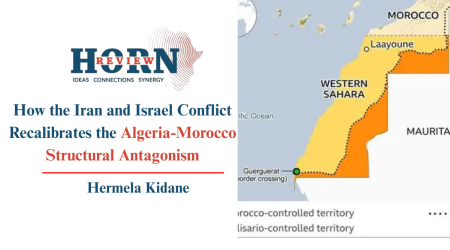
How the Iran and Israel Conflict Recalibrates the Algeria-Morocco Structural Antagonism
The direct hostilities between Iran and Israel have generated effects...
12
Aug
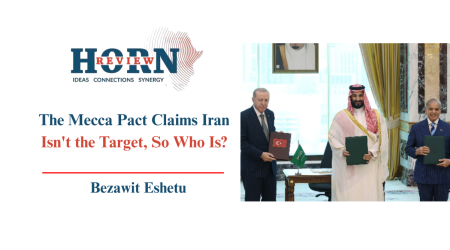
The Mecca Pact Claims Iran Isn't the Target, So Who Is?
On August 7, 2026, in the holy city of Mecca,...
10
Aug
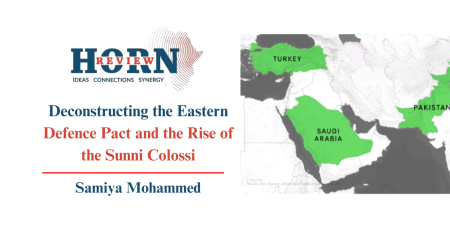
Deconstructing the Eastern Defence Pact and the Rise of the Sunni Colossi
The regional status previously shaped by the Shiite...