The rapid changes that are taking place in the North East Africa region shake the very foundation of the post-1991 geopolitical arrangement imposed on the Horn of Africa, Nile Basin and Red Sea. Ethiopia’s civilizational, cultural and national resilience is reshaping the regional geo-economic map linking the Nile Basin, Horn of Africa and Red Sea into one strategic theater.
The operationalization of the Grand Ethiopian Renaissance Dam Nile (GERD) rewrites the geopolitical mathematics of the Nile with reason and fairness. Ethiopia’s emergence as a geo-economic game-changer in the geo-economically dormant terrain of the region activates the countries to utilize the waters of the Nile for their prosperity. South Sudan seeing this trend is intending to construct the Fula Dam to power its economy and safeguard its water security.
Ethiopia, questioning the legitimacy of past decisions that deprived her of access to the sea, facing chokepoint wars, and anticipating maritime blockades, goes on striving for a durable access to the sea through a reasonable and fair manner. The new breed of leadership seeks to peacefully and legally redress the 1991 injustice that makes Ethiopia landlocked. This illegitimate act was undertaken by the late Egyptian Secretary-General of the UN Boutros Boutros-Ghali in league with the TPLF-Ethiopia and PFDJ-Eritrea.
The strategic sea changes in the region re-graphing the “geo” of the Nile and Red Sea disputes Egypt’s regional vision built on absolute security architecture. The fundamental change in the basic structures of the regional system has forced Egyptian officials to stop the geopolitical rebalancing of the Horn. Egypt’s Foreign Minister authoring a commentary on News24 in 2025 underlined that Egypt is using its defense and diplomatic machinery to restore its dominium on the “two of the most important axes of Egyptian national security”—Nile Basin and Red Sea.
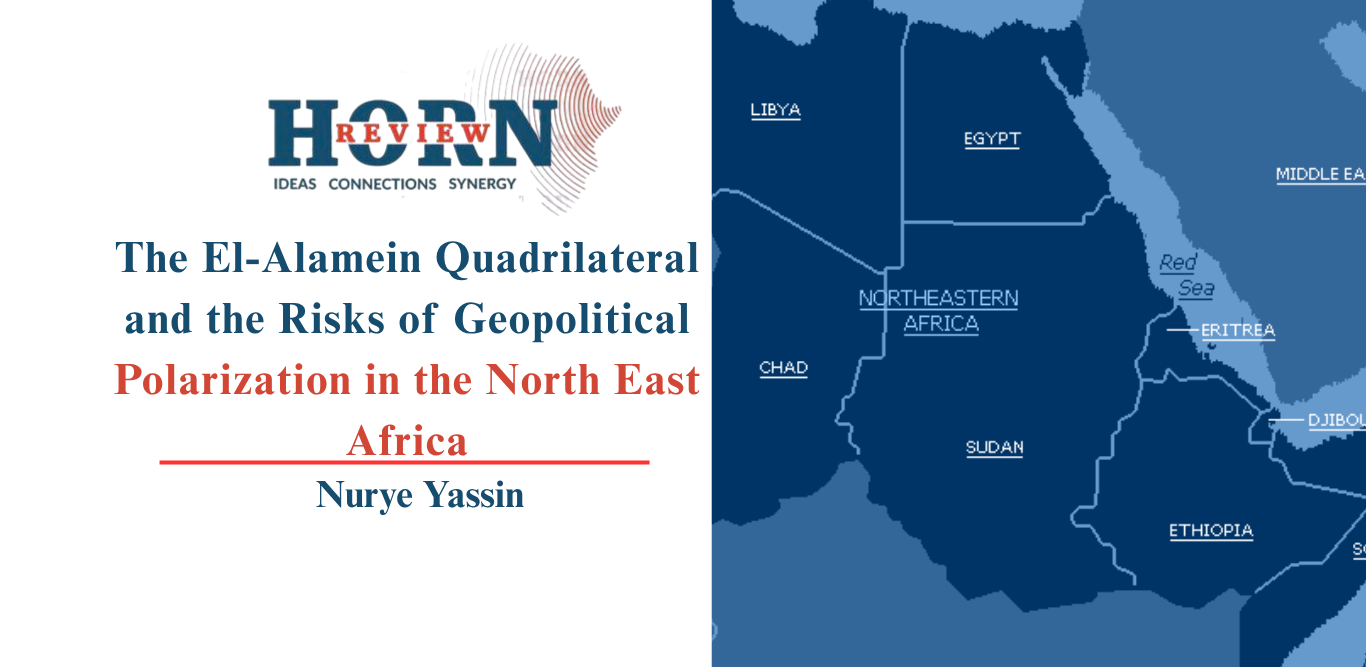
Egypt’s militaristic and diplomatic posture took shape in October 2026 in El-Alamein, forming a Quadrilateral Security Grouping that includes PFDJ-Eritrea, SAF-Sudan and Hassan Sheikh-Somalia. The grouping seeks to re-configure the complicated waters of the Nile and Red Sea without Ethiopia. Egypt which is the brain behind this unilateral governance enterprise chariots the grouping to run the sovereignty of PFDJ-Eritrea, SAF-Sudan and Hassan Sheik-Somalia through Cairo. For Ethiopia, the significance of this assemblage lies not simply in the number of participating states, but in the implications of their emerging military and intelligence coordination for the region’s wider security architecture. The grouping defines Ethiopia as a structural challenger to the alliance and Egypt’s primacy in the region.
The emerging security alliance advances Egypt’s Ethiopia strategy which is designed to exploit internal political differences through exporting instabilities. PFJD-Eritrea serves as a liaison in this project. The grouping seeks to promote the dismemberment scenario gaining meaning in the form of Tsimido materially steered by Egypt and PFDJ-Eritrea. This scenario seeking to embroil Ethiopia in “forever wars” intends to control the headwaters of Abay (Blue Nile) and decouple Addis Ababa from the Red Sea. This scenario is being countered by Ethiopia. Ethiopia’s military success, confusing the El-Alamein grouping and surprising the international commentariat, shows Ethiopia cannot be treated as a challenge to be contained but as a concrete pillar of the regional order built on indivisible security paired with open economic architecture.
Besides the continued military and intelligence support, the El-Alamein grouping now turns to a full-fledged ideational war against Ethiopia in the global battle for hearts and minds. Egypt and PFJD-Eritrea are now engaged in diplomatic overdrive hell-bent on delegitimizing Ethiopia’s credibility and producing misinformation that materially disadvantage Ethiopia. The regime in Asmara depicts Ethiopia’s measured self-defense as an attempt to control PFDJ-Eritrea’s ports, turn Asmara into an Ethiopian coastal state, and make Addis Ababa a rule maker in the management of the Red Sea. Ethiopia’s peaceful search for sea access is sold by PFDJ-Eritrea and Egypt to the global audience as expansionism, controlling ports and revising the borders of the Horn. This is a scheme to cover up Eritrean incursion and El-Alamein grouping’s support to insurgent groups in Ethiopia. Besides delegitimizing Ethiopia’s reputation, this diplomatic smear campaign organized and directed by El-Alamein bloc is intended to contain Ethiopia as a “landlocked, truncated, weak and circumscribed country.”
The El Alamein bloc entails that Egypt seeks to build its Red Sea position on keeping littoral states and non-littoral states apart in order to remake the geography and governance of the Red Sea without Ethiopia. For this to happen, Egypt does so by employing a combination of foreign-policy perceptions, economic pull, security coordination, and military support in the region. The framing of Red Sea for Red Sea littoral states advances closed regionalism and governance unilateralism, embracing Egypt’s conception of Arab Lake. The littoral-centric framing, originated with the formation of the Red Sea Council in 2020, evidently demonstrates the El-Alamein grouping’s policy to exclusively dictate the terms and rules of engagement on all issues of the Red Sea and Gulf of Aden. This exclusively competitive approach risks producing overlapping security initiatives, diplomatic polarization and uncertainty for trade and investment in the broader region.
The ultimate strategic goal of the El-Alamein grouping is all about undermining the peaceful restoration of Ethiopia’s legitimate access to its natural seashores by PFDJ/TPLF assisted by Egypt together with international complicity. That amounts to omitting Ethiopia’s historicity and ontology on the Red Sea. Professor Tecola Hagos captures this grim reality facing the Horn: “With Ethiopia landlocked, the long-term strategy for the Horn is terribly flawed.” With Ethiopia delinked from the Red Sea and barred from the governance of the water strip, the broader Red Sea and Gulf of Aden connected to the Middle East conflict has become a site of contest where land-based powers set to challenge the sea powers and an arena of zero-sum competition.
The international community again sticks to the vocabulary and grammar of de-escalation regarding the tensions surrounding Ethiopia and PFDJ-Eritrea. PFDJ-Eritrea’s aversion to talking over fighting which seeks to profit from a contained, landlocked Ethiopia continues to bring insecurity and underdevelopment. Sadly, that war-footing behavior of PFDJ-Eritrea has brought, according to Hassan Umer Abdalla, “a sort of unconsumed divorce and impossible neighborliness” between Ethiopia and Eritrea. Partners with influence should not lose sight of the Eritrean problem fueled by Egypt’s hegemonic ambitions and turbocharged by rival regional security groupings, including, El-Alamein Quadrilateral Security bloc, that intend to corner and stop Ethiopia from ascending.
The El-Alamein security arrangement cannot contribute to stability in the region as it is non-transparent, exclusive and negatively directed towards containing Ethiopia’s development. It has already become a source of mistrust Ethiopia perceives it as an instrument for constraining its legitimate national interests. The international partners plunging themselves in the content while leaving the terms of the conversation that trouble the Nile, Horn and Red Sea overlook the regional security logic—logic of dismemberment. The main objective of regional security architecture underpinned by this logic minted by Egypt is all about safeguarding the singular water, maritime and strategic interests against an existential threat from Ethiopia. Although Ethiopia as a resilient civilizational state has turned this logic of dismemberment into a myth, the same logic poses dangers to the security of the Nile and Horn while fueling the already contested wider Red Sea.
The moment demands that the Horn of Africa finally break with the regressive regional architecture of “rules by few” and exclusion that continues to constrain and suffocate the future of the region with zero-sum rivalry and bloc politics. It demands that the Horn of Africa embrace tougher, harder, but more enabling paradigm of “rules through dialogue” and institutional inclusion replacing “rules by few” and unilateral governance. This enabling paradigm ensures that regional cooperation does not become a framework for strategic exclusion, opening new possibilities for the countries of the Horn to consult on and shape an open, inclusive regional architecture of mutual enablement that frames security as a shared responsibility and development as a shared empowerment.
For this to happen, a new way of imagining agency, doing politics and exercising power is required by the region to deploy native intelligence and negotiate as a collective with the extended neighborhood—broader Arabian Peninsula—and the wider international community to seize the moment. As the global rules are being re-written in the fraying international order for survival and influence, will the Horn of Africa imagine, think and act otherwise to be an author of its future?
By Nurye Yassin, An Independent Researcher on Horn-Gulf Relations