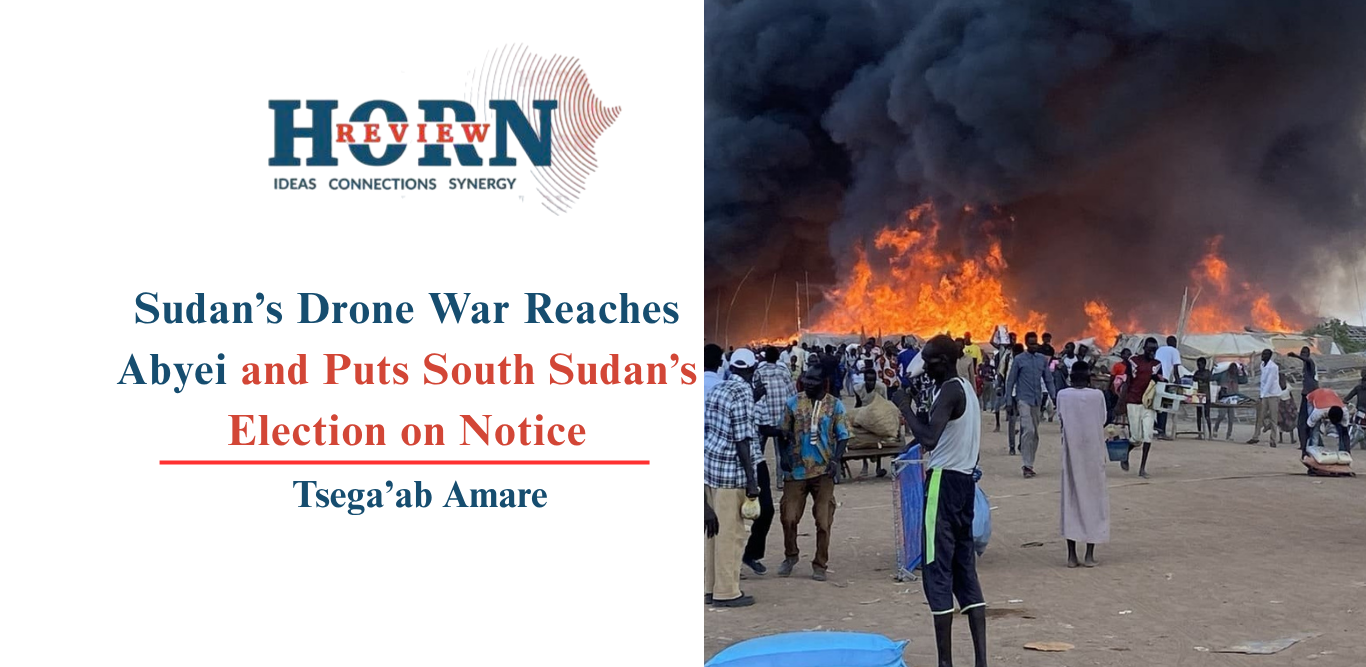
The drone strike on the Amiet market inside the disputed Abyei region marks a clear escalation in Sudan’s war. The Sudanese Armed Forces and the Rapid Support Forces increasingly fight over supply lines as much as over cities. The attack followed the strike on the Al-Dabab funeral convoy and market in West Kordofan, which reportedly killed about 150 people, and repeated hits on Nyala. Combined, recent incidents have left an estimated 250 to 300 dead. The pattern across these strikes indicates a deliberate turn toward mass-casualty drone operations against logistics nodes that double as civilian spaces.
Interdiction of RSF fuel and supply lines has become a central SAF operational priority. The logic is straightforward. The RSF depends on fuel to hold distant fronts in Darfur and Kordofan and to sustain urban operations; cutting the flow degrades its mobility more cheaply than any ground offensive. Amiet market sits on a known cross-border trading route. Diplomatic and conflict sources told Reuters that its fuel depot had previously supplied RSF forces, and local sources cited by Radio Tamazuj said the RSF bought fuel there. An anonymous SAF officer reportedly claimed the target was tankers arriving from South Sudan bound for the paramilitary. Whether those tankers were military-bound remains unverified. Yet a daytime strike on a commercial market shows that SAF treats dual-use civilian infrastructure as a legitimate target when the military payoff is high. That calculation reflects attrition logic in a war of exhaustion, where accepting political cost and civilian deaths is preferable to letting the enemy refuel.
The technology and doctrine behind such strikes have matured on both sides. Hitting a specific fuel section of a market roughly ten kilometers from Abyei town, and generating secondary fires that multiplied casualties, suggests improved targeting intelligence drawn from informants, signals or aerial surveillance, along with a higher tolerance for civilian harm. Reciprocal drone activity in the same week, with the RSF and its allies launching drone strikes against SAF positions and civilian areas in Khartoum, Tendelti, and Blue Nile State, points to an escalation spiral in which markets, and displacement sites become routine targets. The distinction and proportionality rules of international humanitarian law are eroding in practice. Both parties invoke the claim that they do not target civilians as a rhetorical shield while observing no operational constraint that matches it.
The strike also externalizes the war. Abyei is jointly administered oil-rich region that is claimed by both Khartoum and Juba. A strike there tests South Sudan’s red lines while signaling to regional actors that the SAF will pursue RSF logistics wherever they run. The accusation that the tankers originated in South Sudan serves a political purpose even if it remains unproven. It frames Juba as a passive or active enabler of the RSF, complicates its self-image as a neutral party, and may deter informal cross-border trade that benefits the paramilitary. Khartoum can absorb the risk of angering Juba because South Sudan’s oil exports still transit Sudanese territory and its fiscal position remains fragile. Juba summoned the Sudanese ambassador, yet that leverage is thin.
The consequences for South Sudan’s electoral timetable are immediate. The general election scheduled for 22 December 2026, the first since independence, falls nine weeks after this strike. The National Elections Commission has placed Abyei within the 102 constituencies, including the Abyei Administrative Area in the Warrap State allocation. Recent high-level meetings under President Salva Kiir sought to resolve the Twic–Abyei boundary dispute affecting Constituency No. 1. Voter registration has not begun nationally. Civic education, security arrangements under the 2018 peace agreement, and funding all remain incomplete. Riek Machar remains under house arrest facing treason charges, and SPLM-IO elements continue localized fighting and have threatened registration efforts in areas they influence.
Abyei now poses a practical problem that no timetable can resolve. Election officials would have to register voters, deploy staff and secure polling stations in a territory that has just absorbed about 8,000 newly displaced people, sit under active drone threat, and relies on the UN Interim Security Force for Abyei for baseline stability. Proceeding invites low turnout, contested results or violence. Excluding the area invites accusations that the vote is not national. Both options strengthen the argument that the election is being rushed under incomplete conditions to produce a government with a formal mandate.
South Sudan depends on oil exports that cross Sudan; past pipeline disruptions removed the bulk of state revenue and left salaries unpaid, magnifying the effect of the structural weakness it possesses. That fiscal dependence is a structural constraint on Juba’s foreign policy: any robust response risks the same revenue stream that must fund the election. Inflows of refugees and returnees from Sudan, numbering in the hundreds of thousands, further complicate any credible voter roll.
Two readings of the strike are now competing. One holds that insecurity is outrunning state capacity and that holding elections under these conditions risks further fragmentation. The other, favored by the government and by the 39 parties that have publicly endorsed the 22 December date, holds that instability is the reason to finish the transition quickly and secure a popular mandate that can then address succession and security deficits. The Abyei attack does not settle the dispute, but it sharpens the dilemma. A vote that cannot safely include one of the most symbolically charged territories in the region will struggle to claim full national legitimacy, while further delay risks the drift into crisis that the government says it wants to avoid.
The Amiet strike therefore operates on two levels. Tactically, it advances an intensifying logistics war in which drones reach secondary and tertiary spaces, including disputed border zones, and in which no rear area is safe if it plausibly sustains the RSF. Strategically, it forces Juba to decide whether its electoral calendar can absorb the reality that Sudan’s war now operates inside South Sudan’s contested territory, or whether the calendar itself becomes another casualty.
By Tsega’ab Amare, Researcher, Horn Review