The island of Zuqar sits in the southern Red Sea, less than twenty miles from the Eritrean coast and roughly sixty miles from the Bab el-Mandeb strait. It is volcanic, rugged, and sparsely populated. For most of the past three decades, it has been a footnote in regional diplomacy and a symbol of the unresolved border dispute between Yemen and Eritrea. That is no longer the case. With Houthi forces now in control of Zuqar and the surrounding Hanish archipelago, the significance of the island has shifted. The question is not simply about the seizure of territory. If the Houthis consolidate their position in this strategic area, there is a strong possibility that the island could return to a role it has played before as a smuggling hub, a tactical staging ground, and a strategic chokepoint from which the flow of weapons and the movement of ships can be controlled. It could also become a point of friction with Eritrea, a former ally with a contested history over the Hanish Islands and Jabal Zuqar.
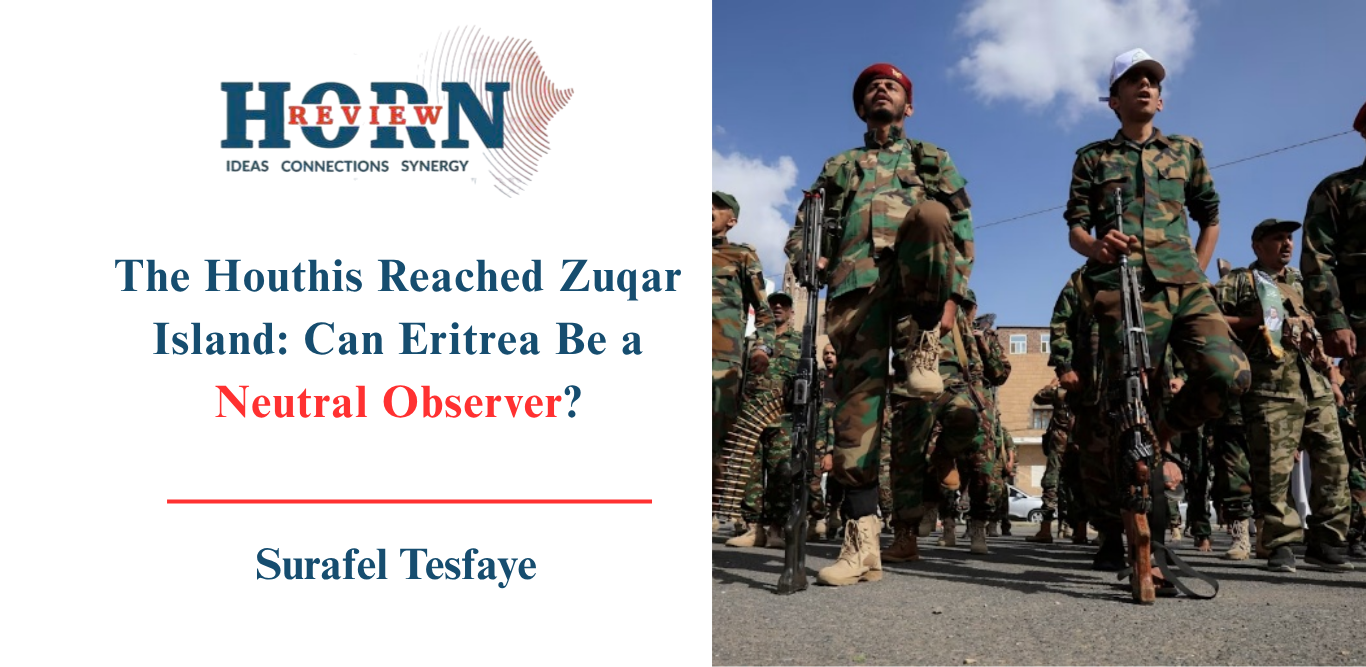
The Houthi capture of Zuqar is not merely a military gain in Yemen’s civil war. It represents a significant shift in the balance of power across the Red Sea, with implications for global shipping, regional security, and the fragile alliances that have sought to contain Houthi expansion. The island’s volcanic peaks, which the Yemeni government and the Saudi-led coalition once used to monitor and intercept Iranian weapons shipments, now serve the opposite purpose. They provide the Houthis with a platform to protect incoming arms from Iran, track international vessels, and project power across one of the world’s most important maritime corridors.
To understand why Zuqar matters, it is worth recalling that the island has served this function before. During Eritrea’s long armed struggle for secession from Ethiopia, rebel groups including the Eritrean Liberation Front and later the Eritrean People’s Liberation Front used Zuqar and the Hanish Islands as naval hideouts. The island’s rugged topography provided cover for weapons caches, fuel storage, and fighters. From these bases, the rebels launched maritime attacks against Ethiopian military logistics and slipped fighters onto the Eritrean mainland near Assab and Massawa. Arab League states including Egypt, Syria, Iraq, and Libya backed these operations, viewing the Red Sea as an Arab domain and seeking to weaken the Ethiopian government. Yemen, both north and south, provided diplomatic support, sanctuary, and transit rights for weapons flowing through Yemeni waters and islands.
Once Eritrea achieved secession in 1993, the strategic partnership that had held the Eritrean-Yemeni relationship together disappeared. Both states claimed the islands based on competing colonial and historical claims, and in 1995, the dispute erupted into open conflict when Eritrean forces attacked Yemeni positions on Greater Hanish. The fighting lasted three days and left eighteen dead and over two hundred captured. The Permanent Court of Arbitration in London eventually awarded Yemen sovereignty over the islands in 1998. The ruling settled the legal question, but it did not diminish the archipelago’s strategic value. For nearly two decades, the islands remained largely quiet. That quiet ended when Yemen’s civil war turned the Red Sea into a contested arena.
The current situation reverses the dynamic that prevailed from late 2015, when the internationally recognized opp. For years, the island served as a fortified anti-smuggling interception base. The coalition used its radar platforms to monitor shipping lanes and block Iranian dhows from transferring missile components and drone parts to smaller vessels bound for Houthi ports. Now that the Houthis have recaptured Zuqar and the entire Red Sea coastline, the same platforms and vantage points serve the opposite purpose. The Houthis can track international vessels, secure their own supply lines, and spot naval blockades attempting to prevent weapons from reaching their mainland strongholds.
The implications extend beyond arms smuggling. A Houthi-controlled Zuqar gives the group a two-way corridor. It can receive advanced precision and ballistic weapon components from Iran while using the island as a safe harbor to smuggle weapons outward to allied conflict zones deep into the Horn of Africa or parts of Sudan. The island’s proximity to the Bab el-Mandeb, which connects the Red Sea to the Gulf of Aden, makes it a strategic link between the Indian Ocean and the Mediterranean via the Suez Canal. In Houthi hands, it becomes a choke point that can be leveraged against international shipping.
For Eritrea, the Houthi consolidation on Zuqar presents an acute security dilemma. Asmara has long insisted that Red Sea security must be managed by littoral states and has rejected foreign military fleets or Western bases on its territory. But if the United States or a coalition of regional powers scales up direct military action to break the Houthi blockade, Eritrea’s preference for neutrality will become impossible to maintain. The country’s 1,000-kilometer coastline, including the strategic ports of Assab and Massawa, would be a critical asset in any naval campaign. Washington has already initiated diplomatic shifts to ease sanctions on Asmara in exchange for access to its coastline to counter Iranian influence. In a hot war, that pressure would intensify.
Eritrea’s neutrality would also be tested by the Houthis themselves. The group has already built covert smuggling and intelligence networks within marginalized cross-border communities such as the Afar rebel groups and al-Shabaab along the East African coast. For Eritrea’s highly centralized government under President Isaias Afwerki, any Iran-backed group attempting to arm or radicalize domestic populations is treated as an existential internal security threat. The Houthis have shown a willingness to exploit such communities, and Eritrea cannot remain passive toward a group actively subverting its internal stability.
The spillover risk is equally serious. If the Houthis deploy anti-ship missiles and air-defense systems on Zuqar, any airstrikes targeting those batteries will inevitably bleed into Eritrean airspace and territorial waters. Missile crossfire and naval skirmishes would shatter Eritrea’s neutrality by geography alone. The Red Sea has become the central geopolitical flashpoint of international trade, and Eritrea will ultimately have to choose between accepting Western and Saudi integration to protect its borders or risking its coastline becoming an active war zone dominated by Iranian proxies.
This is why the broader regional alliance that Saudi Arabia has sought to build, the Red Sea Littoral States Alliance, rests on a fragile assumption of shared collective security interests. That assumption miscalculates the transactional foreign policy of key actors, most notably Eritrea. When Asmara joined the Saudi-led coalition in 2015, its participation was never driven by regional altruism or permanent ideological opposition to the Houthis. President Afwerki engaged in a calculated geopolitical gamble aimed at breaking Eritrea’s international isolation and securing relief from Western sanctions. At that moment, the strategic interests of the Gulf Cooperation Council aligned perfectly with Eritrea’s domestic survival imperatives. Further Sudan was at peace and actively contributing forces to the anti-Houthi campaign. That era is gone.
Today, Sudan is torn apart by civil war, and the old regional alignments have shattered. Eritrea’s alignment will be guided strictly by cost-benefit analysis. Asmara will not absorb the immense security risks of confronting a consolidated Houthi presence on Zuqar out of loyalty to a diplomatic bloc. It will only participate in an anti-Houthi coalition if it can extract tangible concessions such as direct financial subsidies, guaranteed energy security, or robust military hardware. In the absence of substantial external incentives, Eritrea will decouple from the alliance and pivot to armed neutrality.
If protecting its coastline requires cutting back-channel deals with the Houthi-Iranian axis, Asmara will choose that path over a costly, uncompensated military confrontation. The Red Sea Littoral States Alliance is not a monolithic defense pact. It is a fragile convergence of convenience that will fracture along the lines of narrow national self-preservation.
What makes the current crisis more dangerous than previous disruptions in the Persian Gulf is the absence of viable alternatives. When the Strait of Hormuz was closed during past conflicts, Saudi Arabia could rely on the Red Sea as a safety valve, ramping up its East-West pipeline to pump oil away from the Persian Gulf and out of the Red Sea port of Yanbu. That alternative has now been compromised. Precautionary shutdowns of the East-West pipeline occur following drone attacks, and the Houthis hold the southern exit of the Red Sea. The only remaining alternative is circumnavigating the African continent via the Cape of Good Hope, which adds up to four weeks of transit time and exponentially drives up freight costs, insurance rates, and consumer inflation globally.
The claim that this is a bilateral conflict between the Houthis and Saudi Arabia does not hold. Saudi Arabia accounts for approximately sixty-six percent of the cargo flowing through the Bab el-Mandeb, and the vast majority of its crude exports are destined for Asian markets such as China, India, Japan, and South Korea. When the Houthis declare a maritime embargo or launch missiles at tankers, they are choking off the lifeblood of global industry. A full blockade removes roughly four percent of the global oil supply from the market, causing energy costs to spike worldwide. The Littoral countries that found on the red sea basin most of them lack the capability to stop them. The Houthis do not operate a traditional navy that can be defeated in a standard sea battle. They operate a highly effective asymmetrical arsenal of anti-ship ballistic missiles, one-way attack drones, and remote-controlled explosive boats. Nations like Eritrea, Djibouti, Sudan, and Somalia have coast guards and small navies tailored for anti-piracy, not for defending against advanced Iranian-supplied ballistic missile systems.
By gaining a foothold on Zuqar and dominating the Bab el-Mandeb chokepoint, the Houthis have effectively achieved a dual-lock on global energy. With the Strait of Hormuz closed and the Red Sea corridor under a Houthi maritime embargo, the international community faces a crisis that transcends regional politics. For Eritrea, neutrality is no longer a viable option. Geography has made that choice for Asmara. A neutral observer cannot exist on a coastline that sits within missile range of a Houthi-controlled island. The only remaining question is whether Eritrea will choose to become a participant in a broader regional security framework or a target of one. Asmara has always been a calculating actor on the Red Sea stage, and the current moment will test whether that calculation leads to cooperation or isolation.
Surafel Tesfaye, Researcher, Horn Review
Untuk informasi lebih lanjut tentang toto slot online, Anda dapat merujuk pada Slot Toto Online