
Egypt’s Geopolitical Paradox on the Nile: Selective Partnerships as a Strategy of Containment
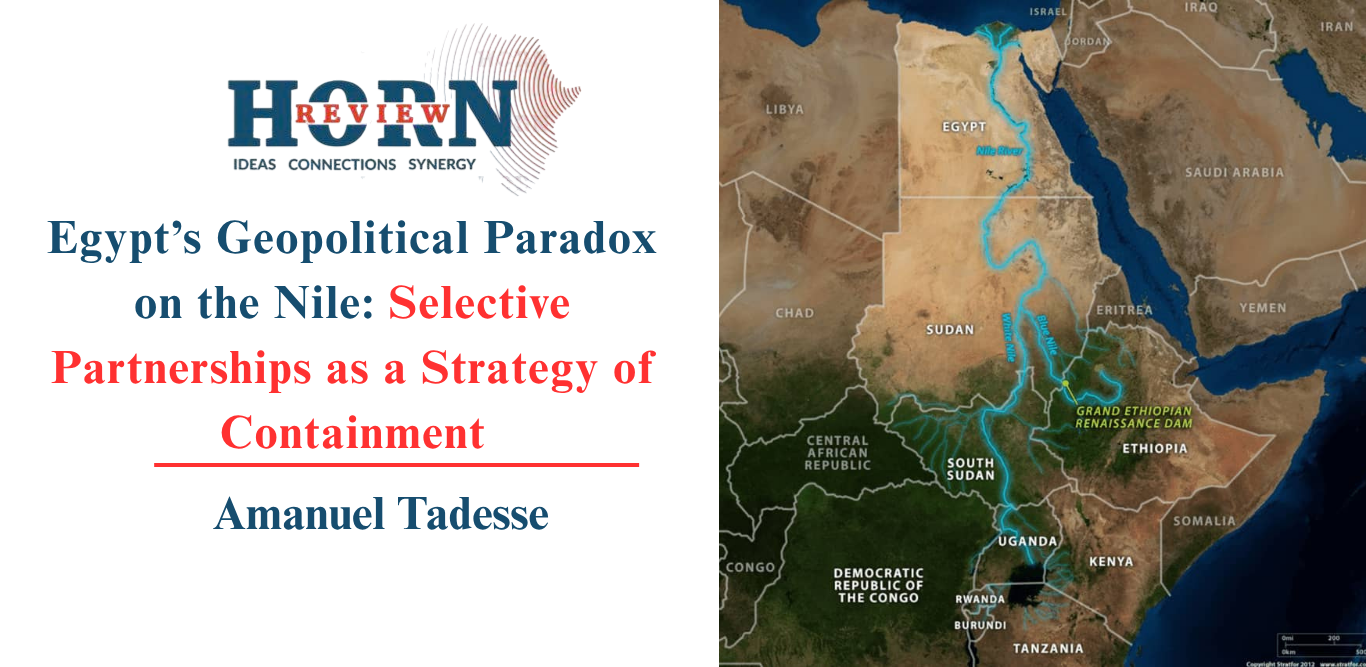
Egypt’s response to Ethiopia’s development and utilization of the Nile has increasingly moved beyond the technical and legal dispute surrounding the Grand Ethiopian Renaissance Dam (GERD). Under President Abdel Fattah el-Sisi’s, Cairo’s strategy has expanded into a combination of diplomatic lobbying, political outreach, media messaging, development partnerships, multilateral engagement, and strategic efforts to mobilize international support for conception of Nile water security.
Egyptian officials and political actors have repeatedly characterized the Nile as an existential matter of national security. Ethiopia, for its part, has consistently maintained that the GERD is essentially a development project intended to generate electricity, promote economic transformation, and contribute to regional energy integration. Addis Ababa has also maintained that the dam is not designed to cause significant harm to downstream states and has repeatedly expressed its preference for cooperation and negotiated arrangements concerning the use of the Nile.
There is nothing inherently unusual about a state using diplomacy to defend its vital national interests, and Egypt is no exception in this regard. Every sovereign state is entitled to pursue its legitimate interests through international engagement. The more pressing question, however, is whether Egypt’s growing activities along the Nile Basin are part of a deliberate strategy to constrain Ethiopia’s diplomatic leverage, regional standing, and development options. It is therefore crucial here to look at Egyptian current Nile diplomacy through the lens of geopolitical containment.
Conceptually speaking, a strategy of containment aims to prevent a target state, in this case, Ethiopia from translating its growing economic, geographic, or political capabilities into greater regional influence. Egypt has deployed this strategy through diplomatic, economic, institutional, and normative means. In the Nile context, Cairo’s strategy manifests as: internationalizing the GERD dispute, framing Ethiopia’s development projects strictly through a security lens, mobilizing support from major global powers, and strengthening political and security partnerships across the Red Sea and the Horn of Africa. This shifting environment warrants a closer probe into Cairo’s strategy and the ways in which it seeks to shape regional narratives and maneuver geopolitically.
Water Securitization and the Preservation of the Status Quo
One of the most misconception of Egypt’s current Nile Diplomacy is the securitization of water. Officials in Cairo and their media affiliates consistently frame the GERD in their rhetoric as an existential threat to Egypt’s national security, elevating transboundary water management into a matter of national survival. This strategy reflects a classic playbook of water securitization through which domestic political and economic anxieties are externalized. Once an issue is constructed as existential, compromise becomes politically more difficult, and alternative interpretations of the disputes are easily portrayed as threats to national security. Water securitization has also a domestic political end. Egyptian political elites employ this narrative to consolidate domestic public support and divert attention from internal economic strains and governance challenges.
The underlying objective of Cairo’s diplomatic gestures is to preserve the geopolitical status quo in Nile water governance, protect historically entrenched downstream privileges, and delegitimize Ethiopia’s sovereign right to utilize its transboundary water resources. Egyptian narratives have increasingly portrayed Ethiopia’s water infrastructure projects as unilateral measures that allegedly contravene accepted principles of International water law.
From the perspective of international water law, however, such characterizations represent a significant departure from established legal precedent. From Ethiopia’s standpoint, the central issue is whether historical patterns of water use can operate as a permanent constraint on the development of an upstream state whose populations and energy needs are growing rapidly. International water law does not grant a downstream state an absolute veto over the development of transboundary water resources by an upstream state. Ethiopia’s development efforts are properly pursued under the principle of equitable and reasonable utilization, as enshrined in Article 4 of the Agreement on the Nile River Basin Cooperative Framework.
The Geopolitical Paradox: Egypt’s Selective Partnerships in Africa
This geopolitical maneuvering extends far beyond the Nile Basin. Cairo’s diplomatic engagements across Africa appear designed to limit Ethiopia’s regional influence and strategic role in both the Red Sea and the Horn of Africa.
A clear instance of this dynamic is Egypt’s involvement via a consortium comprising Arab Contractors and Elsewedy Electric in Tanzania’s Julius Nyerere Hydropower Plant Project on the Rufiji River located at the Stiegler’s George site in the Selous Game Reserve. Formally inaugurated on August 22, 2026, with an installed capacity of 2,115 MW and a reservoir capacity exceeding 30 billion cubic meters, the project plays a vital role in increasing regional power connectivity across East Africa.
Beyond its engineering footprint, Cairo’s participation reveals a clear effort to project influence across the broader continent and reshape regional narratives on transboundary water cooperation. Cairo frames its involvement in Dar es Salaam project as evidence of its commitment to supporting African development and fostering cooperation between upstream and downstream states.
Politically speaking, Egypt’s participation in the Nyerere Dam project is an attempt to counter growing criticism that its strategy to Nile politics is purely defensive and aimed at curbing upstream growth. By championing a flagship energy project in an upstream African nation, Egypt seeks to rebrand itself as a constructive development partner. However, a stark geopolitical paradox occurs when Cairo’s involvement in Tanzania is contrasted with its aggressive stance toward Ethiopia.
“If Egypt genuinely embraces the principle that African countries ought to cooperate on water infrastructure and that hydropower serves shared regional interests, there is no logical vindication for treating Ethiopia’s development of its own water resources as an existential threat.”
Why is Cairo eager to finance and construct hydropower infrastructure in one upstream country while persistently framing Ethiopia’s energy projects as national security risks? Rather than advancing genuine, basin-wide cooperation grounded in equitable and reasonable utilization, Egypt appears to be using selective partnerships to shift regional balances and marginalize Ethiopia’s development agenda. In this sense, the Nyerere project serves not only as an infrastructure milestone, but also as a strategic instrument designed to shape a narrative that isolates Addis Ababa.
Genuine cooperation cannot be selective; it must apply equally to Tanzania, Ethiopia, and every other Nile Basin state. Sustainable diplomacy cannot be built on the premise that certain upstream countries are permitted to harness their water resources while Ethiopia is forced to accept restrictions on its own growth. Ethiopia’s position must remain clear and uncompromising: the Nile is a shared basin, and economic development cannot be treated as a privileged right for some and a security threat when pursued by others. The future of the Nile Basin should be anchored in equal partnership, equitable utilization, mutual benefit, and total respect for the legitimate development aspirations of all basin states.
Normative Power and the Internationalization of the Nile Question
Egypt continually competes for normative power using diplomacy to internationalize the Nile question. Cairo’s recent diplomatic engagement with Beijing provides a clear illustration. On September 1, 2026, China’s President Xi Jinping travelled to Cairo for an official state visit, marking the 70th anniversary of diplomatic ties between the two nations and advancing the 2014 Comprehensive Strategic Partnership Agreement. This diplomatic outreach culminated in the Egypt’s-China Joint Communique on Deepening of the Comprehensive Strategic Partnership, issued on September 2, 2026.
Paragraph 3 of the communiqué touches directly on the Nile in a manner that challenges Ethiopian national interests. In it, China reaffirmed its understanding of “the vital importance of the Nile River as Egypt’s primary lifeline, recognizing Egypt’s legitimate right to protect its water and food security and its developmental interest,” while both sides called on all Nile Basin states to “adhere to international law, including the obligation not to cause harm”.
In practice, Cairo leverages its diplomatic ties to secure foreign alignment, using bilateral forums to advance its downstream water interests while attempting to marginalize upper riparian states. China’s inclusion of this language reflects its strategic intent to maintain a strong footprint in Egypt and balance U.S. influence in the region. When major powers incorporate one party’s preferred terminology into bilateral communiques, that terminology acquires greater international visibility and normative weight.
While Beijing likely acted to advance its bilateral ties with Cairo rather than to intentionally undermine Ethiopia, these explicit statements mark a departure from China’s traditional policy of strict non-interreference in regional disputes. By echoing Cairo’s talking points on the Nile and Red Sea governance, Beijing creates the perception that it is offering diplomatic backing to Egypt at the expense of Ethiopia’s legitimate rights. This shift is particularly striking given Beijing’s strategic partnership with Ethiopia and its substantial economic footprint across the Horn of Africa.
Nevertheless, the physical reality of the GERD remains a source of leverage that secures Ethiopia’s national interests on the ground regardless of diplomatic efforts to isolate Addis Ababa. Still, Ethiopia must become more proactive in shaping the language on the Nile rather than reacting after other states have established the narrative. Rather than demanding that external powers take its side, Ethiopia should insist that any international discussion of Nile governance reflect the full body of international water law, including equitable and reasonable utilization alongside the legitimate development needs of all riparian states.
The Political Maneuvering in the Red Sea vs. the Nile
Ethiopia maintains that the two major bodies of waters, the Nile and Red Sea are deeply intertwined. This connections stems from Ethiopia’s landlocked status, its need for secure access to the sea, Egypt’s position along the Suez Canal and Red Sea, and the reality that developments in one area inevitably impact the other.
Egypt’s strategy of countering Ethiopian influence in the Red Sea has also reflected in the joint communiqué with China. Regarding Red Sea security, Paragraph 16 stressed that “the governance and security of the Red Sea are primarily the responsibility of the littoral states.” This assertion reinforces competing interpretations of regional order. While Egypt uses this principle to reinforces the exclusive role of coastal nations, it raises a critical strategic question for Ethiopia: Should landlocked states whose access is denied by conspiracy and whose vital economic, security, and trade interests depend heavily on Red Sea access be excluded from regional governance arrangements?
To counter Cairo’s restrictive approach and persuade long-standing partners like China, Ethiopia must advocate for an inclusive regional governance framework on the Red Sea. Under this model, landlocked states with substantial economic and security stakes in the Red Sea are granted an appropriate voice in regional arrangements, preventing the Red Sea from becoming another arena where Ethiopia’s strategic role is progressively narrowed.
Drought, Desertification, and the Emerging Normative Battlefield
Ethiopia must also closely monitor Egypt’s engagement in international environmental institutions, climate summits, and water forums.
In another notable instance of multilateral outreach, Egyptian Minister of Water Resources and Irrigation, Professor Hani Swilam, participated in the 17th Session of the Conference of the Parties to the United Nations Convention to Combat Desertification (UNCCD COP17), held in Ulaanbaatar, Mongolia, from August 17 to 28, 2026, under the theme “Restoring Land, Restoring Hope.” In his address, Minister Hani framed land degradation, desertification, and drought not merely as environmental challenges, but as issues with directly impacting food and water security.
Of particular relevance to Ethiopia, Cairo sought to establish a tight link between drought governance and transboundary water management, arguing that shared water resources must be governed under international law to prevent significant downstream harm. This strategy shows Egypt’s attempt to align Nile governance with the broader international climate agenda.
Furthermore, Egyptian delegates emphasized the predominance of rainfall and “green water” (soil moisture) over “blue water” (rivers and lakes), in upper basin countries, suggesting that upstream states should rely primarily on rain-fed agriculture and rangeland development. While presented as an environmental proposition, this framing carries heavy geopolitical implications: it implicitly prescribes how upstream states should pursue agricultural development while placing normative emphasis on protecting downstream river flows.
For Ethiopia, this tactic warrants close monitoring. Environmental and drought-related governance platforms could gradually become new normative avenues used to restrict transboundary river utilization. While drought resilience is a legitimate global concern, its institutionalization must not result in frameworks that disproportionately burden upstream countries.
Looking forward, Egypt’s selection to host UNCCD COP18 in 2028 will provide Cairo with a prominent diplomatic platform to shape global policies on drought governance. The potential development of binding international drought instruments could directly or indirectly impact transboundary river rights. Ethiopia must engage proactively in these emerging forums to ensure that new international norms on drought governance remain firmly with principles of equitable utilization, sovereign equality, and sustainable development.
Strategic Paths for Ethiopia to Respond to Egypt’s Current Diplomatic Gestures
Based on the above discussion, which reviews Egypt’s geopolitical containment strategies against Ethiopia, the following recommendations are outlined to counter such geopolitical moves:
First, Ethiopia must frame all transboundary water utilization based on the principle of equitable and reasonable utilization, as codified in the CFA, rather than engaging solely with Cairo’s zero-sum security framing. To reinforce this position, Addis Ababa should host dedicated regional forums highlighting energy integration, cross-border power grids, and climate adaptation benefits generated by upstream infrastructure.
Second, Addis Ababa must champion a diplomatic coalition within the Horn of Africa and regional bodies like IGAD and the AU to advocate for inclusive Red Sea governance frameworks that explicitly integrate landlocked nations whose trade and security depend on maritime access. Building strong maritime security and logistics partnerships across Red Sea littoral states would emphasize shared regional economic stability over exclusive coastal regimes.
Third, Ethiopia must directly engage strategic partners, such as Beijing, to demonstrate how hydropower development in Ethiopia creates positive externalities that benefit all riparian states and promotes transboundary water cooperation.
Fourth, to counter downstream attempts to limit river extraction, Ethiopia must actively define green water and soil-moisture usage in international environmental summits as complementary to, not replacements for, blue water infrastructure. Furthermore, Ethiopia needs to form a basin-wide coalition and developing nations within the AU framework leading into UNCCD COP18 in Cairo to ensure emerging international drought governance tools protect all riparian development rights without creating asymmetric legal burdens.
By Amanuel Tadesse, International Law and Foreign Relations Expert, Horn Review

RELATED
Posts

4
Oct
Eritrea's Buffer is Collapsing: What Comes Next?
Ethiopian National Defense Force’s capture of Mekelle, if sustained, may...
4
Oct
Hassan Sheikh’s Sea Access Remarks: The Ankara Formula Restated, Not a Concession
President Hassan Sheikh Mohamud’s remarks on 3 October 2026 that...
4
Oct
Egyptian Airpower and the GERD: From Strike Capability to Strategic Limits
The Grand Ethiopian Renaissance Dam is within the theoretical reach...
4
Oct
Is Washington Miscalculating on Eritrea?
The United States is attempting a precarious balancing act in...
3
Oct
How Should Saudi Arabia Approach the Conflict in Northern Ethiopia?
Saudi Arabia’s position toward the renewed conflict in northern Ethiopia...

2
Oct
The possibility of Sudan’s War Converging with Ethiopia’s Renewed Conflict
Ethiopia’s renewed conflict has changed the security significance of its...
2
Oct
Egypt’s Denial of Intervention in Ethiopia Does Not Survive Scrutiny
Egypt’s Foreign Ministry has answered Ethiopian charges of external...


2
Oct
Why the Ethiopian Prime Minister and Sudanese Armed Forces Commander Must Meet
A direct meeting between Ethiopian Prime Minister Abiy Ahmed and...
30
Sep
Eritrea's Diaspora Opposition and the Politics of the Coming Transition
Something is changing in Eritrean opposition politics, but it is...