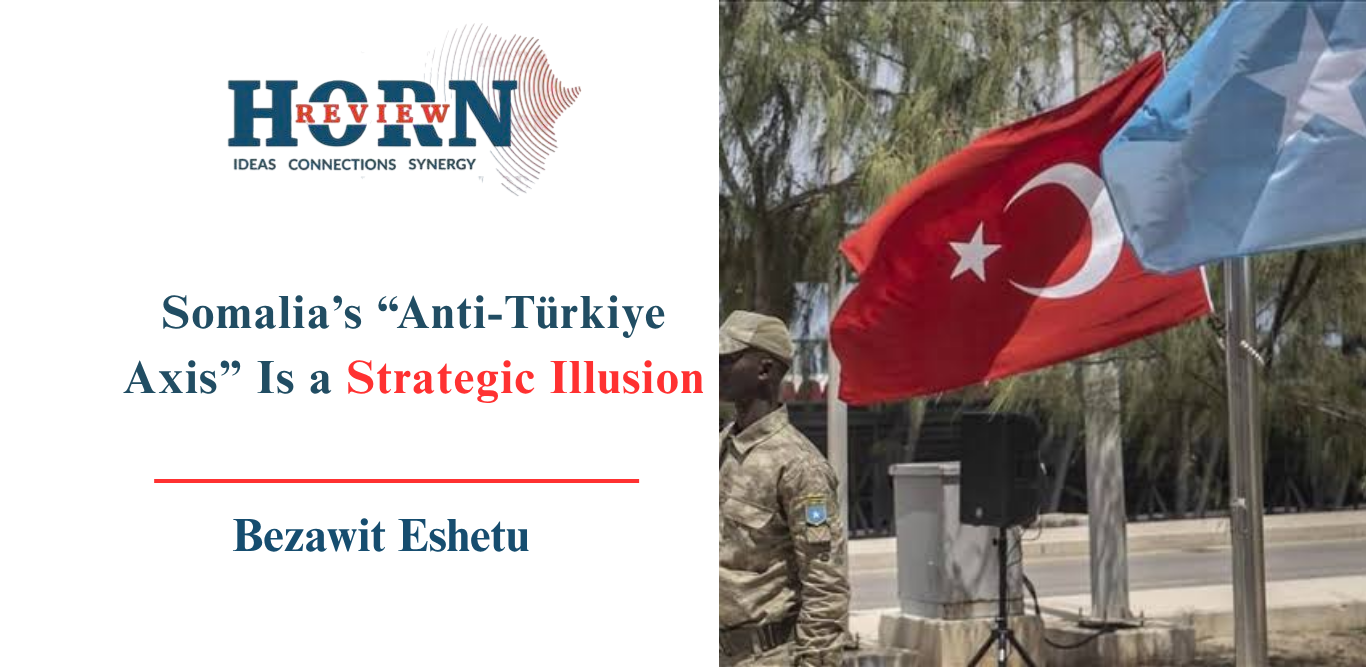
The Red Sea Axis article, “Why Somalia’s Military Rise Sparked an Anti-Türkiye Axis,” correctly identifies a major shift in Somalia’s security environment, but it assigns that shift too much coherence. Ethiopia, the United Arab Emirates, Israel, and Kenya are presented as components of a common response to Türkiye’s expanding role in Somalia. The stronger explanation is that Türkiye’s rise has intersected with several pre-existing rivalries, border-security concerns, maritime interests, and geopolitical calculations, producing parallel forms of resistance without requiring a coordinated anti-Türkiye axis. The key question, therefore, is not why these states have aligned against Ankara but why Somalia’s changing military and political balance has given each of them greater incentive to protect its own interests.
Türkiye’s expanding military assistance to the Somali National Army has shifted the internal balance of coercive power in Mogadishu’s favor. By strengthening the federal government’s ability to project force, Ankara has raised the costs of open defiance by federal member states and given President Hassan Sheikh Mohamud greater leverage in contests over political authority. That leverage was exercised in early March when Parliament extended presidential and parliamentary terms from four years to five and postponed elections from May 2026 to 2027. The president signed the amendments almost immediately. Opposition figures, including former prime minister Mohamed Hussein Roble and the Somali Future Council, denounced the process as illegitimate; Puntland and Jubaland responded by suspending recognition of federal institutions.
Yet that shift does not erase the independent strategic logic of the states responding to it. The UAE’s position around Berbera and Bosaso is rooted in a commercial and maritime-security network that spans the Red Sea and Gulf of Aden. DP World’s investment in Berbera, estimated at roughly four hundred to 442 million dollars since the concession began in 2017, predates Somalia’s current military buildup and forms part of a wider portfolio that includes Djibouti and other regional assets. Abu Dhabi therefore has longstanding reasons to preserve its maritime access and commercial influence irrespective of Ankara’s presence in Mogadishu.
Kenya’s calculations are similarly anchored in geography. Its relationship with Jubaland reflects the need to contain al-Shabaab spillover into its northern counties and manage cross-border kinship networks that predate the Somali federal state. Nairobi’s engagement with Jubaland consequently reflects a frontier-security strategy shaped by local political realities. Its simultaneous cooperation with Türkiye also complicates the notion of an ideological anti-Turkish alignment. The Kenyan government that hosts Jubaland’s opposition figures extradited FETÖ-linked individuals to Türkiye within a day of their arrest in October 2024, demonstrating that its relationship with Ankara remains capable of pragmatic cooperation where Kenyan interests require it.
Israel’s position follows another trajectory. Its recognition of Somaliland, described as the first by a United Nations member state, followed a year negotiation tied to Israeli Red Sea security interests and its post-Abraham Accords diplomacy. The decision also triggered condemnation at the UN Security Council from states with no direct stake in Turkish-Somali relations, including Russia and members of the Arab Group. Israel’s move therefore fits more naturally into a broader strategy surrounding the Red Sea, Somaliland, and regional connectivity than into a narrowly defined contest with Türkiye.
Ethiopia presents the clearest example of why the regional picture cannot be reduced to Turkish expansion. Landlocked since Eritrean secession in 1993 and reliant on a single primary corridor through Djibouti, Addis Ababa has long-standing incentives to diversify its access to the sea while securing its eastern frontier. Its dispute with Egypt over the Grand Ethiopian Renaissance Dam forms one element of a wider strategic calculus in which relationships with Somaliland and with Somali federal member states along the border serve enduring interests in maritime access, border security, and strategic depth. These priorities predate Ankara’s growing presence in Mogadishu and would persist even if Türkiye’s role diminished substantially.
Those same calculations surface most sharply in South West State and Baidoa. Abdiaziz Hassan Mohamed Laftagareen initially cooperated with Mogadishu’s push to harmonize the federal electoral framework, yet disagreements over South West’s electoral timetable revealed a deeper contest over political authority. Federal forces subsequently entered Baidoa, established control of the city, and contributed to Laftagareen’s resignation and departure to Nairobi. The intervention, however, failed to produce durable political control. His forces later returned to the battlefield and mounted repeated attempts to regain ground, underscoring that possession of the provincial capital did not resolve the underlying struggle. Baidoa thus emerged as a point where Somalia’s internal balance, Ethiopia’s border-security interests, and Egypt’s expanding regional role intersected directly.
The proposed replacement of Ethiopian forces in Baidoa by Egyptian personnel carries particular weight for Addis Ababa. Baidoa sits within Ethiopia’s wider security environment along its frontier; an Egyptian military foothold in Somalia would place a state with competing Nile interests closer to Ethiopia’s eastern flank. Viewed alongside Egypt’s encirclement strategy toward Ethiopia, such a deployment risks heightening strategic pressure on Addis Ababa and constraining its room for maneuver. Ethiopian efforts to retain influence through local authorities, clan structures, and elders therefore reflect a consistent effort to preserve strategic depth. Türkiye’s role may intensify these calculations, but it does not create or explain their underlying logic.
This wider context also changes how claims of externally directed opposition should be assessed. Criticism of the March constitutional amendments came from exiled opposition figures, Hawiye traditional elders who formed a National Salvation bloc in Mogadishu, a former chief of the Custodial Corps, and independent academic commentators. These constituencies have distinct political grievances that cannot automatically be attributed to foreign sponsorship. Foreign-funded information operations are a documented feature of Horn of Africa politics, yet claims about the proportion of inauthentic accounts within a particular campaign depend on the methodology and independence of the source making the assessment. Evidence of information manipulation can therefore coexist with genuine domestic opposition without collapsing the two into a single explanation.
The resulting picture is a regional realignment driven by intersecting interests rather than a unified coalition. Puntland has achieved the clearest local military reversal of federal authority during 2026, South West remains contested despite Mogadishu’s declaration that the issue was settled, and Jubaland’s leadership has endured sustained federal pressure. At the same time, Egypt’s encirclement strategy of Ethiopia and its involvement in Somalia’s security increasingly connects developments in Somalia to the wider strategic competition surrounding the Nile, the Red Sea, and the Horn.
Thus, the most defensible conclusion is that Somalia’s external alignments will continue to reflect the unresolved distribution of political authority inside the federation, while the states engaging Somalia will pursue their own security, maritime, commercial, and geopolitical interests through whichever local relationships best serve them. The result may resemble an anti-Türkiye axis from a distance, but the underlying structure is a set of overlapping strategic responses and not a single coordinated front.
Bezawit Eshetu, Researcher, Horn Review