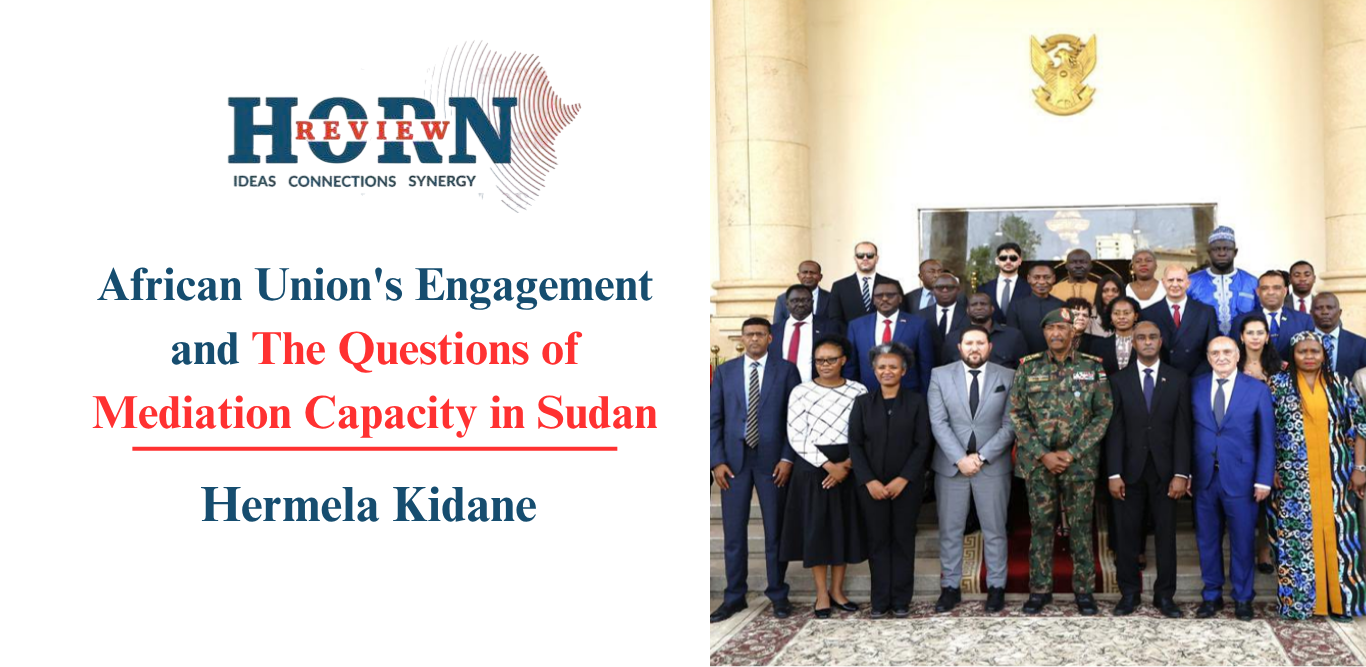
The visit of the African Union Peace and Security Council delegation to Sudan in August is a moment in the continental organization’s handling of the Sudanese conflict. Led by Ambassador Mohamed Khaled who is Algeria’s Permanent Representative to the African Union and Chairperson of the Council for August the delegation met General Abdel Fattah al Burhan. In public statements the Council reaffirmed its commitment to Sudan’s sovereignty, territorial integrity and national unity condemned external interference that fuels the conflict and explicitly rejected any attempts to establish parallel entities or governments that could undermine those principles. It further welcomed the government’s return to functioning from the capital as a step toward restoring state institutions. At the same time the Council reiterated the necessity of inclusive political dialogue and national reconciliation as the pathway to a durable settlement.
These positions while consistent with core principles in the AU’s Constitutive Act acquire particular weight in the context of the protracted war between the Sudanese Armed Forces and the Rapid Support Forces. The Rapid Support Forces and allied groups have established the Sudan Founding Alliance commonly referred to as Tasis a parallel administrative and political structure headed by Mohamed Hamdan Dagalo that seeks to govern territories under its control particularly in Darfur and parts of Kordofan.
The AU’s rejection of parallel entities therefore functions as a clear non recognition of Tasis and an affirmation of the Transitional Sovereignty Council as the principal authority with which the organization will engage. Such non recognition aligns with a pattern in which the African Union and many of its member states have long declined to recognize parallel authorities in member states viewing them as threats to territorial integrity and constitutional order. The AU may reasonably view this stance as continuous with its longstanding policy of opposing the fragmentation of member states and unconstitutional changes of government. However the manner and context of its articulation brings up questions about the perception of neutrality even as the organization continues to call for inclusive dialogue.
Egypt has maintained close ties with the Burhan administration over Nile waters. Algeria’s leadership of the current AUPSC rotation as a prominent member of the Arab League has led some observers to note a convergence between the AU’s public messaging and positions advanced by certain Arab states. This alignment risks being interpreted as the continental body reflecting regional priorities rather than maintaining an independent African posture. Historical patterns of AU engagement under previous leadership including the tenure of Commission Chairperson Moussa Faki Mahamat already attracted scrutiny regarding consistency and balance. The present path appears to lean more distinctly toward one set of regional preferences.
Ethiopia has invested substantial diplomatic capital in building the institution as a vehicle for African solutions and the implications are particularly sensitive. A Sudan whose political orientation is perceived as heavily shaped by Egyptian influence could alter the regional balance in the Horn of Africa and complicate already complex negotiations over the Grand Ethiopian Renaissance Dam. The utility of the AU to Ethiopia rests in measure on its capacity to operate above competing external agendas. The current approach risks being viewed in Ethiopia as diminishing the organization’s neutrality and by extension its value as a platform that reliably advances broader continental interests without subordinating them to those of particular regional coalitions.
Effective mediation depends on the confidence of all principal parties. By publicly rejecting the political project associated with one major armed actor while affirming the legitimacy of the other the AU has constrained the space in which it can present itself as an impartial facilitator. Calls for inclusive political dialogue and national reconciliation coexist with statements that appear to predefine the acceptable parameters of inclusion creating an inherent tension that the organization has yet to fully resolve. When the Sudanese authorities themselves urge the AU to support the designation of the Rapid Support Forces as a terrorist organization and reject any equivalence between the national army and the paramilitary force the limited counterbalancing emphasis from the continental body further reinforces perceptions of asymmetry.
Sovereignty arguments cut in more than one direction. The AU rightly insists on non interference and respect for territorial integrity. At the same time the Sudanese people retain the ultimate right to determine their own political arrangements. An insistence that only one configuration of authority is legitimate risks appearing to constrain that right particularly when de facto territorial control and administrative capacity on the ground do not align neatly with formal diplomatic recognition. Historical experience in other African conflicts suggests that refusing political engagement with actors who exercise effective control over territory and populations often prolongs rather than shortens hostilities while reducing the leverage available to external mediators.
The AU’s earlier suspension of Sudan following the 2021 events positioned the organization as a defender of constitutional order. The present engagement framed around the government’s return to Khartoum and steps toward institutional restoration marks an adjustment. Whether this adjustment strengthens or weakens the organization’s normative authority depends on how consistently principles are applied across cases and how carefully the distinction between principled non recognition and operational engagement is maintained. Within the wider Quintet mechanism any perception that the AU has already taken a definitive side may complicate coordination and reduce the collective effectiveness of international efforts.
The visit illustrates the recurring tension between the AU’s dual roles as guardian of sovereignty and as potential honest broker in intra state conflicts. By aligning its public posture so clearly with one party the organization has increased the difficulty of performing the second function effectively. The risk is not only reputational. It is that an institution designed to help African states resolve their differences may find itself less able to contribute meaningfully to ending a conflict that continues to exact an enormous human cost. Sustaining long term credibility as a continental peacemaker requires careful attention to the perceptions of impartiality that underwrite successful mediation.
By Hermela Kidane, Researcher, Horn Review