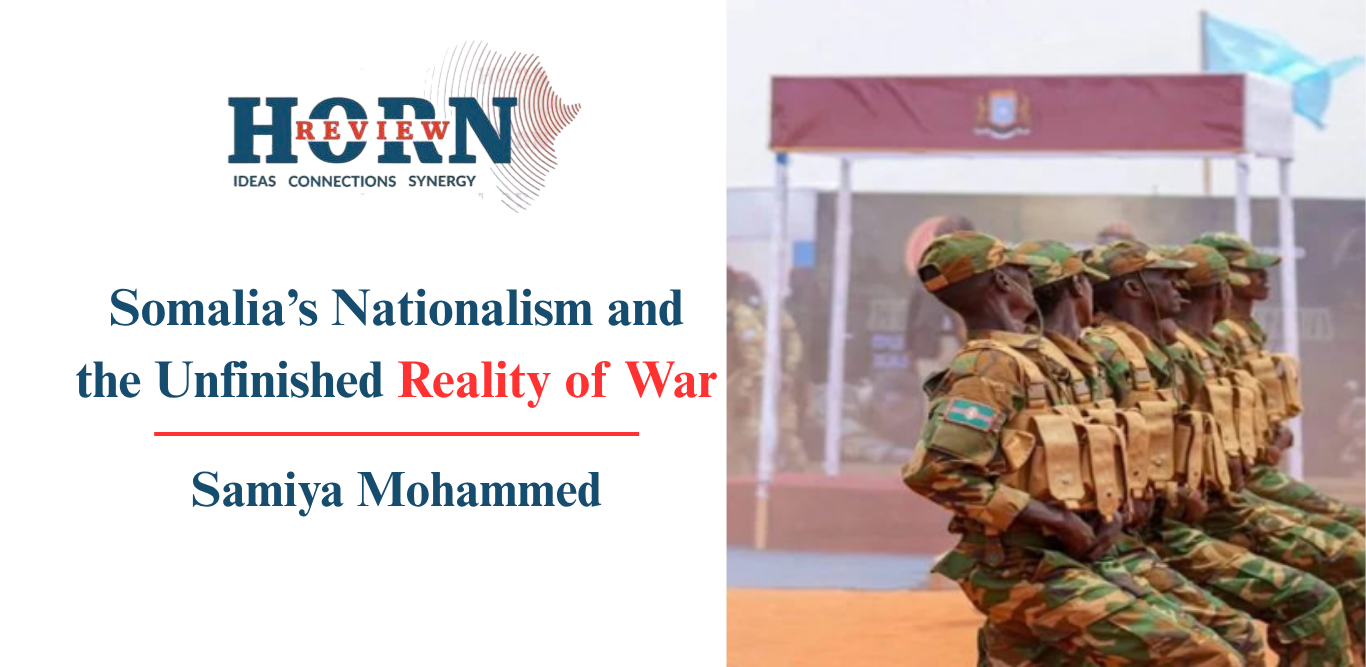
President Hassan Sheikh Mohamud’s supervision of the Somali National Army graduation in Galgaduud is an inflection point in the nation’s sovereignty narrative. The event by a symbolic gesture toward external forces with an offering of flowers and farewell was engineered to project the emergence of a self reliant security apparatus timed to coincide with a Saudi backed training surge. This politics however exists in opposition to the operational deficits that define the contemporary Somali battlefield. The assertion of independence while useful for consolidating domestic legitimacy fails to account for the institutional atrophy and the demonstrated superiority of the Al Shabaab militant network. Symbolism however does not translate into operational capability and the deployment of 3,000 soldiers cannot address the logistical, intelligence and air support gaps that currently constrain Somali military effectiveness. The Somali National Army remains a force in transition critically lacking the command structures, control mechanisms and sustainment infrastructure required to hold recaptured territories against an adaptive insurgency. President Mohamud offers a vision of autonomy but the operational reality remains one of persistent external dependency and asymmetric threat.
Acknowledging the pattern does not necessitate paralysis and it demands a recalibration of expectations and strategy. One approach is to treat this cohort not as a replacement for international forces but as a specialized asset for securing fixed, high value infrastructure such as government districts where the risks of desertion and clan reversion are mitigated by consistent supervision and immediate logistical support. The clear implication of President Mohamud’s remarks is that Somalia is on a path to assume full security responsibility rendering the presence of thousands of African Union peacekeepers obsolete. This is a politically potent message for a domestic audience weary of foreign military presence in a sentiment that is palpable in Mogadishu and across the country. The sight of foreign convoys, the sound of foreign accents in security coordination and the perception of foreign dictate in matters are sources of national irritation.
The President’s narrative exploits nationalist aspirations while simultaneously appealing to international partners anxious to conclude their resource intensive commitments. By projecting operational confidence and declaring transition readiness Somalia leverages its diplomatic position to extract more favorable conditions from donors and the African Union specifically increased financial aid, sustained logistical assistance and an extended withdrawal schedule all while reducing the overt political visibility of those same foreign forces. This diplomatic action is to balance the benefits of external assistance against the domestic costs of foreign occupation. However this politics falters against the operational realities of the insurgency. It devolves into a form of security creating a expectation of military proficiency that the SNA does not currently possess.
To evaluate the President’s declaration, one must look dispassionately at the state of the conflict and the current balance of power. Al-Shabaab has not been defeated and this is a fundamental point that must be stressed. The insurgent group has not been destroyed nor has its capacity to inflict pain been broken. It has been contained and attrited in certain areas by a specific combination of military assets. The containment is the African Union troops who remain the primary holders of territory. These forces from countries occupy the key population centers and supply routes that prevent Al Shabaab from controlling the country’s urban main lands. They provide the static, defensive weight that forms the backbone of Somali security. The other is the application of force by external special forces, drones and advisors. It is this component that conducts the targeted airstrikes and night raids that degrade Al Shabaab’s leadership and logistical networks in which an intelligence driven, high risk capability that the SNA cannot yet reliably perform.
The history of the African Union mission in Somalia is a repeated transitions and withdrawals where a pattern that has been characterized not by the consolidation of state control but by the space that follows the departure of foreign troops. Each time African contingents have drawn down or abandoned forward operating bases as a prelude to a handover Al-Shabaab has moved to fill the void. The group’s capacity to exploit security gaps is its greatest operational strength. It reconstitutes itself in areas where government forces are weak, reasserts its control over rural populations, re establishes its courts and taxation systems and prepares for the next phase of its campaign. The narrative of a successful transition is a story told in the political capitals of the world but in the villages and towns of the Somalia the narrative is one of impending return. The assertion that 3,000 new soldiers fundamentally alters this force generation math is dangerously optimistic. Somalia still requires tens of thousands of reliable, paid, logistically supported, and non clan captured troops. It needs an army with its own integrated air support, sophisticated intelligence gathering apparatus, robust medical evacuation capabilities and most crucially a deeply embedded institutional will to hold ground without immediate foreign backup.
If African forces were to depart tomorrow under current conditions, the scenario that comes is not one of triumphant Somali independence but of rapid state collapse. The most probable near term outcomes are not matters of abstract analysis but of concrete, predictable path. President Mohamud’s decision to frame the graduation in terms of a handover is a politically sophisticated move in this context. It allows him to take personal credit for a perceived national advancement to signal to a restive public that his government is working towards full sovereignty and to pressure international partners for better terms of engagement all while trying to reduce the overt visibility of foreign military intervention. Every Somali president since the inception of the federal state has performed a version of this nationalism. It is a predictable and rational response to the impossible position of leading a country that is perpetually dependent on outsiders for its very survival. The self reliance is a political necessity a tool for managing domestic expectations and international relationships.This political necessity does not make the rhetoric true.
The graduation in Galgaduud is a milestone and the soldiers who completed their training deserve recognition for their service. Their existence is a testament to the potential of Somali youth and the continued international investment in the country’s future. But to misread this event as a turning point and as an inflection in the war that signals an imminent end to dependency is to court disaster. The battlefield has not issued the same communique as the presidential palace. The declaration of victory and the distribution of flowers is politics and politics is the art of managing perceptions. War, however is the brutal arithmetic of forces, logistics and territory. In that arithmetic the facts remain unalterable. Somalia cannot currently survive without African troops in any meaningful sense of holding territory, preventing Al Shabaab resurgence or maintaining a coherent state. To pretend otherwise to allow nationalist aspiration to override strategic reality is not a sign of strength but a dangerous abdication of the responsibility to confront the truth. Somalia depends not on the poetry of sovereignty but on the work of building institutions that can withstand the twin pressures of internal division and external threat in which a work that remains for the foreseeable future incomplete.
By Samiya Mohammed, Researcher, Horn Review