
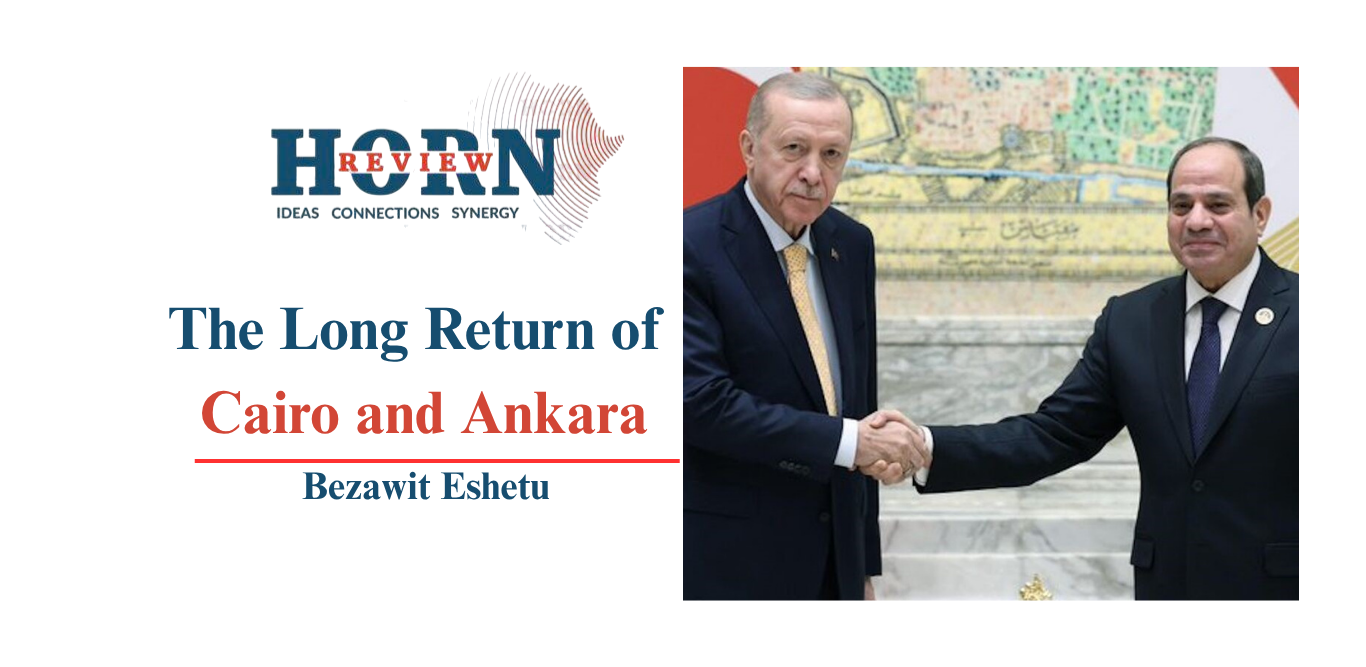
The Long Return of Cairo and Ankara
The rapprochement between Egypt and Turkey that has unfolded across 2024, 2025, and 2026 invites two competing readings. The conventional account treats it as a product of contemporary pressures, war in Gaza, Ethiopian ambitions on the Red Sea, currency crises that pushed both economies toward hedging. another reading finds something older at work, a structural logic that has governed the relationship between Cairo and Istanbul since Ottoman fleets first patrolled the Red Sea against Portuguese intrusion five centuries ago. Understanding which reading holds explains why the current thaw has moved from restored ambassadors to joint fighter jet development in barely two years, a pace that outstrips every prior attempt at normalization. It also exposes what makes this convergence fragile, since the same historical pattern that draws the two states together has, at several points, driven them apart with equal force.
When Portuguese carracks rounded the Cape of Good Hope at the turn of the 16th century and pushed into the Indian Ocean, they threatened the overland spice routes that financed Mamluk Egypt. Cairo’s sultans dispatched fleets to contest Lisbon’s advance, defending the maritime approaches to Arabia alongside allies in Gujarat. When Ottoman forces absorbed Egypt in 1517, Istanbul inherited that imperative, extending direct rule down the African coast through the province of Habesh by 1555 and securing ports such as Massawa, Zeila, and Berbera against Portuguese encroachment. Holding the Bab el Mandeb chokepoint served two purposes at once, shielding the Hejaz from seaborne assault and preserving the trade revenue that financed imperial ambition. The lesson embedded in that episode is thin. Cairo and Istanbul aligned for a transactional reason, because an external power threatened to seize control of a corridor both depended on, and that template would resurface in the Horn of Africa five centuries later under strikingly similar terms.
That template collapsed once Egypt itself became the destabilizing force. Muhammad Ali Pasha’s modernization of the Egyptian army produced a power capable of humbling the empire that nominally ruled him, and his son Ibrahim Pasha marched into Syria in 1831, capturing Damascus, Aleppo, and Homs before pressing into Anatolia. At the Battle of Konya in December 1832, Ibrahim’s disciplined force routed a larger Ottoman army and captured its commander, opening the road toward Constantinople. Harsh weather and the arrival of Russian forces, summoned by an alarmed Sultan Mahmud II, halted the advance, and British and French pressure produced the Convention of Kütahya, which preserved Ottoman survival while ceding Syria to Egypt. The episode fixed opposing memories into each nation’s political imagination. Cairo remembers Ottoman suzerainty as a ceiling placed on Egyptian greatness, while Istanbul remembers Muhammad Ali as the vassal whose defiance accelerated imperial decline, a divergence that colored the relationship long after both empires disappeared.
The 20th century locked the successor states into decades of cool distance rather than open hostility. Turkey joined NATO in 1952 and helped anchor the Baghdad Pact in 1955 alongside Iraq, Pakistan, and Britain, positioning itself against Soviet influence. Gamal Abdel Nasser answered with a platform of non-aligned pan-Arabism that treated Turkish overtures with suspicion, a divergence that produced a near collision over Syria during the 1957 crisis. Anwar Sadat’s pivot toward Washington and his peace treaty with Israel opened a different kind of distance, placing Cairo in a camp that an increasingly Islamist-leaning Turkish political scene viewed with ambivalence. Hosni Mubarak’s three decades in office settled the relationship into what analysts term a cold peace, steady trade and diplomatic courtesy without genuine strategic partnership. What held throughout this period was parallel ambition, two regional powers pursuing separate spheres of influence in the absence of the external maritime threat that had once forced their hands together.
The rupture that followed the Arab uprisings proved far more consequential than any prior friction, because it fused ideology to geography. When Egypt’s military, led by then defense minister Abdel Fattah el Sisi, removed President Mohamed Morsi in 2013, Ankara condemned the move as a coup and granted refuge to exiled Muslim Brotherhood leaders, allowing anti-Sisi media networks to broadcast from Istanbul. That ideological clash over political Islam hardened into a contest fought through proxies across several theaters. In Libya, Egypt backed Khalifa Haftar’s forces in the east while Turkey armed and defended the Tripoli government in the west, pushing both states to the edge of direct confrontation in 2020. In the eastern Mediterranean, Cairo’s maritime boundary agreements with Cyprus and Greece collided with Ankara’s continental shelf claims and offshore drilling campaigns. The competition extended into the Horn of Africa, where Turkey’s 2021 sale of Bayraktar drones to Ethiopia, arriving as Addis Ababa’s standoff with Cairo over the Grand Ethiopian Renaissance Dam peaked, registered in Egyptian security circles as a direct challenge to Nile water interests and regional standing.
Pressure to reverse course built steadily through the middle of the 2020s. Currency depreciation and inflation strained both economies, while the Gaza war and an assertive Israel gave Cairo and Ankara shared incentive to coordinate rather than compete. Erdogan’s February 2024 visit to Cairo, his first in twelve years, opened the thaw, and Sisi reciprocated in Ankara that September, when the two presidents co-chaired the inaugural session of the High-Level Strategic Cooperation Council. The mechanism gained further weight on February 4, 2026, when Erdogan returned to Cairo for the council’s second meeting, producing a joint declaration, a military framework agreement, and a suite of memoranda spanning trade, health, and agriculture. Bilateral trade, standing at 6.5 billion dollars in 2023, climbed past 8 billion dollars in 2024, with both governments now targeting 15 billion dollars within five years. What distinguishes this reset from earlier thaws is the speed with which political normalization translated into military substance, a sequence that moved from restored ambassadors to signed defense industry agreements in barely two years.
That translation accelerated through 2025 and 2026 in ways earlier normalizations never attempted. In September 2025 the two navies resumed their Friendship Sea exercises after a thirteen-year interruption, with Turkish frigates, a submarine, and F-16 jets operating alongside Egyptian vessels in the eastern Mediterranean. The February 2026 Cairo summit produced a 350-million-dollar defense package between Egypt’s Ministry of Defense and Turkey’s state owned Mechanical and Chemical Industry Corporation, covering export of the TOLGA close-in air defense system for roughly 130 million dollars and a joint venture to build a 155-millimeter artillery ammunition factory alongside light ammunition production lines inside Egypt. In June 2026 the Egyptian Air Force joined the Anatolian Eagle exercise on Turkish soil alongside Azerbaijan and a NATO airborne early warning aircraft, while Egyptian and Turkish special forces trained together in the Golden Eagle drills. The sequence culminated on July 13, 2026, when Egyptian Defense Minister Ashraf Salem Zaher, the first Egyptian defense minister to visit Ankara since 2013, signed letters of intent covering military and defense industry cooperation, with Turkish officials confirming exploratory talks on Egyptian participation in developing the KAAN fifth generation fighter.
The Red Sea dimension of this partnership carries an almost exact echo of the 16th century pattern, with Cairo and Ankara again presenting a unified front against a perceived disruption of the maritime corridor. The catalyst arrived on January 1, 2024, when Ethiopia signed a memorandum with the breakaway republic of Somaliland granting Addis Ababa naval access to coastline near Berbera in exchange for eventual recognition, an arrangement Mogadishu treated as a violation of its sovereignty and Cairo treated as an extension of the Nile dam dispute by other means. Egypt answered with a defense pact and troop deployments to Somalia in August 2024, while Turkey deepened its own long-standing defense and port arrangements with Mogadishu, training the Somali navy explicitly to dull Ethiopian ambitions for sea access. Together the two powers have positioned themselves as the primary external guarantors of Somali sovereignty, restoring a role their predecessor states once held over Massawa and Zeila, while quietly containing the parallel investments the United Arab Emirates continues to make in both Ethiopia and Somaliland.
Gaza supplies the emotional glue binding the relationship together, with Cairo and Ankara coordinating alongside Qatar to press for a durable ceasefire and a two-state outcome, united in opposition to Palestinian displacement. The convergence carries real limits all the same, since Egypt continues treating its peace treaty with Israel as an inviolable strategic asset that Ankara’s rhetoric has left largely undisturbed. A far graver test arrived with the widening confrontation between Iran and Israel, which erupted into the Twelve-Day War in June 2025 and resumed on a larger scale on February 28, 2026, drawing Hezbollah into the fighting within days and sending Iranian ballistic missiles into Turkish airspace for the first time in early March, intercepted by NATO-linked air defense assets near the eastern Mediterranean. Ankara’s foreign ministry warned it reserved the right to respond if the incursions continued, a posture that placed Turkey’s NATO obligations in uncomfortable proximity to its Cairo partnership. Egypt and Turkey have managed border security and public messaging around that crisis without visible strain so far, but a wider conflagration involving Iran would test whether their defense cooperation extends beyond training exercises and factory construction into genuine strategic alignment under fire.
What distinguishes this rapprochement from the cold peace of the Mubarak years and the proxy hostility of the 2010s is the transfer of manufacturing capacity rather than the exchange of statements. Joint ammunition plants, drone co-production, and exploratory talks on the KAAN program move technical know-how and eventual design authority onto Egyptian soil, a development that outlasts any single administration in Cairo or Ankara because it creates institutional and economic stakeholders on both sides with an interest in continuity. This localization also erodes an assumption long held in Washington and Tel Aviv, that American patronage represents the only credible route to regional military relevance for a state of Egypt’s size. The historical record offers a caution. The Ottoman-Mamluk alignment against Portugal endured only as long as the external threat it was built to counter, and dissolved once Muhammad Ali’s Egypt grew powerful enough to challenge Istanbul directly rather than stand beside it. Should Egypt’s defense-industrial base mature to the point where it can compete with Turkey for leadership of North Africa’s arms market rather than simply absorb Turkish technology, the same historical grammar of convergence under pressure and rivalry under strength may reassert itself. For now, both capitals appear to have judged that shared vulnerability in a crowded multipolar field is worth more than the memory of old rivalries, a wager the next Iranian missile trajectory could test sooner than either expects.
By Bezawit Eshetu, Researcher, Horn Review

RELATED
Posts
9
Oct
Could the Riyadh Airport Strike Reshape the Yemen Conflict?
A series of claimed missile and drone strikes on King...
8
Oct
The Makkah Pact and the Limits of Collective Defence
The Makkah Joint Defence Agreement rests on an ambitious...
28
Sep
Saudi-led Multinational Maritime Defence Coalition and the Changing Security of Bab el-Mandeb
On 2 September, the Saudi-led Multinational Maritime Defence Coalition...

28
Sep
The AI Disinformation War in the Horn and the Economics of Digital Conflict
In September, Marc Owen Jones, an Associate Professor of...
24
Sep
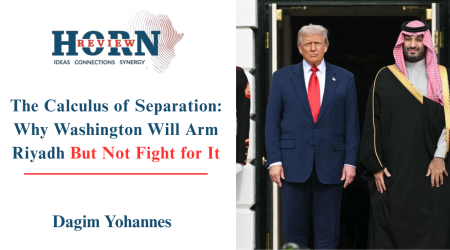
The Calculus of Separation: Why Washington Will Arm Riyadh But Not Fight for It
The episode reveals a distinction in the U.S.-Saudi security relationship...
21
Sep
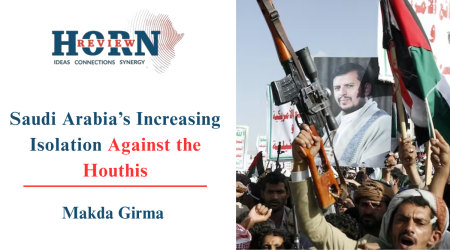
Saudi Arabia’s Increasing Isolation Against the Houthis
Saudi Arabia’s renewed confrontation with Yemen’s Houthis has exposed how...
21
Sep
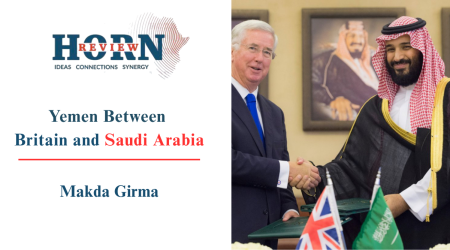
Yemen Between Britain and Saudi Arabia
The Houthi advance along Yemen’s Red Sea coast has exposed...
21
Sep
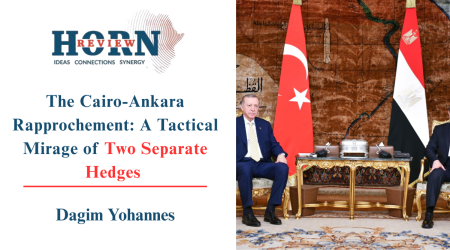
The Cairo-Ankara Rapprochement: A Tactical Mirage of Two Separate Hedges
The recent run of headlines out of Cairo and Ankara,...
20
Sep
The African Union Was Designed to Stand Outside Sudan's War
Every time Sudan's war comes up in public discussion, mentioning...
2
Sep
A Decade of Saudi Miscalculation in Yemen
On March 26, 2015, Mohammed bin Salman, then a thirty-year-old...