Sudan is not merely enduring a civil war; it is becoming the arena through which the political balance of the Horn is being rewritten. For that reason, Ethiopia should not approach the conflict as a cautious neighbor or a distant observer. It should instead use its standing within the African Union and IGAD to push for a settlement shaped by Sudanese civilian needs and by Ethiopia’s own long-term strategic interests. A fractured Sudan would deepen insecurity along Ethiopia’s western borderlands, complicate regional diplomacy, and leave the Nile basin more vulnerable to external manipulation. A stable Sudan, by contrast, would improve Ethiopia’s security environment and give the Horn a better chance of escaping the logic of permanent crisis.
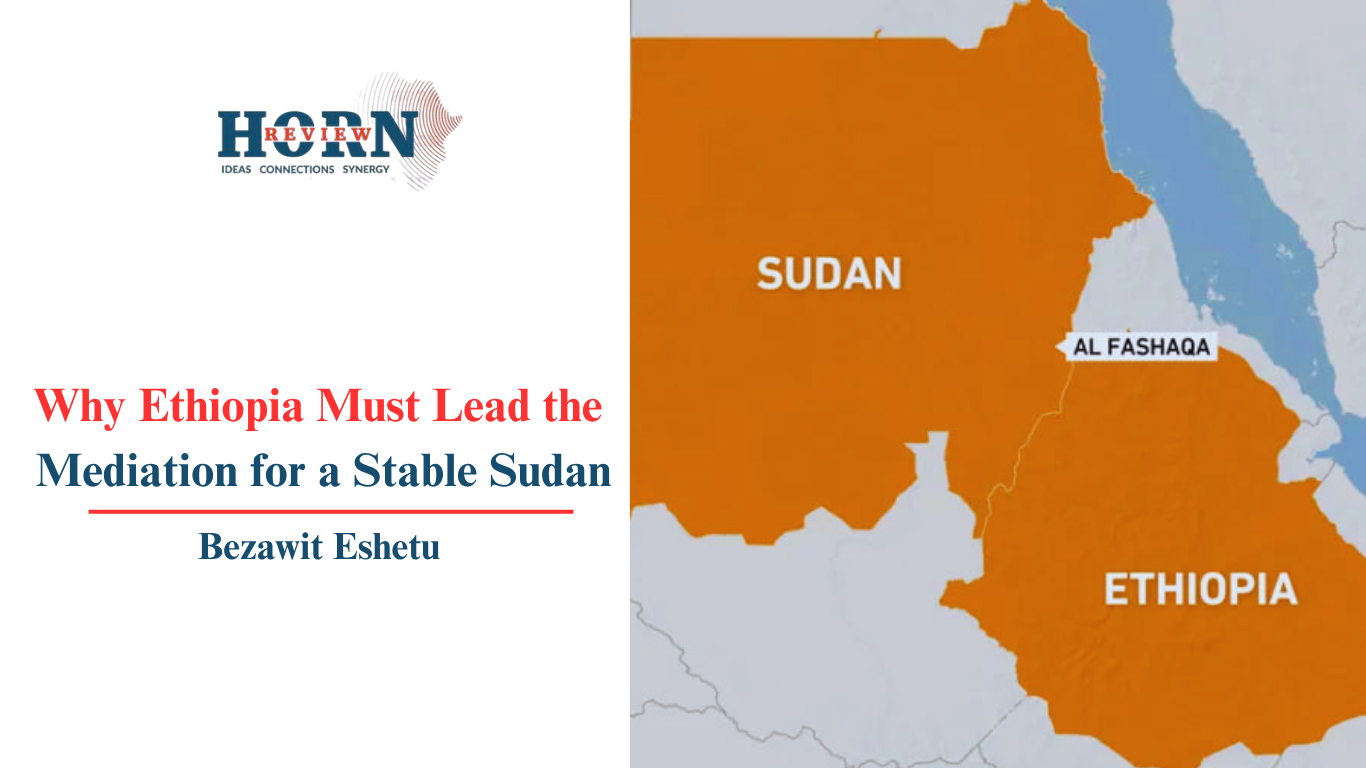
That strategic argument begins with geography, because the Ethiopia–Sudan relationship is rooted in a frontier that is politically active, not merely drawn on a map. The borderland around Al Fashaga has long been contested, cultivated, militarized, and used as a pressure point in both countries’ domestic politics. More recently, trade across the frontier has been severely disrupted by the overlap between Sudan’s war and earlier conflict in Ethiopia, while the border itself has grown less secure as violence on one side feeds instability on the other. For Ethiopia, this means Sudan cannot be treated as an external file. It is an extension of its own security and economic space. Border calm, trade continuity, and political order in Sudan are therefore not separate goals; they are different expressions of the same strategic interest.
The deeper reason Sudan remains so difficult to stabilize lies in the colonial state that was left behind. Under the Anglo-Egyptian Condominium, Britain dominated administration in practice even though Egypt was formally part of the arrangement. That system did not create a balanced political community. Instead, it produced a centralized state that privileged the riverine core while leaving the peripheries underdeveloped, underrepresented, and politically disposable. Frantz Fanon’s theory helps explain why that legacy has remained so durable: colonialism is not just foreign rule, but a total system that shapes the economy, politics, culture, and even the inner life of a people. In Sudan, this means the present crisis is not simply about rival generals. It is about a postcolonial state that never fully escaped the coercive habits and exclusions of the colonial order. A real settlement must therefore do more than stop the shooting; it must begin to undo the political culture that made militarized rule seem normal in the first place.
This is also why the Nile question cannot be treated as a side issue. It has long been one of the main channels through which external power has entered Sudanese politics. For decades, Egypt has treated Sudan as more than a neighbor, using it as a strategic buffer in its wider effort to preserve downstream control over the Nile and prevent any regional order that could reduce Cairo’s leverage. That approach has taken different forms over time: diplomatic alignment, security coordination, pressure over river politics, and a consistent effort to keep Sudan inside Egypt’s preferred Nile framework. The result is that Sudan has often been positioned less as an independent actor than as a pivotal terrain in a larger contest over water and influence. Any transition that leaves the country vulnerable to outside Nile calculations will remain unstable. The real issue is not simply whether Sudan leans one way or another, but whether it can rebuild a sovereign political order that makes its own decisions without being folded into another state’s hydro-strategic agenda.
Ethiopia’s leadership must also confront a harder truth: this war is driven by a systematic logic of atrocity that reaches far beyond the ambitions of two rival generals. The ethnic targeting in Darfur and the destruction of Khartoum’s civilian infrastructure have created a governance vacuum that neither the Sudanese Armed Forces (SAF) nor the Rapid Support Forces (RSF) can legitimately fill. The RSF’s predatory militia model is rooted in coercion, extraction, and fragmentation, while the SAF’s indiscriminate urban warfare has deepened the collapse of state authority. For Ethiopia, a genuinely “Sudanese-owned process” cannot mean a mere power-sharing arrangement between armed actors responsible for mass violence. It must instead be anchored in accountability, civilian protection, and a commitment to preventing the consolidation of militia-statecraft, whose consequences would extend well beyond Sudan and weaken the normative order of the African Union itself.
Building on that principle, Ethiopia should lead a distinctly African-centered response to Sudan’s crisis by leveraging the AU, IGAD, and the Quad to counter the conflict’s dangerous externalization. While the Quad includes actors, whose interests have helped fuel the war, it remains a valuable diplomatic venue for pressing all external powers to halt arms supplies, financing, and other forms of enablement and to back a ceasefire that safeguards Sudanese sovereignty rather than auctioning it off. Yet the peace process cannot be outsourced to distant patrons whose priorities center on influence, logistics, and strategic access instead of Sudan’s long-term stability.
As a direct neighbor absorbing the war’s spillover, refugees, arms flow, and border tensions, Ethiopia, together with other affected African states, must sit at the center of any credible response. Regional actors possess both the strongest incentives and the clearest responsibility to prevent Sudan from becoming a permanent proxy battlefield and to defend the territorial integrity of the Horn of Africa and the Red Sea corridor.
This context demands that Ethiopia refuse to let the Sudanese Armed Forces shape the narrative through unverified claims of drones, border violations, or secret training sites. Such allegations should be treated as wartime propaganda unless backed by credible, independent evidence. In conflicts of this nature, they often serve to widen the battlefield, internationalize an internal power struggle, and divert attention from Sudan’s core crisis of state collapse. Ethiopia must not be drawn into that script. Instead, it should maintain disciplined focus on what matters: brokering a durable ceasefire, securing its borders against spillover, and channeling efforts through the AU and IGAD toward a genuine civilian-led political track.
Working through these institutions is essential, not optional. The African Union’s Peace and Security framework provides the legitimacy needed to shape continental responses, while IGAD brings proven regional mediation experience and has already endorsed an inclusive, Sudanese-owned process under civilian leadership. Ethiopia’s task is to strengthen the correct sequence: halt the fighting, marginalize military spoilers, create space for civilian politics, and coordinate border management to contain the conflict.
At its core, the principle is straightforward: Sudan’s future must be decided by Sudanese civilians capable of building legitimate authority, not by armed factions fighting to preserve their own power. Ethiopia’s strongest stance is therefore disciplined engagement, treating a stable Sudan as a strategic necessity for its own border security, for limiting proxy politics, and for building regional resilience against external manipulation. By using the AU and IGAD to advance a civilian-led settlement, challenge unsubstantiated accusations, and block attempts to turn Sudan into another regional proxy war, Ethiopia would deliver more than a Sudan policy. It would execute a coherent Horn of Africa strategy.
By Bezawit Eshetu, Researcher, Horn Review