By Blen Mamo
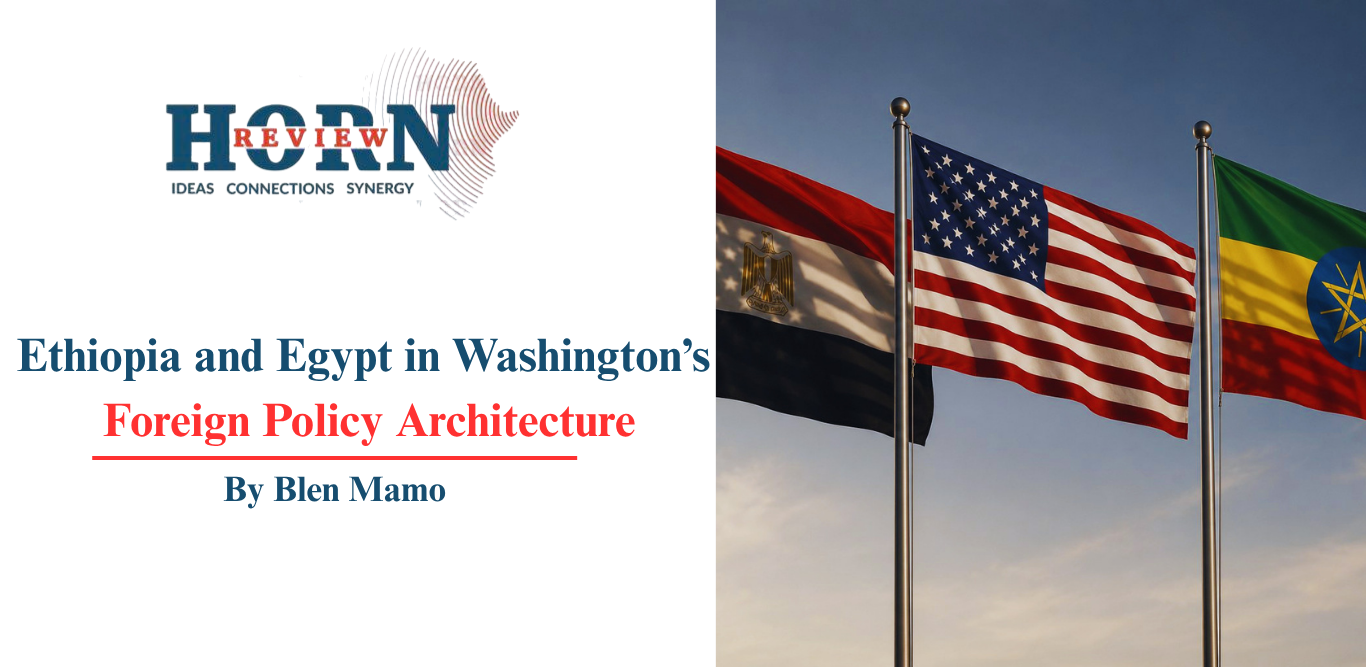
The recent phase of Ethiopian-American engagement reflects an increasingly sophisticated, though still structurally incomplete, attempt by Ethiopia to operate across the full spectrum of the U.S. foreign policy system. The Washington visit of Ethiopia’s Foreign Minister, Gedion Timothewos, signaled a deliberate consolidation of Ethiopia’s post-conflict diplomatic posture, with sustained outreach to the U.S. Department of State and selective engagement with United States Congress and policy think-tanks. This three-track approach – combining executive-branch diplomacy, legislative signaling, and epistemic engagement within research and policy think-tank communities – represents a notable evolution from earlier periods in which Ethiopia’s Washington strategy was more narrowly concentrated and episodic. There is, in fact, a discernible maturation in Ethiopia’s diplomatic grammar. The messaging around the Grand Ethiopian Renaissance Dam has become more structured, less reactive, and increasingly embedded within broader narratives of regional development, sovereignty, and African institutional ownership. Engagement with the State Department has likewise improved in consistency and technical depth, reflecting a clearer understanding of the bureaucratic logic that governs day-to-day U.S. foreign policy formulation. In parallel, Congressional outreach has provided Ethiopia with an additional layer of political visibility and reputational insulation, particularly valuable in an environment where narratives around the Horn of Africa are often externally contested.
Yet the analytical limitation is not the absence of engagement, but the partial mismatch between the level at which Ethiopia is most active and the level at which decisive political arbitration occasionally occurs. This becomes more visible when contrasted with Egypt’s parallel strategy. Egypt has historically maintained a more vertically oriented model of influence in Washington, one that prioritizes direct access to executive-adjacent networks alongside formal diplomatic channels. The contemporary relevance of this approach is illustrated by Egypt’s engagement with President Donald Trump himself, and his inner foreign policy and political orbit, such as Massad Boulos, who serves as a senior advisor on Arab and African affairs. Such engagements are less about formal negotiation in the classical diplomatic sense and more about shaping interpretive frameworks within the advisory ecosystem that feeds directly into White House decision-making. It is important, however, not to reduce this contrast to a narrative of Ethiopian absence or deficiency. The Ethiopian diplomatic effort is both active and increasingly multidimensional – reflecting an emerging recognition in Addis Ababa that U.S. foreign policy is not institutionally monolithic. Rather, it is a layered system in which bureaucratic diplomacy, legislative politics, and executive advisory networks coexist in partial competition.
The structural question, however, lies in the degree of vertical integration achieved across these engagements. Under administrations such as that of Joe Biden, where inter-agency process and State Department coordination retain greater coherence, Ethiopia’s strategy of broad institutional engagement yields more predictable returns. But in a political environment shaped by more personalized executive decision-making – such as that associated with Trump-era governance – the marginal value of State-centric engagement diminishes relative to proximity to presidential advisors and trusted intermediaries. In such contexts, actors within Trump’s inner circle become more than symbolic interlocutors; they function as filters through which regional issues are translated into presidentially legible priorities. This is where the comparison with Egypt becomes analytically sharper. Egyptian diplomacy does not substitute White House engagement for State Department engagement; rather, it ensures that State Department engagement is continuously “amplified upward” through parallel channels embedded within the executive advisory sphere. The result is not a binary choice between institutions but a calibrated stacking of influence, in which bureaucratic diplomacy and personalized access reinforce rather than substitute for one another. Ethiopia, by contrast, has made notable progress in the horizontal expansion of its diplomatic footprint, but the vertical transmission mechanisms – those that carry narratives from State and Congress into the immediate cognitive field of the White House – remain comparatively underdeveloped.
The significance of the reported engagement between Ethiopian officials and Boulos should therefore be read in this light: not as an isolated event, but as a tentative step toward entering a more competitive tier of Washington’s foreign policy ecosystem. Its importance lies less in its immediate policy consequences – especially given his perceived ties with the Egyptian establishment – and more in its potential to signal a shift in Ethiopian diplomatic strategy toward recognizing that, in certain configurations of American politics, access is not evenly distributed across institutions but concentrated within advisory and executive networks that operate above them. The broader implication is that Ethiopia’s foreign policy establishment is not lacking in diplomatic competence, nor in institutional engagement, but is confronting a more subtle challenge of conversion: transforming breadth of access into vertical influence. Egypt’s comparative advantage lies in its long-standing ability to operate at this intersection – where formal diplomacy, intelligence-linked channels, and executive advisory networks converge. Ethiopia’s emerging challenge is to develop a similarly integrated model without losing the normative coherence and multilateral legitimacy that currently underpin its position. A further divergence lies in the role of think tanks and policy institutions. Ethiopian engagement with Washington-based think tanks has expanded only recently and remains in an emerging phase, though it has started getting visible in select policy conversations. This development will contribute to improved narrative sophistication and a more coherent articulation of Ethiopia’s post-conflict and regional positioning. However, it is still characterized by episodic interaction rather than sustained institutional embedding. It has not yet matured into a durable ecosystem of influence capable of consistently shaping debate across cycles of policy attention in Washington. By contrast, Egyptian engagement with think tanks is not a recent adaptation but the product of decades of sustained cultivation. Egypt has long treated Washington’s intellectual infrastructure as a strategic domain in its own right, ensuring that its core narratives are continuously circulated, refined, and reintroduced across policy institutions that interface directly with executive and legislative decision-making. This long-term curation produces a form of narrative persistence: Egypt’s strategic framing of regional security, the Nile, and stability in the Middle East and Africa is repeatedly reinforced within the analytical environments that shape policy priorities before formal decisions are made.
The analytical implication is therefore that Ethiopia lacks institutional consolidation in the U.S. intellectual domain. It has not yet reached the level of systematic integration that would allow U.S. policy think-tanks to function as a stabilizing layer of its influence over time. The feedback loop between analysis, narrative construction, and policy translation remains underdeveloped, limiting the durability of Ethiopia’s messaging within Washington’s broader epistemic ecosystem.
The broader structural point, here, is that Ethiopia has made genuine and meaningful progress in widening its diplomatic and intellectual footprint across Washington. Its engagement is increasingly multi-dimensional – spanning the U.S. Department of State, United States Congress, and emerging policy institutions – but it has not yet fully resolved the challenge of vertical integration. Its influence remains more horizontally distributed than strategically concentrated at the level where presidential attention is prioritized and decisions are ultimately consolidated. Egypt, by contrast, maintains a more vertically efficient architecture of influence. Its long-established engagement with intellectual, diplomatic, and executive-adjacent networks ensures that its strategic narratives are consistently refracted upward into the advisory and decision-shaping spaces closest to the White House. The distinction, therefore, is not one of diplomatic presence versus absence, but of temporal depth and structural design: whether influence is accumulated through recent expansion across multiple venues or engineered over time into a coherent, vertically integrated system capable of shaping outcomes at the apex of executive attention. What ultimately distinguishes the two approaches is not diplomatic capacity in the abstract, but institutional design: whether influence is accumulated horizontally across multiple venues or engineered vertically toward decision-concentrating nodes. In periods where the White House functions as an active and personalized arbiter of foreign policy, this distinction becomes determinative.
Authors Bio
Blen Mamo is Executive Director of Horn Review and a researcher specializing in law, international security, and geopolitics in the Horn of Africa. She holds an LL.B and an M.Sc. in International Security and Global Governance.