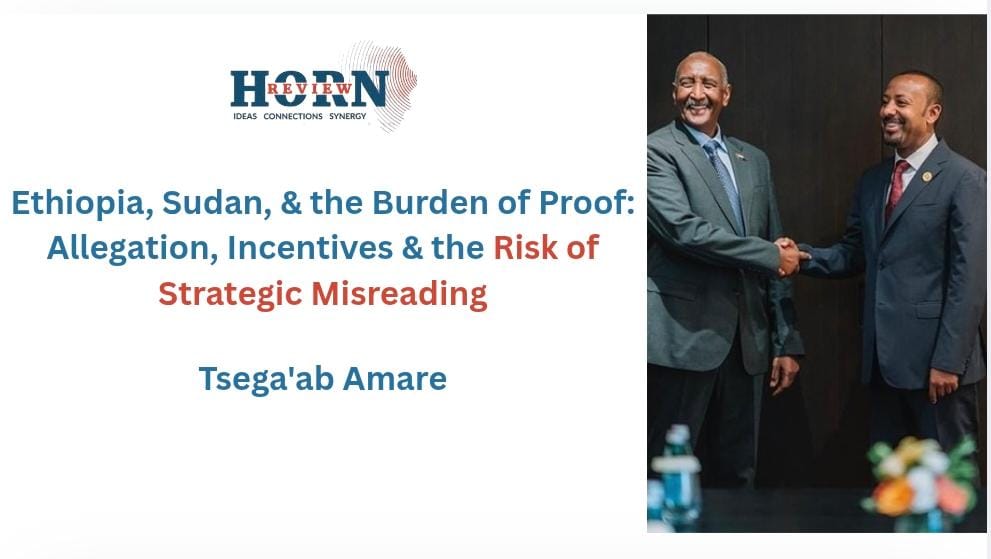
Recent reporting in The Africa Report has amplified allegations that Ethiopia is facilitating Sudan’s Rapid Support Forces (RSF) in the country’s civil war. The claims are serious. They suggest Ethiopian territory is being used as a corridor for weapons transfers, a training space for fighters, and even a platform for drone operations. Such assertions, if substantiated, would signal a major shift in the regional balance of the conflict. Yet a close analytical reading shows that the evidentiary base for these conclusions remains thin. Much of the narrative relies on wartime intelligence provided by actors directly involved in the conflict, conflates porous border realities with deliberate state policy, and underestimates Ethiopia’s structural interest in a stable Sudan. While the Horn is increasingly shaped by fluid alignments and proxy dynamics, the case for a formal Ethiopian alignment with the RSF remains circumstantial and analytically incomplete.
The foundation of many allegations rests on information from Sudanese Armed Forces (SAF) officials and intelligence channels. In civil wars intelligence is rarely a neutral commodity. It functions as an instrument of political warfare. For the SAF leadership, portraying the RSF as a foreign-backed proxy internationalizes the conflict, mobilizes diplomatic sympathy, and shifts the narrative away from battlefield setbacks. At the same time, the narrative of alleged Ethiopian support can be exploited by external actors pursuing their own strategic agendas, framing neighboring states as covert sponsors and leveraging regional tensions to their advantage. The problem is not that such claims are impossible, but that they are presented with a level of certainty that exceeds the available independent verification.
Assertions of organized RSF training camps in Benishangul-Gumuz or systematic drone operations from Ethiopian territory have not been corroborated by neutral satellite imagery, UN or AU monitoring reports, or the kind of physical evidence that typically anchors contemporary international investigations. The distinction between battlefield intelligence and verified fact is critical. Until neutral third-party observers confirm these sites and activities, the narrative remains analytically closer to wartime messaging than to established evidence.
The repetition of similar allegations since late 2025, including reports of intercepted convoys, claims of large training contingents, alleged drone launch sites, and cross-border movements linked to fighting in Blue Nile, does warrant scrutiny. The volume of accusations can create an impression of cumulative proof. However, repetition is not verification. In the absence of corroborated third-party evidence such as independently analyzed satellite imagery, on-the-ground access for neutral monitors, or documented material traces, these claims remain within the realm of wartime signaling rather than confirmed interstate intervention.
A central plank of the complicity narrative concerns the movement of RSF or allied fighters across the Ethiopia-Sudan frontier, particularly around Yabus and Guba. However, this interpretation often overlooks the historical and geographic reality of the roughly seven-hundred-kilometer western border. This frontier has long been characterized by rugged terrain, weak state penetration, cross-border ethnic linkages, and entrenched smuggling networks.
In such contexts, the presence of armed actors or equipment in peripheral zones does not automatically translate into a deliberate policy of state sponsorship. In the Horn of Africa, transit frequently reflects limited state capacity to police distant fringes rather than an active alliance decision taken in a capital. Acknowledging this does not deny the possibility of local complicity, corruption, or exploitation of border zones by third-party networks. It simply distinguishes those phenomena from a centralized, intentional strategy of backing one side in a foreign civil war. Conflating border seepage with national policy risks mistaking geography for intent.
The same caution applies to Ethiopia’s military posture in Benishangul-Gumuz. The region hosts the Grand Ethiopian Renaissance Dam (GERD), the country’s most sensitive strategic asset. A visible security presence there is logically and legally tied to infrastructure protection in a volatile regional environment. Interpreting these defensive measures as support for the RSF not only stretches the available evidence but also risks setting a precedent that could justify external interference, potentially placing the GERD itself in danger. There is a fundamental difference between a territory being a route of convenience exploited by regional networks and a government acting as a partner in conflict.
The incentive structure facing Addis Ababa further complicates the allegation of deliberate support. The central question is who benefits. Supporting an RSF victory or encouraging Sudanese state fragmentation offers Ethiopia high risks and uncertain returns. The country is navigating a fragile post-conflict recovery in Tigray while confronting active insurgencies in Amhara and Oromia.
At the same time, tensions with Eritrea remain a strategic concern. If Ethiopia is wary of the possibility of conventional confrontation with Asmara, it would be strategically illogical to simultaneously provoke the SAF and Egypt by overtly backing the RSF. A three-front security crisis combining internal insurgencies and northern tensions would represent a state survival-level scenario that Ethiopia strongly tries to avoid. Expanding security commitments or tolerating the emergence of a hostile and fragmented security environment along its western frontier would therefore be strategically reckless. Instability in Sudan would likely spill into Benishangul-Gumuz, potentially energizing local armed groups and deepening internal security burdens.
Humanitarian pressures also matter. Ethiopia already hosts large numbers of Sudanese refugees. A further deterioration of the Sudanese state could generate new waves of displacement that Addis Ababa is economically ill-equipped to absorb. Facilitating the expansion of a paramilitary actor that has been repeatedly documented by UN reporting for attacks on civilian infrastructure, including aid convoys and medical facilities, would only accelerate the very refugee flows that strain Ethiopian capacity. At the same time, a complete breakdown in communication with Khartoum would carry its own risks. The SAF leadership maintains close ties with Egypt. A hardened Cairo-Khartoum alignment on Nile politics would complicate Ethiopia’s long-term security environment around the GERD.
In this light, Ethiopia’s policy of maintaining contact with both General Burhan and General Hemedti appears less like endorsement and more like an attempt at conflict containment and mediation. Addis Ababa’s continued engagement with both, including high-level diplomatic contacts, aligns more closely with hedging and de-escalation behavior than with one-sided alignment in a civil war whose trajectory remains unpredictable.
Ethiopia’s close economic and technological relationship with the United Arab Emirates is often cited as indirect proof of complicity. This “client-state” narrative oversimplifies Ethiopian diplomacy of balancing relationships with multiple Middle Eastern powers, including Saudi Arabia, Qatar, the UAE, and Turkey, without fully outsourcing its regional security calculations. While the UAE may exert economic leverage, Ethiopia’s leadership is acutely aware that the long-term cost of a destabilized Sudan outweighs any short-term benefits that could be achieved. Analysts must differentiate between Ethiopia’s economic alignment with Abu Dhabi and its security alignment regarding its immediate neighbors.
Unverified accusations also carry their own dangers. Narratives portraying Ethiopia as an active belligerent can shape threat perceptions among Sudanese actors and their allies. If such claims are accepted as fact, they may justify preemptive escalation, invite additional external actors into the war, or legitimize cross-border actions that risk transforming a civil conflict into a broader interstate confrontation. The Horn of Africa is already burdened by overlapping crises, and it cannot afford another multi-state conflict. Therefore, the burden of proof for such serious allegations must be higher than “anonymous intelligence sources.”
Ethiopia’s posture toward the Sudan conflict is better understood as a precarious balancing act than as a clandestine alliance. Domestic fragility, refugee pressures, GERD security concerns, and the risk of regional escalation all align Addis Ababa’s interests more closely with a negotiated settlement than with an RSF victory that would further fragment the Sudanese state. Moving beyond cycles of accusation and denial requires stronger regional monitoring and transparency mechanisms that can distinguish between criminal logistics, third-party networks, and actual state policy. In conflicts of this complexity, analytical restraint is not caution. It is a responsibility.
By Tsega’ab Amare, Researcher, Horn Review