The Erosion of Federal Authority in Somalia
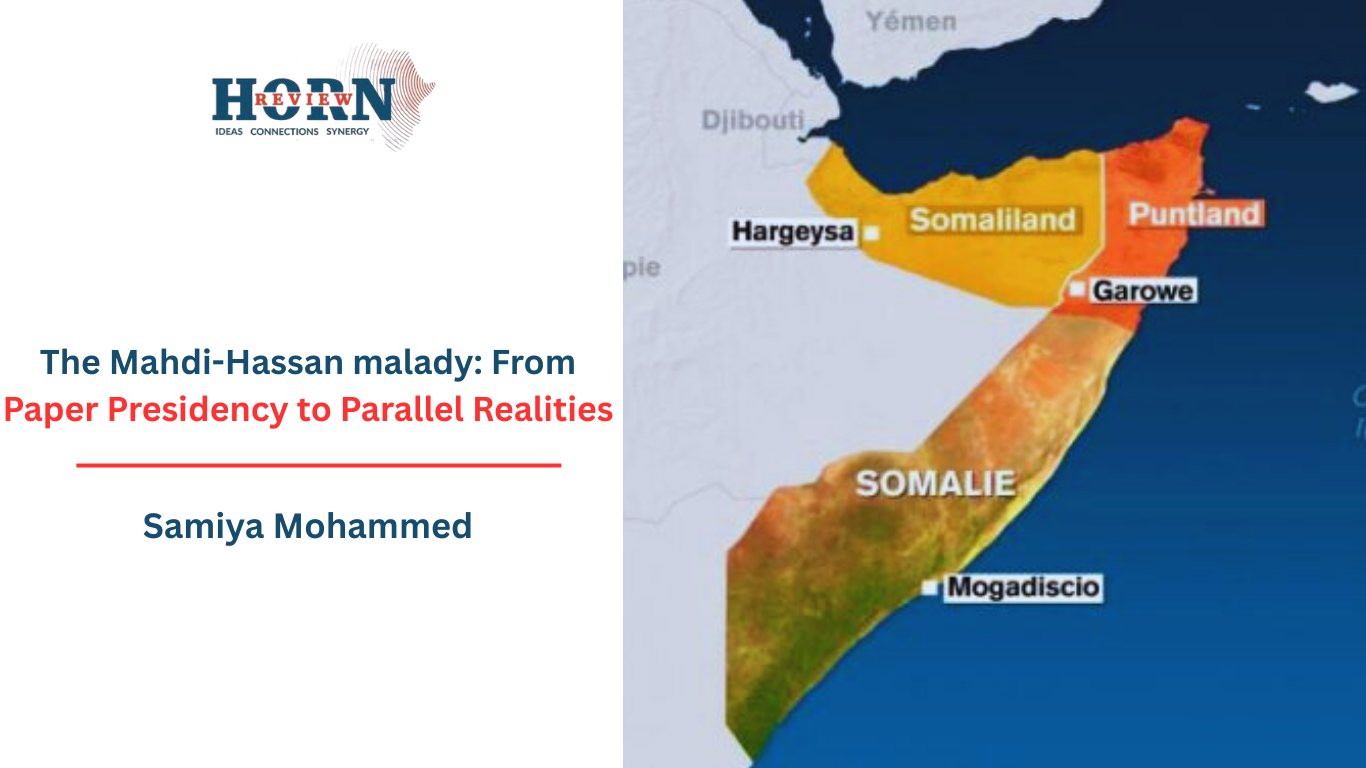
In January 2026 the Federal Government of Somalia led by President Hassan Sheikh Mohamud issued a decree from Mogadishu where he annulled all security and port agreements between any Somali entity and the United Arab Emirates. The move targeting assets like the ports of Berbera, Bosaso, and Kismayo was formulated as a bold reassertion of national sovereignty. The response from Somalia’s federal states was immediate and dismissive. Puntland and Jubbaland declared the annulment null and void asserting their constitutional authority over trade and infrastructure. In Hargeisa the decree was dismissed as irrelevant daydreaming and Fly Dubai flights continued their scheduled service uninterrupted which is a quiet but powerful symbol of business as usual beyond Mogadishu’s reach. This episode is the revelation of an accelerating truth. The Federal Government in Mogadishu is experiencing a loss of effective control over the country’s territory, institutions, and foreign policy a decline that mirrors with precision the impotence of Ali Mahdi Muhammad’s interim presidency during the state collapse of the early 1990s.
Present reality hits hardest once faced with the single most consequential defeat of the past. Following the overthrow of Siad Barre’s dictatorship in January 1991, Ali Mahdi Muhammad was appointed interim president by a faction of the United Somali Congress. His claim to national leadership existed almost entirely on paper. His actual authority was confined to enclaves in northern Mogadishu, primarily controlled by his Abgaal sub clan of the Hawiye. The rest of the capital was dominated by his rival General Mohamed Farah Aidid, leading to devastating intra Hawiye warfare that killed thousands and pulverized the city.
Far from the capital’s ruins, Ali Mahdi’s presidency was a fiction. The Somali National Movement had already declared the independence of Somaliland in the northwest in May 1991 that completely ignored the government in Mogadishu. In the south and central regions factional militias and warlords carved out personal fiefdoms while a devastating famine, exacerbated by militia checkpoints and plunder claimed lives. Ali Mahdi’s regime demonstrated that a title and international recognition were meaningless without the capacity to enforce decisions, secure territory or command loyalty beyond one’s clan militia. It was the archetype of a hollow presidency ruling an archipelago of influence in a sea of anarchy.The parallels between Ali Mahdi’s era and the current presidency of Hassan Sheikh Mohamud are not superficial and they are structural. The recent annulment of UAE deals is just the latest and most vivid symptom of a systemic disease with the erosion of federal authority to the point of ceremonial existence.
The constitutional rupture forms the core of this crisis. In March 2024 Puntland, a founding pillar of Somalia’s federal system took the step of formally withdrawing recognition of the Federal Government. This drastic action was triggered by Mogadishu’s unilateral adoption of historic constitutional amendments which Puntland argued dismantled the foundational federal pact by centralizing power. Citing Article 142 of the Provisional Federal Constitution which protects the powers of existing regional administrations and its own state constitution, Puntland declared it would now operate as an independent government until a consensual constitutional order is restored. This is not routine political friction however it is a fundamental denial of the federal government’s legitimacy by one of its most powerful components.
The federal government’s attempt to nullify the UAE port deals was a direct challenge to the economic lifeblood and security partnerships of Puntland , Jubbaland , and Somaliland. Their instant rejection scores that these regions conduct their own foreign economic policy. As Puntland’s 2024 statement explicitly declared, it now reserves the right to negotiate directly with the international community and international organizations on issues related to its interests. This fractures Somalia into multiple, competing diplomatic fronts.
The situation with Somaliland presents the most extreme case of evaporated authority. Since 1991, it has built de facto statehood with its own government, currency, and security apparatus. The recent historic recognition of Somaliland by Israel in December 2025 was a seismic shock to Mogadishu’s claim of sovereignty. While the African Union and others reaffirmed support for Somalia’s territorial integrity, the event demonstrated that powerful international actors are now willing to engage directly with Hargeisa on a state to state basis rendering Mogadishu’s objections increasingly rhetorical.
Beneath these political crises lies the enduring engine of Somali fragmentation like clannism and the failure to build a truly inclusive national identity. Traditional clan institutions have proven resilient and remain the core of political mobilization and local governance. The post-2012 federal system was designed to manage this reality by devolving power but it has instead institutionalized clan territories, allowing regional elites to consolidate power bases that rival Mogadishu. The consequences are dire and multidimensional.
The defiant reactions from Puntland, Jubbaland, and Somaliland to Mogadishu’s UAE decree are more than rebukes and they are direct evidence of a governing authority whose writ has shrunk perilously. Like Ali Mahdi Muhammad three decades ago, President Hassan Sheikh Mohamud presides over a government whose proclaimed authority vastly exceeds its enforceable will. The federal state controls islands of territory with foreign military support while the nation’s regions make independent deals with foreign powers manage their own security, and openly reject central directives.
One path leads toward a managed but uneasy disintegration and a future where the federal government becomes just the mayor of a Mogadishu city state, presiding over a loose, dysfunctional confederation of increasingly autonomous regions with Somaliland continuing its march toward full international recognition. The other path requires a radical, genuine, and inclusive political settlement that renegotiates the social contract between Mogadishu and the regions. This would mean moving beyond the winner takes all politics fuelled by clannism to build a federalism that is consensual rather than coercive, and where authority is respected because it is shared and legitimate.
The question is no longer whether Mogadishu is losing control, the evidence is overwhelming that it has. The urgent, unresolved question is whether Somalia’s political elites and their international partners can learn from Ali Mahdi’s presidency and forge a new, sustainable basis for coexistence before the current hollow presidency gives way to another era of catastrophic fracture.
By Samiya Mohammed, Researcher, Horn Review