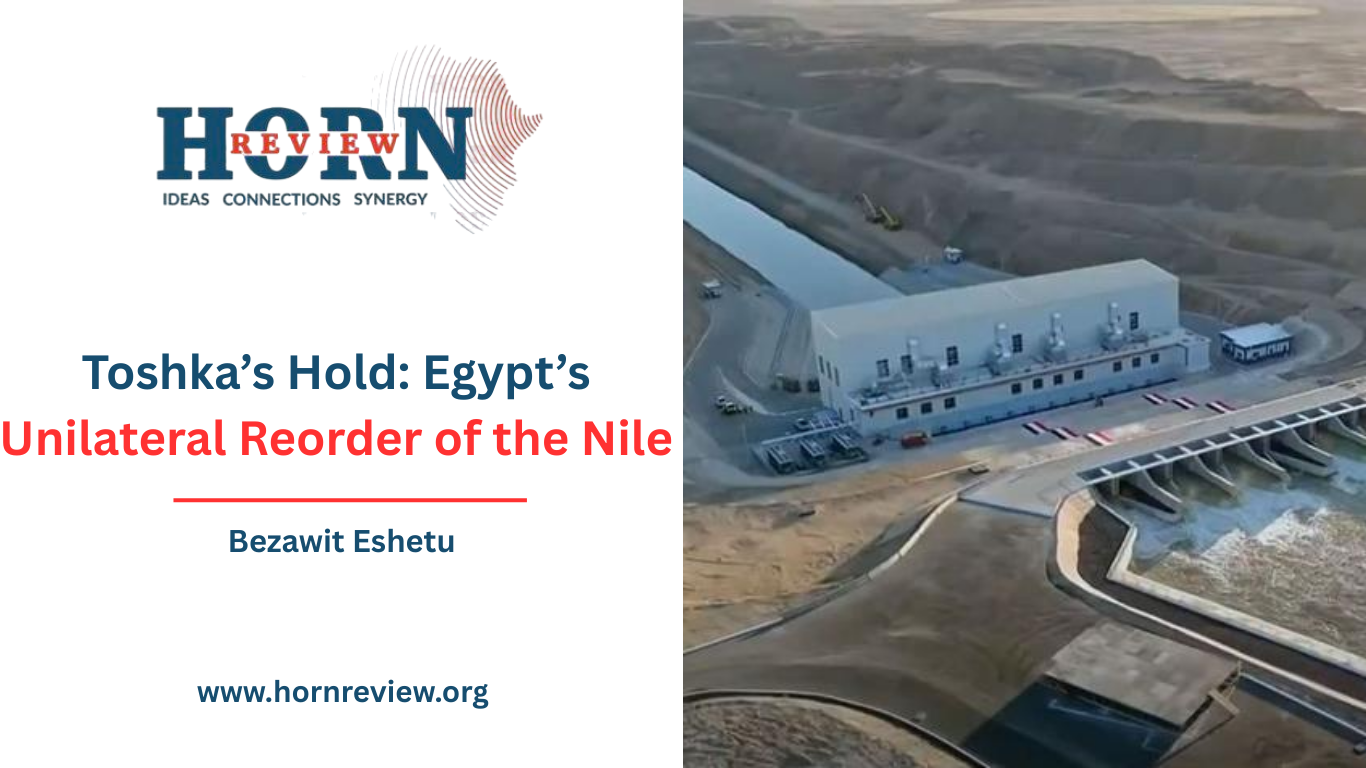
Egypt’s recent enlargement of the Toshka canal and spillway constitutes a substantive unilateral reconfiguration of Nile water management inside Egypt. Egyptian outlets and state-linked commentators report that the upgraded system can now divert and hold inland volumes on the order of 56 billion cubic metres, effectively creating a large artificial reservoir in the Western Desert that operates under Cairo’s domestic authority. That scale places Toshka in the same order of magnitude as longstanding allocations and expectations that structure basin operations; it therefore alters the operational facts on the river rather than merely reflecting routine flood management.
Technically, the conversion of episodic spillways into large, repeatable inland detention changes two interdependent hydrological variables with direct operational consequences: the timing of seasonal pulses and the net fraction of flow available to downstream users after detention losses. Many downstream farming systems, notably flood-recession agriculture in Sudan are synchronized to narrow seasonal windows and to the sediment pulses that accompany high flows. Withholding or deferring several billion cubic meters during those critical windows forces downstream operators to reschedule planting, to alter reservoir refill sequences, and to recalibrate pumping and irrigation regimes. Simultaneously, large shallow lakes in arid basins are hydrologically inefficient: high surface-area-to-volume ratios elevate evaporative losses and seepage converts part of the detained volume into subsurface storage that is not easily recoverable for basin-scale use. Together, changes in timing and in net available volume translate technical detention into measurable impacts for downstream water users.
These technical effects are not evenly distributed across riparians. Sudan is unusually exposed because its agricultural calendar and many irrigation infrastructures rely on predictable seasonal peaks and on the replenishment and sedimentation that high flows deliver. In the current environment, Khartoum’s capacity to observe and respond is constrained by a severe humanitarian and governance crisis that has degraded monitoring systems, displaced populations, and limited institutional coordination. When an upstream change coincides with weakened downstream measurement and limited evidentiary capacity, harm becomes both harder to detect in real time and harder to remediate through operational negotiation or diplomatic recourse. The practical result is that technically modest deviations in timing or volume can have outsized socioeconomic consequences.
The procedural context that governs transboundary rivers exists precisely to manage these kinds of trade-offs: international water law and basin arrangements codify duties of notification, data sharing and consultation for measures likely to have cross-border effects, because independent assessment and negotiated operating rules are the instruments by which differing priorities are reconciled. Egypt’s public justification for Toshka which is presented as precautionary protection of the Aswan High Dam and as normalizing flood management amid unusually high inflows is plausible as a technical objective. It becomes problematic, however, if pursued without prior regional engagement and transparent data exchange. Implementing large-scale diversions unilaterally substitutes hydraulic capacity for the legitimacy and risk-sharing that only joint assessment can produce, and it narrows the technical avenues available to resolve downstream harms.
Political framing magnifies the stakes. Cairo’s rhetoric condemning unilateral action elsewhere in the basin, most notably its repeated criticisms of Ethiopia over the Grand Ethiopian Renaissance Dam (GERD) rests on principles of no significant harm and cooperative management. Those principles retain normative force only when applied consistently. From the perspective of Addis Ababa and other upstream capitals, the Toshka maneuver is a striking instance of reciprocal unilateralism: a downstream state that invokes legal norms while operationalizing a major reallocation of flow paths inside its territory reinforces perceptions of double standards and erodes trust. The irony is heightened by scale and intent: GERD’s reservoir capacity is widely reported at about 74 billion cubic metres and was conceived primarily to generate electricity and drive development; Egypt’s Toshka initiative now claims a roughly comparable inland detention capacity under purely domestic authority. That symmetry in scale underscores why basin politics turn as much on perceived fairness of process as on hydrology.
A rigorous technical reading does not exonerate all upstream choices, nor does it absolve downstream concerns; it clarifies the trade-offs that must be managed. Ethiopia’s right to develop its water resources for power and economic growth is consistent with modern watercourse principles that endorse equitable and reasonable use, provided operations seek to avoid significant harm to co-riparians and engage in good-faith cooperation. The 2015 Declaration of Principles that Ethiopia, Egypt and Sudan signed reflects that balance by committing the parties to cooperation even while leaving detailed rules unresolved. Ethiopia’s argument that the GERD is a legitimate development instrument is therefore defensible in legal and policy terms, provided operational transparency and timely data sharing inform downstream risk management. At the same time, Egypt’s Toshka works should not be judged solely by national intent: the technical and political consequences for neighbors are material and require the same transparency and cooperative processes that Egypt demands of others.
Policy coherence requires reciprocal procedural practice. Practically, that means Egypt should disclose the engineering scope of the Toshka upgrades, the operable intake and storage capacity now available, and empirically grounded estimates of diversion timing, evaporation and seepage. Basin states and neutral experts should quickly convene an independent hydrological audit that translates engineering specifications into scenarios of downstream impact across the seasonal cycle. Those scenarios must form the basis for negotiated, binding operating protocols that preserve the predictable seasonal pulses Sudanese agriculture depends on, specify compensation where temporary reductions are unavoidable, and establish real-time monitoring and automatic data exchange so that deviations trigger pre-agreed mitigation. These measures convert domestic technical fixes into shared operational options that reduce the incentive for retaliatory unilateralism.
Absent procedural correction, the most likely short-term political dynamic is escalation by reciprocity: unilateral maneuvers that secure transient technical advantage tend to prompt countervailing actions and to institutionalize hydraulic brinkmanship. By contrast, integrating Toshka into a jointly managed operational regime could reframe it as a regional instrument for collective flood management and drought resilience, provided arrangements rest on verifiable data and equitable procedures. That choice between engineering capability divorced from negotiation or operational capacity embedded in cooperative governance is the strategic core of contemporary Nile politics. The basin’s long-term stability depends less on the engineering volumes that states can marshal than on whether those capacities are anchored to shared legitimacy and predictable, enforceable rules.
A responsible judgment must therefore be straightforward: Egypt’s Toshka expansion is defensible as a national emergency measure only if it is coupled immediately with full transparency and a commitment to joint technical review; absent that commitment, the move is rightly viewed as a unilateral reallocation of seasonal surplus that exacerbates regional mistrust and amplifies risk for vulnerable downstream users, above all Sudan. Recognizing Ethiopia’s development rights does not require tolerating operational opacity; similarly, insisting on procedural norms for upstream projects obliges Egypt to submit its own significant reconfiguration of the river to the same scrutiny. The basin will not achieve durable management by selective invocation of legal norms. It will do so only by converting capability into jointly governed, verifiable practice.
If policymakers are serious about stabilizing the Nile’s politics, the immediate tasks are technical and institutional rather than rhetorical: disclose, audit, negotiate and monitor. Those steps are modest in form but consequential in effect. They preserve legitimate national objectives while protecting downstream livelihoods, and they prevent the creation of a hydrological status quo premised on unilateral engineering advantage rather than on negotiated legitimacy. In a river basin marked by asymmetry and historical grievance, that is the only viable path to sustainable cooperation.
By Bezawit Eshetu, Researcher, Horn Review