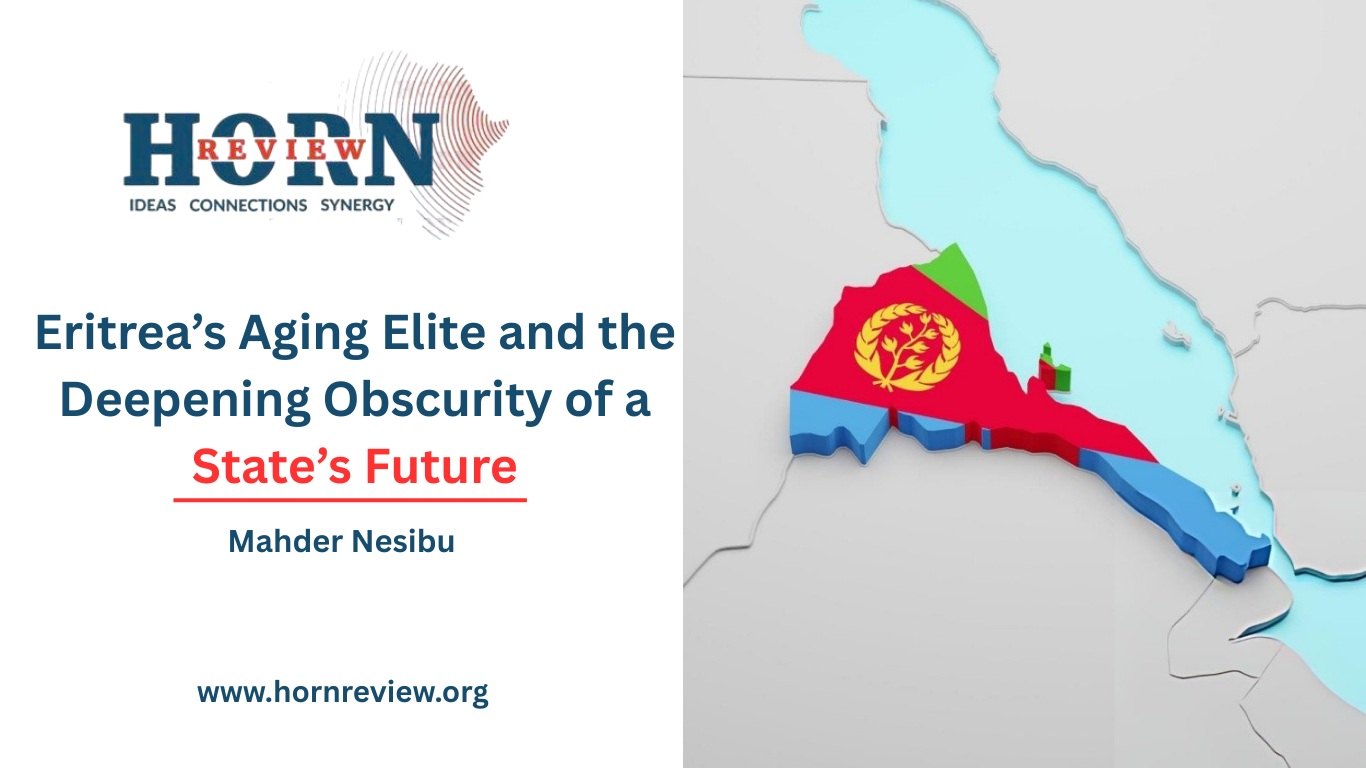
The future of Eritrea remains increasingly opaque as the senior ranks of the People’s Front for Democracy and Justice (PFDJ) continue to thin and the generation that established the state reaches the end of its political lifespan. The party, which has governed Eritrea under the leadership of President Isaias Afewerki, emerged from the Eritrean People’s Liberation Front (EPLF) and carried with it many of the attitudes, methods, and expectations formed during decades of armed struggle. The political culture that developed during that period rested on discipline, centralization, and a belief that unity relied on unquestioned leadership. These principles were viewed as indispensable during wartime. Once the PFDJ became the governing authority, they hardened into a system that dominated nearly every aspect of life in the country and permitted little institutional evolution.
This system took shape incrementally. When the EPLF entered Asmara in 1991, many believed that the movement included individuals capable of guiding Eritrea toward a structured political future. The early post-liberation years still carried a sense of possibility, and Eritrean society anticipated a phase of genuine state-building. Over time, however, there was a steady removal of that potential. Those within the ranks who expressed concerns about Eritrea’s trajectory were marginalized. The consolidation of authority by President Isaias unfolded slowly but decisively. The promise of a broader leadership was displaced by the ascent of a single figure whose control grew more rigid each year, and the initial optimism that surrounded independence was gradually subdued.
This trajectory shaped a political landscape defined by inflexibility. The president’s authority expanded as the party’s inner circle contracted. What remained was a leadership dominated by individuals from the liberation generation who had risen through a strict wartime hierarchy. Their influence was closely tied to their standing during the struggle. The assumptions and habits forged in that context shaped the way the party governed. A mentality rooted in vigilance, endurance and defensive thinking became the guiding framework of the state. The political and social environment grew narrower as the system prioritized loyalty and uniformity over institutional development.
The divide between the tegadelai generation and the younger Warsai generation widened with each passing year. The PFDJ built its authority on the symbolic legacy of the fighters and placed them at the summit of a generational hierarchy. Their fight formed the foundation of the state’s legitimacy and were used to justify an arrangement where the youth were treated as inheritors without autonomy. The Warsai designation allowed the PFDJ to integrate young people into a controlled structure that limited their access to education and economic space. This created a population that carried the responsibilities of citizenship without the ability to form independent views or ideas. The structure turned the youth into a dependent group, tied to national service and unable to cultivate the political awareness that might eventually challenge the established order.
This dependency became a defining feature of PFDJ rule. The absence of education, the scarcity of opportunities for independent work and the constant surveillance of public life reduced the capacity of young Eritreans to imagine or articulate alternatives. The party did not create a mechanism through which a new generation could emerge with the skill or confidence to manage a state. Instead, it kept the political arena sealed and allowed only those who belonged to the older cohort to shape national direction. Over time, this system hollowed out the state’s foundations. Institutions that might have trained future administrators were weakened or dismantled. The University of Asmara, once a national center of intellectual life, was dismantled. Civil society was eliminated. Independent media ceased to exist.
The combined effect of these developments is now becoming increasingly visible. President Isaias, at seventy-nine, has remained in power longer than the history of the Eritrean state itself. His leadership is inseparable from the legacy of the EPLF, and the PFDJ has been structured around him for decades. Many of the senior officials who surround him are also members of the same tegadelai generation. They hold all the key positions in the political bureau, within the security establishment and across government bodies. Their careers have been shaped entirely by the wartime movement and the centralized state that followed. As they reach advanced age, the system is losing figures who once held operational authority, and each passing marks another indication of how little preparation has been made for a future without them.
The repeated announcements by Information Minister Yemane G. Meskel on the deaths of senior military and party figures reflect this trend. These statements signal more than the passing of individuals. They highlight the fragility of a political order that depends on an aging elite without successors. The PFDJ relied on this cohort to maintain cohesion. As it fades, the absence of any alternative leadership becomes more apparent. Eritrea moves toward a period where the old guard can no longer sustain the system, while the younger generation has been prevented from gaining the skills that political life demands.
This challenge is compounded by the social and economic pressures that have accumulated for decades. The economy remains tied to PFDJ-controlled networks such as the Hidri Trust and the Red Sea Trading Corporation. These structures were created to support the party’s survival rather than foster national development. They concentrate resources in the hands of the ruling establishment and deprive the population of avenues for independent economic activity. As a result, the next generation will inherit a fragile economic landscape shaped by survival mechanisms rather than functioning markets.
Social divisions also stand to influence the future. Communities in the lowlands, Muslim groups and non-Tigrinya populations experienced prolonged marginalization under the current system. Their grievances remained suppressed and unresolved. The PFDJ’s focus on security and control kept these issues beneath the surface without addressing their origins. In a post-PFDJ environment, these concerns are likely to reappear with greater force. Eritrea’s political history includes early Muslim political organization and longstanding tensions between different regions of the country. These dynamics remain deeply rooted, even if muted for many years, and they will shape any future transition.
The exiled opposition remains active yet operates entirely outside Eritrea. Its members have been absent from state institutions for many years, and the long arc of emigration has deprived the country of a generation that might have developed political confidence within its own institutions. Much of the educated youth lives abroad, forming the only space where alternative visions of Eritrea are expressed with freedom, although this distance weakens their influence. Those who imagine a political order beyond the PFDJ do so without familiarity with the administrative culture that shapes authority inside the country, and their political outlook develops without the experience that domestic participation would provide.
The diaspora also carries enduring divisions. Exiled Eritreans draw on different perceptions, and these contrasting experiences create varied interpretations of the present. PFDJ-linked networks abroad reinforce this fragmentation by monitoring communities and exerting pressure on those seeking to organize independently. These dynamics hinder the formation of a cohesive alternative movement, leaving political groups dispersed and unable to build momentum toward a future transition.
This distance between external political imagination and internal political constraint produces a significant gap. Those with the capacity to guide Eritrea’s future remain outside the state, and those within the country live under conditions that suppress political initiative.
As the PFDJ’s leadership continues to age, Eritrea is increasingly faced with the consequences of a system that avoided renewal for decades. The absence of institutional development, the dispersal of educated youth abroad and the tight restrictions on political life leave the state approaching a phase for which it is structurally unprepared. As this grip loosens, the next generation will confront a wide set of challenges, and the pressures embedded in the country’s economic, institutional and social landscape will surface with greater clarity. The cohort that inherits this moment remains ill-equipped to manage its demands, shaped by circumstances that offered neither preparation nor room to develop the capacity that such a period will require.
By Mahder Nesibu, Researcher, Horn Review