From Promise to Material Breach: 25 Years of Eritrea’s Defiance of the Algiers Agreement
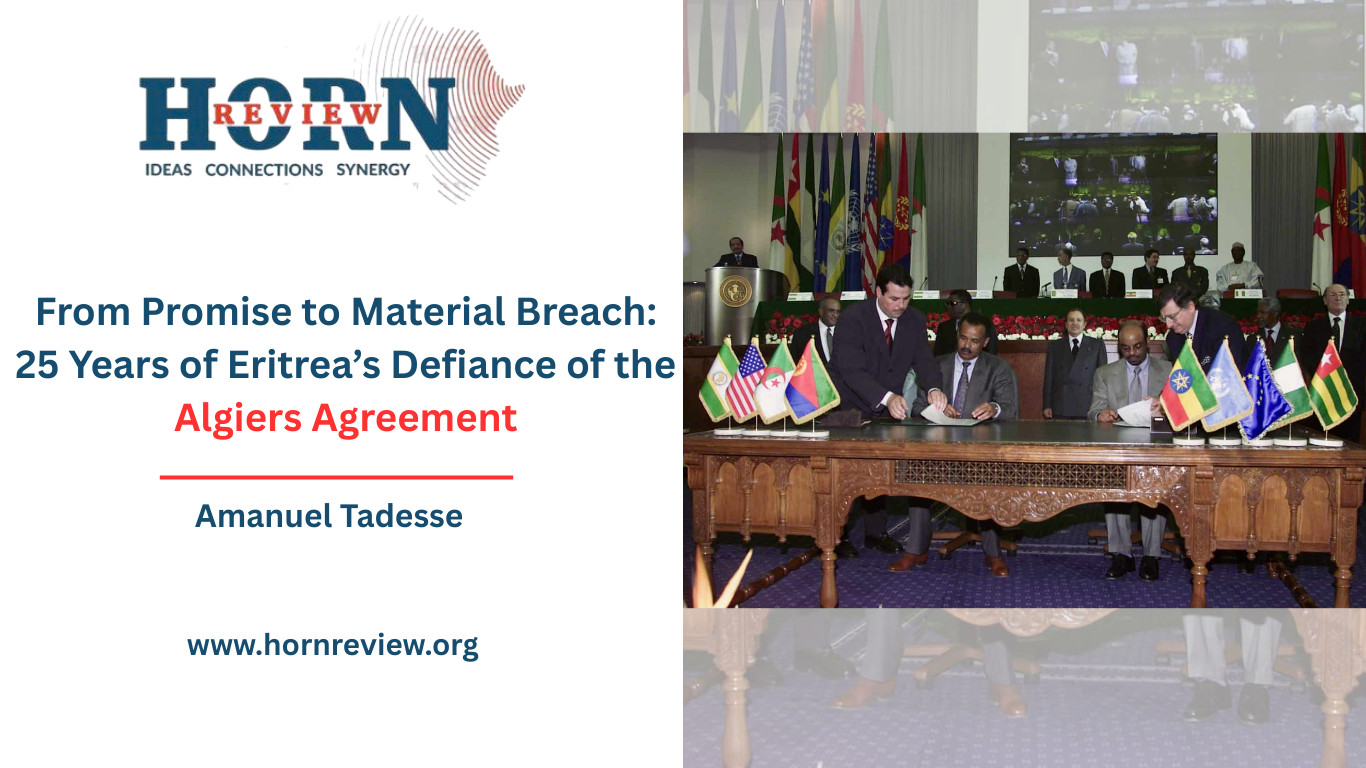
Following Eritrea’s independence in 1993, relations between Ethiopia and Eritrea deteriorated into a full-scale armed conflict between 1998 to 2000 over the flashpoint of Badme as boundary disputes. Although Ethiopia prevailed militarily, the war was formally terminated through the Algiers Peace Agreement of December 2000, concluded under the auspices of the United Nations, the African Union, the European Union, the United States, and Algeria as guarantor. The Agreement sought to replace military confrontation with legally binding mechanisms, notably through the Eritrea-Ethiopia Boundary Commission (EEBC) and the Eritrea-Ethiopia Claims Commission (EECC).
Despite its formal acceptance of the Agreement, Eritrea has repeatedly engaged in subversive conduct that amounts to material breaches within the meaning of International Law of Treaties, particularly under the Vienna Convention on the Law of Treaty (VCLT, 1969). These breaches have systematically undermined the object and purpose of the Algiers Agreement-the permanent and definitive cessation of hostilities and the peaceful, legally binding settlement of disputes and have obstructed the effective operation of its institutional mechanisms. Eritrea’s conduct has further violated the spirit and intent of subsequent normalization efforts, including the Asmara Joint Declaration and the Jeddah Peace Agreement of 2018, thereby destabilizing regional peace and security in the Horn of Africa.
Examining Eritrea’s material breaches of the Algiers Agreement under international law and clarifying their legal effects, including Ethiopia’s entitlement to invoke termination under Article 60 of the VCLT, is therefore imperative to puncturing the regime in Asmara’s fundamentally deceptive narrative. For the last 25 years, Eritrea has cynically masqueraded as a law-abiding state while systematically hollowing out the very treaty it claims to have defended, reducing the Algiers Agreement to a diplomatic hostage and a propaganda instrument. This deliberate abuse of international law has served no peace but the regime’s coercive agenda, regional destabilization, proxy warfare, territorial adventurism, and the sustained assault on Ethiopia’s sovereignty, security and national interests. Exposing this duplicity is a necessary act of political and normative demystification.
Material Breach Under International Law
Before assessing whether Eritrea’s conduct amounts to a material breach of the Algiers Agreement, it is important to clarify the concept of material breach under international law as it applies to bilateral treaties. Article 60(1) of the VCLT provides that “a material breach of a bilateral treaty by one party entitles the other party to invoke the breach as a ground for terminating or suspending the treaty operation in whole or in part.”Article 60(3) defines a material breach as either (a) a repudiation of the treaty not sanctioned by the Convention or (b) the violation of a provision essential to the accomplishment of the treaty’s object and purpose.
Although the VCLT entered into force after many foundational treaties were concluded, the rule on material breach has attained and codified into the status of customary international law. For instance, in the Namibia Advisory Opinion Case (ICJ, 1971), the court noted that “the Convention’s rules on treaty termination for breach “may in many respects be considered as a codification of existing customary law.” Similarly, in Gabcikovo Nagymaros Project Case (ICJ, 1997), the court held that Articles 60 to 62 of the VCLT reflect customary international law, applying even when the treaty predates the Convention. These precedents confirm that material breach is a universally recognized ground for termination of bilateral treaties, subject only to the doctrine of persistent objection.
Against this legal framework, the Algiers Agreement, now in its 25th year, must be assessed. Article 1 of the Agreement explicitly identifies its object and purpose as “the permanent cessation of hostilities and the peaceful, legally binding resolution of disputes through adjudicate and institutional mechanisms.” Eritrea’s conduct must therefore be evaluated in light of whether it has repudiated the Agreement or violated provisions essential to achieving these objectives.
- Obstruction of the Operation of UNMEE and Non-Cooperation with the EEBC
Eritrea imposed crippling operational restrictions on the United Nations Mission in Ethiopia and Eritrea (UNMEE), including fuel embargos, denial of aerial access, and severe limitations on freedom of movement. These measures critically undermined the Mission’s ability to discharge its mandate and led to its forced withdrawal in 2008. The UN Security Council in its resolution 1827 in 2008 confirmed that Eritrea’s conduct “rendered the UNMEE incapable of fulfilling its functions and effectively paralyzed the boundary demarcation process.”
In parallel, Eritrea obstructed the EEBC by denying access to technical experts for demarcation, refusing to cooperate in the placing boundary pillars, and rejecting agreed modalities for implementation. Such conduct constitutes a clear violation of Article 14(14) of the Algiers Agreement, which obliges both parties to cooperate fully with the Boundary Commission. The ICJ has consistently acknowledged in Nicaragua v. United States, (1986) that“States remain bound to comply with their treaty obligations in good faith, even in politically sensitive contexts.” Eritrea’s persistent refusal to cooperate with the EEBC therefore amounts to repudiation of essential provisions and qualifies as a material breach under Article 60(3)(b) of the VCLT.
- Support for Armed Groups and Proxy Warfare
Article 1 of the Algiers Agreement reiterates “the obligation of both parties to refrain from the threat or use of force against one another,” mirroring Article 2(4) of the UN Charter. Contrary to this obligation, Eritrea has, over 25 years, provided material, logistical, and political support to armed non-state actors operating against Ethiopia, ARDUF, OLA-Shene, extremist Fano armed groups, and remnants of the now defunct TPLF.
As established in the Nicaragua Case, such support constitutes an indirect use of force and violates both the prohibition on the use of force and the principle of non-intervention. Eritrea’s direct military intervention during the 2020-2022 Northern conflict further aggravated its responsibility. Its conduct thus defeats the object and purpose of the Algiers Agreement and qualifies as a material breach under Article 60(3)(b) of the VCLT.
- Militarization of the Temporary Security Zone
The Algiers Agreement and the Comprehensive Peace Agreement established a Temporary Security Zone (TSZ) as a demilitarized buffer within Eritrean territory, supervised by UNMEE. In October 2006, Eritrean forces entered the TSZ with heavy military equipment, directly contravening the Agreement and UN Security Council Resolution 1320. Subsequent UN Resolutions, including 1767 (2007) and 1798 (2008), condemned Eritrea’s actions and demanded unconditional withdrawal.
Eritrea’s persistent militarization of the TSZ undermined a core mechanism of the peace framework and destroyed the treaty’s raison d’être. Scholars like Villiger note that treaty termination is justified when a state’s actions destroy the very purpose of the treaty. Corten and Klein similarly argue that the non-implementation of treaty-mandated demilitarized zones amounts to a material breach. Eritrea’s repeated militarization of the TSZ therefore qualifies as a material breach under Article 60(3)(b) of the VCLT.
- Continued Unlawful Territorial Occupation Post – 2018
Ethiopia’s unconditional acceptance of the EEBC decision in July 2018 marked a decisive legal step to end the decades-long stalemate of “no peace, no war.” This acceptance was politically and normatively operationalized through the Asmara and Jeddah Peace Agreements, both of which reaffirmed the binding character of the EEBC decision.
Notwithstanding Ethiopia’s compliance, Eritrean forces have continued to occupy substantial parts of sovereign Ethiopian territory, including areas of Irob, Gulo-Mekeda, Egela, Tahtay Adiyabo, and Zalambessa. UN reporting has further confirmed the presence of Eritrean forces in locations awarded to Ethiopia, including Weraetle, Alitena and Sebeya.
Although the EEBC determined in 2002 that Badme fell within Eritrean territory, it emphasized that implementation should occur through a peaceful and coordinated process. Eritrea’s post 2018 conduct constitutes a unilateral use of force to alter territorial control, engaging Article 2(4) of the UN Charter and the law of belligerent occupation under Article 42 of the 1907 Hague Regulations.
UN and human rights investigative mechanisms have documented extrajudicial killings, arbitrary detention, sexual and gender-based violence, forced conscription and other violations of occupied areas. These acts constitute grave breaches of the Fourth Geneva Convention and may amount to war crimes or crimes against humanity.
Reports by the Interim Tigray Administration during Getachew Reda’s tenure have also indicated attempts by Eritrean security forces to issue Eritrean national identity documents to residents of occupied Ethiopian territories while denying Ethiopian nationals their civic and political rights. If substantiated, such measures suggest an attempt at de facto annexation, a practice unequivocally prohibited under international law and incompatible with the temporary nature of occupation. Eritrea’s continued military presence and occupation after 2018 defeats the object and purpose of the Algiers Agreement and establishes a material breach under Article 60 of the VCLT.
The Legal Effect of Terminating the Algiers Agreement
The 25-year history of the Algiers Agreement demonstrates Eritrea’s persistent defiance. Its systematic obstruction of EEBC implementation, interference with UNMEE, militarization of the TSZ, re-occupation of Ethiopian territory, and support for proxy armed groups constitute material breaches with serious consequences under the VCLT, the law of state responsibility, and peremptory norms of international law.
Under Article 60(1) of the VCLT, Ethiopia is entitled to invoke termination or suspension of the Algiers Agreement. Eritrea’s refusal to cooperate with the EEBC’s processes, militarization, and post-2018 occupation directly undermine the Agreement’s essential provisions. Termination is a lawful, proportionate response aimed at safeguarding Ethiopia’s sovereignty, upholding international law, and restoring regional stability.
Eritrea’s conduct constitutes internationally wrongful acts attributable to the state, including violations of jus cogens norms, entitling Ethiopia to lawful countermeasures and reinforcing its inherent right to self-defense under Article 51 of the UN Charter. Termination under Article 60 of the VCLT, grounded in a persistent record of non-compliance, represents a defensive assertion of treaty integrity and legal accountability rather than a repudiation of peace.
Ethiopia’s Lawful Rights in Response to the Material Breach
Eritrea’s sustained and systematic violations of the Algiers Agreement constitute material breaches within the meaning of Article 60 of the VCLT, thereby entitling Ethiopia, as a matter of law, to invoke termination of the Agreement. These breaches have effectively undermined the Agreement’s legal and institutional foundations, neutralized the operative framework of the EEBC, and engaged Eritrea’s international responsibility, including for conduct implicating peremptory norms of international law. In this context, termination cannot be characterized as a repudiation of peace; rather, it represents a lawful and proportionate response directed at safeguarding Ethiopia’s sovereignty, upholding the authority of international law, and restoring a credible basis for regional stability.
Eritrea’s conduct further constitutes internationally wrongful acts attributable to the state, including violations of the prohibition on the threat or use of force and the principle of non-intervention. Such conduct entitles Ethiopia to adopt proportionate and lawful countermeasures, encompassing treaty termination and other calibrated legal, political, and diplomatic responses to territorial encroachment and proxy-based aggression. In parallel, Ethiopia remains fully entitled to invoke its inherent right of self-defense under Article 51 of the UN Charter in response to external incursions and Eritrea-backed armed activities. This right operates independently of, and is reinforced by, Eritrea’s treaty breaches. While Ethiopia has consistently pursued diplomatic engagement and constructive dialogue in good faith, international law does not require the indefinite toleration of violations that result in the continued occupation or destabilization of its territory.
When properly invoked, Article 60 of the VCLT grounded in a well-documented and persistent record of Eritrean non-compliance frames termination as a defensive assertion of treaty integrity and legal accountability, rather than an abandonment of peaceful settlement. It strengthens Ethiopia’s position in international fora, underscores a clear rejection of destabilization through proxy violence, and reinforces deterrence within the jus ad bellum framework.
References
International Court of Justice Cases
- International Court of Justice. (1949). Corfu Channel (United Kingdom v. Albania), Merits (ICJ Reports 1949, p. 4).
- International Court of Justice. (1986). Military and Paramilitary Activities in and against Nicaragua (Nicaragua v. United States of America), Merits (ICJ Reports 1986, p. 14).
- International Court of Justice. (1997). Gabčíkovo–Nagymaros Project (Hungary v. Slovakia) (ICJ Reports 1997, p. 7).
- International Court of Justice. (1971). Legal consequences for States of the continued presence of South Africa in Namibia (South West Africa) notwithstanding Security Council Resolution 276 (1970) (Advisory Opinion, ICJ Reports 1971, p. 16).
International Treaties, Agreements, and Conventions
- Agreement between the Federal Democratic Republic of Ethiopia and the State of Eritrea. (2000, December 12).
- United Nations. (1945). Charter of the United Nations (1 UNTS XVI).
- United Nations. (1949). Geneva Convention relative to the protection of civilian persons in time of war (Fourth Geneva Convention) (75 UNTS 287).
- Hague Conference on Private International Law. (1899). Hague Convention (II) with respect to the laws and customs of war on land.
- Hague Conference on Private International Law. (1907). Hague Convention (IV) respecting the laws and customs of war on land.
- United Nations. (1969). Vienna Convention on the Law of Treaties (1155 UNTS 331).
United Nations Security Council’s Resolutions
- United Nations Security Council. (2000). Resolution 1320 (UN Doc. S/RES/1320).
- United Nations Security Council. (2007). Resolution 1767 (UN Doc. S/RES/1767).
- United Nations Security Council. (2008). Resolution 1798 (UN Doc. S/RES/1798).
- United Nations Secretary-General. (2008). Report of the Secretary-General on the United Nations Mission in Ethiopia and Eritrea (UN Doc. S/2008/28).
Books and Scholarly Works
- Corten, O., & Klein, P.-M. (Eds.). (2011). The Vienna Convention on the Law of Treaties: A commentary. Martinus Nijhoff.
- Villiger, M. E. (2009). Customary international law and treaty termination. Springer.
By Amanuel Tadesse, International Law and Foreign Relations Expert

RELATED
Posts
9
Sep
Sudan’s War and Ethiopia’s Narrowing Strategic Space
How SAF–Eritrea Cooperation and TPLF Mobilization Are Reshaping the Regional...
9
Sep
Understanding the Transactional Alliance between Yemen's Houthis and Somalia's al Shabaab
The alleged al Shabaab fighters among Houthi casualties on...
9
Sep
Somalia’s “Anti-Türkiye Axis” Is a Strategic Illusion
The Red Sea Axis article, “Why Somalia's Military Rise...
9
Sep
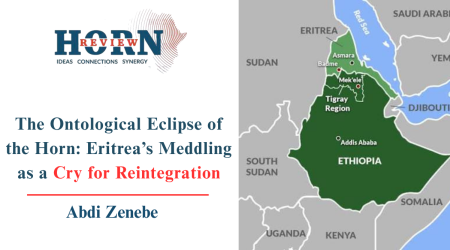
The Ontological Eclipse of the Horn: Eritrea’s Meddling as a Cry for Reintegration
By Abdi Zenebe (PHD), Deputy Director, FDRE Institute of Foreign...
8
Sep
TPLF's Obasanjo Complaint Masks a Leverage Deficit, Not a Neutrality One
The Tigray People’s Liberation Front’s September 6 statement accusing...
8
Sep
Clan Realism and the Capture of Somalia's Intelligence
The National Intelligence and Security Agency of Somalia occupies a...
7
Sep
Somalia's Centralization Drive and Kenya's Potential Response
The confrontation in the Horn is frequently distilled into simplistic...
7
Sep
Somaliland Recognition and the Limits of Bureaucratic Risk Aversion
The United States position on Somaliland is one of the...