
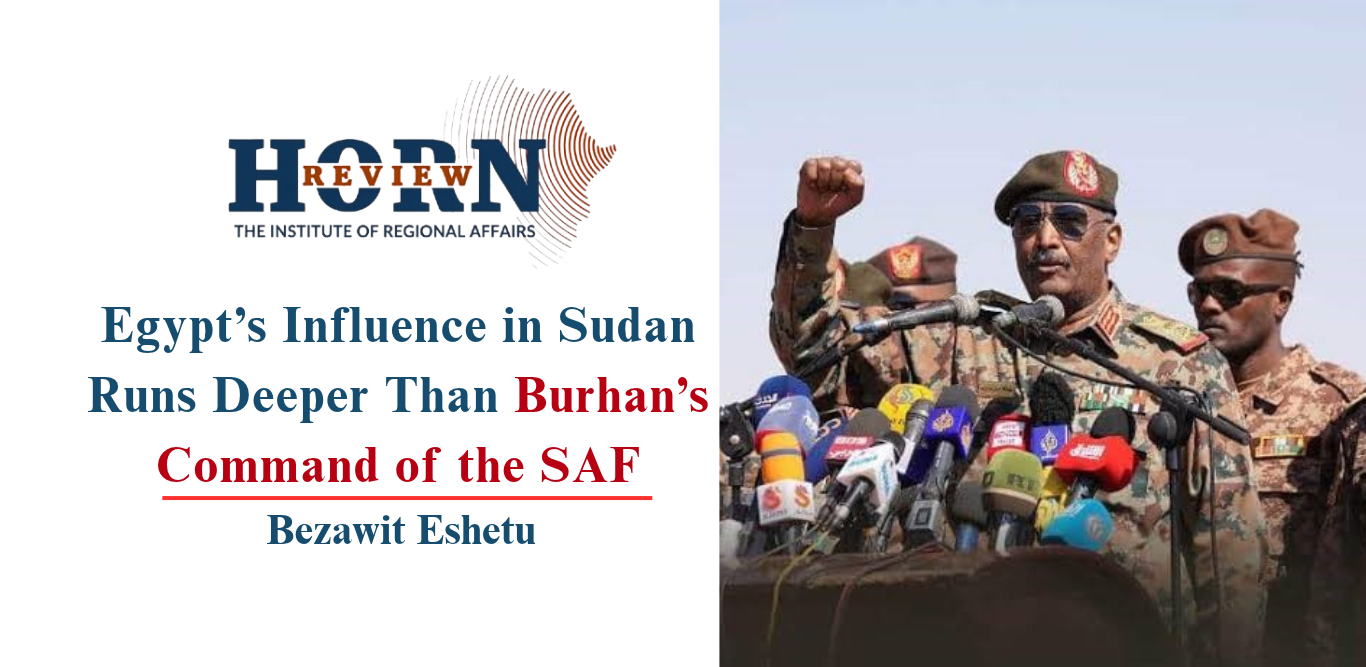
Egypt’s Influence in Sudan Runs Deeper Than Burhan’s Command of the SAF
Egypt’s relationship with Sudan is frequently reduced to Cairo’s support for General Abdel Fattah al-Burhan since the war began in April 2023. This interpretation confuses the most visible interlocutor with the wider structure through which Egyptian influence operates. Cairo’s engagement extends across the SAF, military intelligence, defense production, commercial networks and political constituencies surrounding the state. Burhan occupies a central position in this architecture, but the relationship has been built through institutions, personnel and strategic interests that predate his leadership and can outlast it. The durability of this institutional relationship is also rooted in the social composition of the Sudanese state, particularly the networks that have historically shaped its political, administrative and military establishment.
Since independence, political and administrative authority has been disproportionately concentrated among networks associated with the Nile Valley north of Khartoum, particularly the Ja’aliyyin, Shaigiya and Danagla lineages. The senior military officer corps has reflected this pattern, even as the army’s broader ranks have recruited from communities across the country. This distinction between a socially diverse military and a command structure rooted disproportionately in the riverine core has shaped the SAF’s institutional identity and its conception of the state it serves. Unequal access to education, administrative employment and military training helped consolidate these networks within the central establishment, while peripheral communities often encountered state authority through coercive administration and military campaigns
This hierarchy has deep historical roots. The Turco-Egyptian conquest beginning in 1820 incorporated Sudan into a Nile-centered imperial administration and established Khartoum as a major military and political center. British rule subsequently reorganized the country’s coercive institutions, including through the establishment of the Sudan Defense Force in 1925 following the withdrawal of Egyptian forces. The development of military recruitment, training and access to state institutions remained uneven across the country, reinforcing the distinction between the central military establishment and locally recruited forces in peripheral regions.
The Sudanese Armed Forces inherited this institutional legacy, developing as the principal military institution of the central state and acquiring an organizational identity closely associated with its preservation. Yet the state also relied on a different model of coercive authority in regions where its formal institutions had a weaker presence. The Rapid Support Forces (RSF) emerged from this parallel system of government-backed militia mobilization during the Darfur conflict, before being formalized as a separate force in 2013. Its recruitment networks in Darfur and Kordofan, distinct command structure and independent commercial resources gradually gave it the organizational capacity to challenge the army’s military primacy.
The confrontation between the SAF and the RSF therefore reflects the crisis of a state architecture that concentrated political and military authority in Khartoum while depending on peripheral armed formations to extend and enforce its power. What had functioned as an instrument of central control ultimately developed into a rival center of coercive power.
Cairo’s preference for the SAF follows from the strategic value of a centralized Sudanese state under military leadership with established relations with Egypt. Sudan’s long border with Egypt, its position between the Nile Valley, the Sahel and the Horn of Africa, and its importance to Nile diplomacy make the character of authority in Khartoum a matter of Egyptian national security. The conventional army offers Cairo an identifiable counterpart for border coordination, security agreements and regional diplomacy. It also provides an institutional partner through which Egypt can seek continuity in Sudan’s position on the Grand Ethiopian Renaissance Dam (GERD).
Former British ambassador Dame Rosalind Marsden described Egypt’s strong preference for the Sudanese army and Burhan, highlighting the close links between the two militaries and Cairo’s interest in retaining Sudan as an ally in negotiations over the GERD. The relationship therefore connects military cooperation to Egypt’s wider strategic interests in the Nile Valley.
The military relationship has an institutional history extending well beyond Burhan. The 1976 Joint Defense Agreement formalized an established security partnership, which subsequently developed through officer training, professional exchanges and defense contacts. This foundation was further developed in March 2021, when Egyptian Chief of Staff Mohamed Farid and his Sudanese counterpart, Mohamed Othman al-Hussein, signed a military cooperation agreement covering training, joint exercises and security coordination. Exercises such as Nile Eagles have since provided practical settings for cooperation in air operations and maritime training.
Joint training familiarizes officers with one another’s procedures and operational practices, while regular exchanges and coordination sustain channels of communication across different levels of the military hierarchy. Over time, these interactions generate institutional familiarity and networks that are less dependent on the political fortunes of any individual leader. Egypt’s relationship with the Sudanese Armed Forces therefore operates through a wider military establishment, including senior officers, professional networks and bilateral committees that preserve cooperation across changes in political leadership.
The historical breadth of Egyptian engagement also extends into Sudanese religious and social networks. During the 1950s, Egypt’s Free Officers government cultivated Sudanese Sufi networks through al-Azhar and religious diplomacy as part of its efforts to preserve influence over the Nile Valley. These networks offered channels of political influence beyond formal government institutions and military command. The historical experience illustrates an enduring feature of Egypt’s approach to Sudan, in which military, political, religious and social relationships have operated alongside one another.
Egyptian engagement with the SAF also extends into the economic and industrial institutions that underpin its organizational capacity. In November 2020, Egypt’s National Organization for Military Production and Sudan’s Military Industry Corporation signed a memorandum of understanding on manufacturing cooperation. This institutional link was reinforced in April 2021, when Sudanese Defense Industries System General Manager Merghani Edris met Egypt’s Minister of State for Military Production, Mohamed Ahmed Morsi, to discuss expanding industrial cooperation. The significance of these exchanges lies in their connection of the two countries’ military-production establishments, creating an institutional basis for cooperation that extends beyond conventional defense diplomacy. The relationship also reaches into commercial activity surrounding the military establishment.
Sudanese military-linked enterprises have been associated with Egyptian army-affiliated companies in arrangements involving agricultural trade and exports. GreenZone, a company linked to Sudan’s military-industrial establishment, featured in reported trading arrangements, while Multiple Directions, another military-linked enterprise, was alleged to maintain connections with Egyptian intelligence. Taken together, these relationships indicate that bilateral engagement extends into the commercial networks through which Sudan’s military establishment has accumulated and managed economic resources. They also provide additional channels through which institutional relationships between the two countries can operate beyond formal military command structures.
This institutional engagement has a corresponding political dimension. Egypt’s relationships with Sudan have extended beyond the SAF command to political and armed constituencies whose participation could influence the composition of any post-Bashir governing arrangement. In February 2023, Cairo hosted a meeting of Sudanese political and armed groups that had rejected the December 2022 Framework Agreement. Among the participants were Democratic Bloc figures Gibril Ibrahim, Minni Arko Minnawi, Gaffar al-Mirghani and Mohamed al-Amin Terik, alongside other political forces. The meeting took place as civilian groups and international mediators were attempting to organize the transition around the Framework Agreement, and it provided a separate platform for forces contesting that political process.
Cairo’s engagement with these constituencies was consequential because their influence extended into armed movements, regional political networks and competing claims over the transitional order. The initiative thus reflected an approach to Sudanese politics that encompassed the military command as well as the political forces capable of shaping the environment in which the army would exercise power. Egypt’s relations with these actors provided channels for engagement beyond the formal structures of the SAF and broadened its presence within Sudan’s fragmented political landscape.
The political significance of these relationships becomes clearer when considered alongside the internal composition of the SAF itself. The army is not a politically homogeneous institution. Islamist supporters of the former National Congress Party have retained considerable influence within the officer corps and over Burhan, while figures associated with the former regime regained greater public visibility following the October 2021 coup. These networks coexist with professional military constituencies, officers with established institutional interests and commercial actors connected to the military economy developed under Bashir. Their interests and political orientations do not necessarily coincide, but together they shape the army’s institutional outlook, its relationship with civilian authorities and the prospects for security-sector reform. Egypt’s longstanding contacts with the senior command, intelligence services and military-industrial leadership place it in contact with several of the institutions and networks through which this fragmented power structure operates.
The history of Egypt–Sudan relations under Bashir also demonstrates that longstanding institutional ties do not necessarily prevent political confrontation. Bashir’s Islamist orientation, his government’s relations with Iran and its regional policies increasingly brought Khartoum into conflict with Cairo. The 1995 assassination attempt against Hosni Mubarak in Addis Ababa, which Egypt alleged had received Sudanese support, further deepened the crisis, while the Halaib dispute added a territorial dimension to bilateral tensions.
Relations began to improve in 1999 following Bashir’s marginalization of Hassan al-Turabi and efforts to reduce Sudan’s regional isolation. The shift illustrated the extent to which political alignment could determine the intensity of cooperation, even where military and historical connections remained established. Egypt’s relationship with Sudan has consequently involved periods of both convergence and confrontation, shaped by the political orientation of successive governments as well as the strategic interests of the two states.
Following Bashir’s removal in 2019, Cairo’s engagement shifted towards the Transitional Military Council and the military leadership that emerged as the principal center of authority during the transition. The GERD dispute strengthened this orientation, while the March 2021 defense cooperation agreement and subsequent joint exercises expanded the existing military relationship. Egypt’s response to the October 2021 coup, its reception of the Burhan–Hamdok agreement and its February 2023 initiative involving political groups outside the Framework Agreement reflected a wider effort to maintain relations with the institutions and constituencies shaping Sudan’s political transition. Burhan’s growing importance to Cairo was closely connected to his position within the military establishment and his command of the SAF. His emergence as Egypt’s principal interlocutor thus coincided with the continuation of a military relationship that had developed well before his assumption of command.
Egypt’s position within this relationship is consequently deeper than its association with Burhan. Its links with the SAF extend through the senior command, successive generations of officers, military intelligence and defense-industrial institutions, with professional exchanges and bilateral cooperation providing continuity beyond changes in military leadership. Burhan occupies an important position within this network, but the relationship does not originate with him or depend exclusively on his tenure. A change in the SAF’s leadership would alter Cairo’s immediate interlocutors, but would not in itself erase the institutional connections developed between the two military establishments.
By Bezawit Eshetu, Researcher, Horn Review

RELATED
Posts
19
Nov
Saudi Arabia, RSF and the Shadow of The Yemen War
A chain of high-profile defections has begun to fray the...
19
Nov
Why the SAF–Houthi Relationship Matter Beyond Sudan
The Century Foundation has published a detailed report...
19
Nov
The Structural Autopsy of the 1991 London Talks and Its Lasting Legacy
The current Ethiopian state establishment is engaged in a comprehensive...
19
Nov
Is the Historic Ethio-Djibouti Port Diplomacy Set to Deepen Over the Quest for Sea Access?
Nearly three decades of bilateral agreements have proven that Djibouti...
16
Nov
Ethiopia as a Focal Point Between the Quad and Quintet Coalition on Sudan
Sudan's war has brought together numerous regional and international actors,...
16
Nov
Somalia's National Forum Failed to Materialize on November 14, Why?
The gathering scheduled to take place in Mogadishu between November...
16
Nov
Why Darfur's Local Peace Deals Keep Collapsing
In the arid borderlands of South Darfur, long-simmering tensions between...
16
Nov
Political Contestation is Driving Mass Desertion in the Somali National Army
The desertions currently afflicting the Somali National Army following the...
16
Nov
The SAF as Egypt's Proxy in the Projection of Regional Power
To understand the tragedy consuming Sudan, observers often isolate the...
16
Nov
Sisi’s Strategy of Externalising Egypt’s Economic Crisis
Egypt’s persistent economic difficulties have placed President Abdel Fattah al-Sisi’s...