
Egyptian Offer of Troops to Saudi Arabia: Why Now?
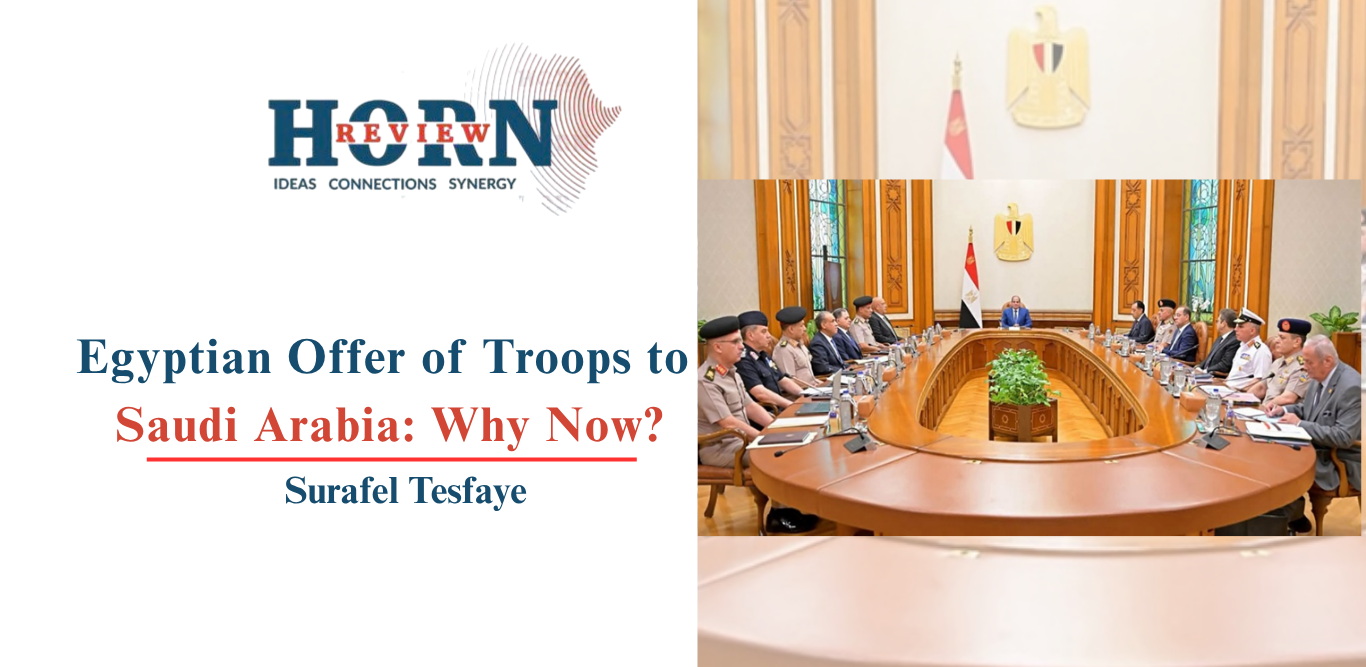
When President Abdel Fattah el-Sisi asked Egypt’s parliament on 18 October 2026 to approve sending military forces abroad, he framed the request around a single idea: that Saudi security and Egyptian security are inseparable. The National Defense Council issued a statement declaring that Cairo stands with Riyadh to protect the kingdom’s resources, borders, and Islamic holy sites, and Sisi repeated the theme in his own remarks. The immediate trigger was a sharp escalation in Houthi attacks, most notably a strike on Riyadh’s King Khalid International Airport that killed fifteen people and wounded several others, including Egyptian nationals.
On the surface, this reads as a familiar story about Arab collective security, with Egypt stepping forward as the region’s traditional shield. But the timing, the economic arithmetic, the diplomatic friction that preceded the request, and the long history of Egyptian-Saudi security arrangements all point to something more complicated. This pledge is not simply a reaction to a single incident. It is the product of a crisis that has been building since late 2023, and it is shaped by a relationship that has been defined for seventy years by the exchange of Egyptian military weight for Gulf financial support.
The economic pressure is the clearest place to start. Egypt’s foreign minister has stated that the Suez Canal has hemorrhaged roughly $10 billion in revenue since Houthi attacks on Red Sea shipping began forcing vessels onto longer routes around Africa. Other estimates put the annual loss at $7 billion dollars, which amounts to $17 billion blow over three years. The canal is Egypt’s most reliable source of hard currency, and its decline has pushed an already fragile economy closer to the brink. The Houthis insist their fight is primarily with Saudi Arabia and their strikes have concentrated on Saudi pipelines, airports, and infrastructure. Yet Cairo has concluded that it cannot remain insulated from a conflict that has already damaged its economy without any attack on Egyptian interest. When the Red Sea becomes an active warzone, global shipping bypasses the region, and when shipping bypasses the region, the canal empties out. That is the primary driver behind Egypt’s willingness to accept military risk it has historically avoided.
The financial relationship with Riyadh adds a second layer of pressure that leaves Cairo with limited room to manoeuvre. Saudi Arabia currently holds about 10.3 billion dollars in deposits at the Central Bank of Egypt, and 5.3 billion dollars of that total matures in October 2026. These deposits function as financial leverage rather than unconditional support, and their imminent maturity gives Riyadh considerable influence over Egyptian decision-making at a vulnerable moment. Egypt’s economic survival has been tied to Gulf support since 2013, when Saudi Arabia, the UAE, and Kuwait provided roughly 23 billion dollars in post-revolution aid. Sisi has reminded the Egyptian public of the free shipments of oil, gas, and wheat the Gulf provided during Egypt’s own political instability, presenting the current military support as a repayment of that debt. The arithmetic is straightforward. If Egypt declines to assist Saudi Arabia at a moment of acute security anxiety, Riyadh could withhold or recall those billions, and the result would be an immediate fiscal crisis in Cairo.
There is also a political dimension that Cairo has not forgotten. In August 2026, Saudi Arabia, Turkey, and Pakistan signed the Mecca Joint Defense Agreement, a pact committing all three states to treat an armed attack on one as an attack on all. Egypt was not among the signatories, and not because it declined. Multiple Saudi sources told Middle East Eye that Riyadh actively blocked Egypt’s inclusion despite Ankara’s push for Cairo to be brought into the arrangement. The reasons cited by those sources are revealing. Saudi officials were frustrated by what they regarded as Egypt’s minimal and passive role in the war against the Houthis, its cautious balancing during the US and Israeli confrontations with Iran, and its growing financial dependence on the UAE. One former senior adviser to the Saudi monarchy described Egypt as a dependent that takes without giving back. That was not a minor diplomatic oversight. It was a public signal that Riyadh no longer regarded Cairo as an indispensable security partner.
The exclusion left Egypt in a difficult position. If Riyadh could build a new defense architecture with Turkey and Pakistan while leaving Cairo outside, Egypt’s regional leverage would shrink considerably. Turkish and Pakistani troops guarding Saudi skies would undercut Egypt’s historical claim to be the guarantor of Arab security, and Cairo would be pushed to the sidelines of an order it once helped to shape. As another regional analyst pointed out, Egypt was determined not to be seen as the ally that stood by while others defended the kingdom. The bilateral offer Sisi presented to parliament is best understood as a way around that problem. It lets Cairo demonstrate its value to Riyadh without being bound by the legal triggers of a trilateral treaty it did not write, and it keeps Egypt at the table even after being excluded from the main table.
The apparent contradiction with Turkey resolves itself once this is clear. Ankara wanted Egypt inside the Mecca Pact to build a broader pan-Islamic bloc with maximum military weight, while Riyadh preferred a tighter arrangement with Turkey and Pakistan. Egypt’s bilateral offer is not a move against Turkey. It is a move to ensure that Cairo is not overshadowed by Ankara’s growing role as the kingdom’s defender.
This is where the historical record becomes directly relevant to the present calculation. Egypt and Saudi Arabia signed a formal Mutual Defense Treaty on 27 October 1955, with terms stating that an attack on either country was an attack on both and creating a unified military command. A tripartite pact with Yemen followed in 1956, establishing a supreme council of defense and foreign ministers, a permanent war council of chiefs of staff, and a joint command under a single commander in chief. The treaty was never formally abrogated, but it was effectively frozen for seventy-four years, first by the proxy war Egypt and Saudi Arabia fought in North Yemen during the 1960s and then by the shifting alignments of the decades that followed. Egyptian legal scholars have noted that the 1955 treaty remains on the books, and Sisi’s move is being presented in Cairo as the activation of a dormant bilateral framework rather than an entirely new commitment. This is a more accurate way to understand the pledge than treating it as a response to the Mecca Pact alone. Egypt is not asking Riyadh to reopen a door that was closed in August. It is reaching for a separate door that has been standing open, unused, for three generations.
To understand why that treaty was signed, one has to return to the regional politics of 1955. Egypt opposed the British-backed Baghdad Pact because Cairo viewed it as a vehicle for Western imperialism that would marginalize Arab leadership. Egypt signed its own treaty with Saudi Arabia to create a purely Arab alternative, ensuring Egypt remained the dominant political force in the region. Saudi Arabia, though deeply conservative, joined Egypt because it opposed the Hashemite monarchies ruling Iraq and Jordan, both of which were entering the Baghdad Pact. For a brief period, Egypt trained the Saudi army, and Saudi Arabia financed Egypt during the 1956 Suez Crisis. The alliance was built on shared opposition to Western-backed regional architecture and served both countries for as long as that opposition held.
It collapsed because the two states had fundamentally different visions for the region. The 1955 alliance fell into a proxy war in Yemen when Egypt attempted to export its anti-royalist, socialist ideology to Saudi Arabia’s border. The conflict was a battle over who would dictate the political future of the Middle East, a clash historians describe as the Arab Cold War. Nasser wanted to spread his revolutionary Arab nationalism across the region, and Saudi Arabia viewed that ideology as an existential threat to its own royal family. The spark was the September 1962 coup in North Yemen, when nationalist officers overthrew the centuries-old Zaydi Imamate and declared the Yemen Arab Republic.
The North Yemen Civil War became Egypt’s Vietnam. Egyptian troops, untrained for mountain guerrilla warfare, suffered heavy losses. The proxy war cost Egypt over twenty thousand soldiers killed and drained its economy of roughly one million dollars a day. The conflict left the Egyptian military exhausted, disorganized, and bogged down in Yemen, which contributed directly to Egypt’s defeat by Israel in the 1967 Six-Day War. Devastated by that defeat, Nasser was forced to accept a settlement with Saudi King Faisal and withdraw all Egyptian forces from Yemen. The 1955 treaty was not simply broken. It was buried in the mountains of Yemen.
The reconciliation came at the Khartoum Arab Summit in August 1967, two months after the Six-Day War. What Cairo and Riyadh both described at the time as the existential threat from Israel forced a pragmatic truce between Nasser and Faisal. Egypt agreed to withdraw all seventy thousand of its troops from Yemen within a few months, and Saudi Arabia agreed to cease all financial and military backing to the Yemeni royalists. Because the 1967 war had closed the Suez Canal and cut off Egypt’s primary source of income, Saudi Arabia, Kuwait, and Libya agreed to pay Egypt an annual subsidy of ninety-five million pounds, with Saudi Arabia paying the largest share. To seal the peace, Nasser and Faisal united behind the Khartoum Resolution against Israel: no peace with Israel, no recognition of Israel, and no negotiations with Israel. By uniting against a common enemy, they closed the book on their proxy war. That settlement established the modern template of Egypt exchanging security alignment for Gulf financial support, and it is the template Sisi is operating within today.
The memory of the 1960s is precisely why Egypt’s decisions in October 2026 are so cautious. A conventional Egyptian army became trapped in Yemen’s mountains facing asymmetric tribal fighters, and the Egyptian public has not forgotten the cost. More than twenty thousand soldiers died in Yemen, leaving a generation of families marked by loss, and any suggestion of sending forces near Yemen now triggers immediate domestic pushback. The war cost Egypt one million dollars a day and contributed to the military exhaustion that preceded the 1967 defeat. The military establishment continues to view foreign interventions as a threat to national defense at home. This is why Sisi has explicitly limited the scope of the current deployment. It is framed strictly as a border-defense operation inside Saudi Arabia, not a ground invasion of Yemen, precisely to reassure a public that remembers what happened the last time Egyptian troops went into that country.
The nature of the commitment reinforces the impression that Egypt is offering a political signal rather than a decisive military contribution. The authorization Sisi requested is strictly defensive. Egyptian forces will deploy only if Saudi Arabia makes an explicit formal request, and their mandate is limited to guarding borders, intercepting aerial threats, and securing infrastructure, not launching offensive operations inside Yemen. The initial footprint is telling. It consists of transport aircraft rather than frontline combat units, with two C-130H planes recently landing at King Fahd Air Base in Taif. Any future deployments are likely to feature air defense and radar crews to help intercept Houthi drones, alongside logistical personnel. The parliamentary vote has been delayed until 26 October 2026, with opposition parties quietly instructed to abstain. These are not the actions of a state rushing to war. They are the actions of a state trying to satisfy a demanding patron without inviting Houthi retaliation onto its own interest.
The comparison with 2015 is instructive. When Cairo joined the Saudi-led coalition in Operation Decisive Storm, its main objective was to protect the Suez Canal from a Houthi movement that had entered Mocha and threatened the Bab al-Mandeb Strait, while keeping its Gulf financial lifelines open. Even then, Egypt limited its involvement to naval patrols and intelligence sharing, refusing Saudi requests to send ground troops into Yemen. The trauma of the 1962 intervention still shaped policy. In 2026, Egypt is following the same playbook, avoiding a ground invasion and choosing a defensive deployment inside Saudi borders instead. The difference is that the current threat environment is moving faster. The Houthis seized Mocha in September 2026 before a Saudi-backed counteroffensive forced them out earlier this month, and the coast has become an active frontline at the gateway to the Bab al-Mandeb. With the battlefield so close to the shipping lanes, the economic bleeding in the Suez Canal has become too painful to ignore. Sisi is willing to go further than he did in 2015, but only to a strict point.
When the various threads are pulled together, Egypt’s military pledge looks less like a grand strategic realignment and more like a calculated transaction shaped by a very old pattern. Egypt is not entering the Houthi conflict out of ideological commitment or pan-Arab solidarity. It is responding to a set of pressures that leave it with few alternatives. The collapse of Suez Canal revenue threatens domestic stability, the looming maturity of Saudi deposits threatens its financial lifeline, and exclusion from the Mecca Pact threatens its regional relevance. Sisi’s calculation is straightforward. If Egypt has nothing to contribute to regional defense, it becomes irrelevant. Offering a visible and active partnership keeps the country from isolation. By combining a defensive mandate with a small initial footprint and a delayed vote, Cairo is trying to keep Riyadh satisfied without paying the price of a real war.
There is also a subtler objective at work, and it is the one that ties the current moment to the longer history. Egypt wants back into the Arab security consensus, and it wants that return to happen on terms it can accept. The bilateral deployment achieves several things at once. It demonstrates to Riyadh that Egypt remains a serious military partner. It provides a de facto revival of the 1955 security relationship without triggering the formal obligations that Cairo fears. And it creates a pathway toward eventual inclusion in the Mecca Pact framework without requiring Egypt to accept the NATO-style mutual defense clause that could conflict with its obligations under Article VI of its peace treaty with Israel.
In effect, Sisi is using the deployment to make Egypt impossible to ignore, establishing facts on the ground that will shape whatever regional security architecture emerges from the current crisis. Whether that strategy succeeds in forcing Egypt back into the Arab consensus, or whether it becomes another cautionary tale in a long line of Egyptian interventions that began with promise and ended in exhaustion, depends on whether Cairo can avoid the traps that destroyed the last alliance. The history of 1955 and 1967 suggests that the risks are real, and that the distance between a political signal and a military commitment can collapse very quickly.
By Surafel Tesfaye, Researcher, Horn Review

RELATED
Posts
21
Oct
Where Would Eritrea’s Future Lie in a War with Ethiopia?
After a succession of escalations, the armies of Ethiopia and...
21
Oct
The Sodere Initiative and Ethiopia’s Role in Somali State-Building
Ethiopia’s initiative at Sodere brought Somalia’s rival factions into a...
21
Oct
Khartoum's Conditional Peace Offer and the Egyptian Shadow over Ethiopia-Sudan Relations
Sudan's Foreign Minister, Mohi-Eddin Salem, told French Special Envoy...
21
Oct
Egypt's Strategic Desperation Reaches Djibouti
Egypt's expanding involvement in Djibouti's maritime infrastructure has acquired renewed...
21
Oct
Somalia's Misattribution of Security Failure and the fonts of Federal Overreach
The federal government of Somalia under Hassan Sheikh Mohamud faces...
21
Oct
Sudan’s Drone War Reaches Abyei and Puts South Sudan’s Election on Notice
The drone strike on the Amiet market inside the disputed...
21
Oct
The El-Alamein Quadrilateral and the Risks of Geopolitical Polarization in the North East Africa
The rapid changes that are taking place in the North...
19
Oct
Eritrea’s Garrison State and Its Crisis-Exporting Strategy
The Eritrean People’s Liberation Front did not simply inherit a...