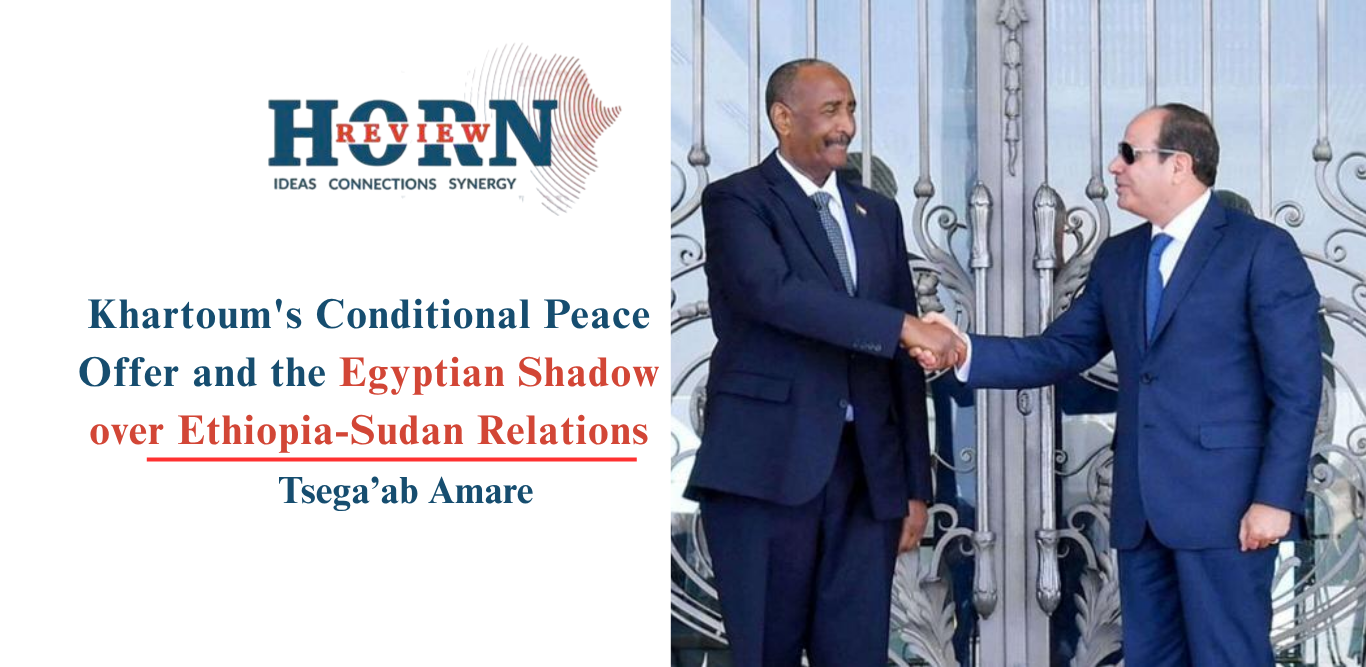
Sudan’s Foreign Minister, Mohi-Eddin Salem, told French Special Envoy Jean-Marie Safa in Khartoum on 13 October that Sudan is open to dialogue with Ethiopia, provided Addis Ababa ceases its support for the Rapid Support Forces and stops undermining Sudan’s security. The formula joins an invitation and an indictment in one sentence and places the burden of the first move entirely on Ethiopia. Offered on those terms, the proposal assumes the grievance runs in one direction, while the open record shows two governments holding allegations against each other. Claims from both capitals appear below as allegations unless public reporting corroborates them.
Ethiopia denies supporting the RSF, and the accusations against it rest largely on statements by Sudanese officials. Addis Ababa said in May 2026 that the Sudanese Armed Forces supplied arms and money to TPLF-linked fighters, facilitating incursions along Ethiopia’s western frontier, and described it as the first time it had publicly accused Sudan’s military government of such cooperation. The same statement alleged territorial violations and the use of Sudanese territory as a hub for anti-Ethiopian forces.[3]
The best documented element of the Ethiopian case concerns Army 70. Tigrayan fighters stranded in eastern Sudan after the 2020 to 2022 war have reportedly fought alongside the SAF against the RSF, and Ethiopia raised the matter with the UN Secretary-General in October 2025. A military that fights beside an armed militia hostile to the Ethiopian federal government cannot easily claim neutrality toward Addis Ababa, and the timeline shows the complaint predates the current exchange. Border history sharpens the point. In late 2020, while Ethiopian federal forces were committed to the Tigray war, SAF units moved into the disputed farmland of Al-Fashaga. Although the legal merits remain debated, the timing left a lasting impression in Ethiopian policy circles that Khartoum treats Ethiopian distraction as opportunity.
On the contrary, the allegation that Ethiopia serves as a transit corridor for a UAE-linked supply route to the RSF demands an evidentiary threshold that current claims have yet to meet. Ethiopia’s interest in a stable Sudan, particularly given the GERD’s exposure to cross-border instability, makes such sponsorship less plausible. Even though Addis Ababa maintains a strong partnership with Abu Dhabi, which is accused of supporting the RSF, diplomatic alignment by itself does not necessarily establish operational complicity. Ethiopia’s active role in hosting Sudanese civilian refugees and its consistent diplomatic push for a negotiated settlement run counter to the logic of sponsoring a destabilizing belligerent. The claim ultimately requires evidence of specific logistical, financial or territorial support.
Behind the immediate dispute lies a complex web of structural factors and regional rivalries. Analysts suggest that Eritrea has increasingly aligned itself with the SAF while simultaneously deepening ties with Egypt, Addis Ababa’s primary antagonist regarding the Nile waters. Intelligence reports indicate that Cairo provides substantial financial, diplomatic, and technological support underpinning Sudan’s western military operations. This alignment supports the assertion by Ethiopia’s army chief that neither Eritrea nor the TPLF can project significant power without the backing of external actors like Khartoum and Cairo.
Background knowledge adds to the pattern, including the 2023 Egypt-Sudan joint military exercises and Cairo’s 2024 security alignment with Eritrea and Somalia, which Addis Ababa read as a message aimed at it. Consequently, Khartoum’s grievances toward Ethiopia likely reflect Cairo’s strategic priorities. For Egypt, maintaining a friendly, dependent administration in Sudan serves a dual purpose: it establishes a critical geopolitical counterweight on Ethiopia’s western flank and secures a vital downstream ally to maintain leverage over the GERD.
A corollary inference, predicated on Cairo’s strategic behavior, posits that Egypt has the least incentive to foster a stable, civilian-led transition to democracy in Sudan. Egyptian leverage expands primarily when Khartoum remains fragmented, militarized, and dependent on external financial, intelligence, and diplomatic support. This structural dependency effectively transforms Sudan into a compliant geopolitical counterweight and provides strategic depth on Ethiopia’s western flank. Conversely, a sovereign civilian administration would be free to pursue independent interests, which could potentially lean toward cooperation with Addis Ababa. Sudan has benefited from the GERD through flood control and cheap electricity, and civilian-era governments in Khartoum treated the dam as negotiable more readily than Cairo did. A self-assured Sudan could therefore drift toward Ethiopia on the Nile file and fractures the downstream bloc.
Recent empirical developments substantiate this analytical framework. Central Bank of Sudan data indicates a profound reconfiguration of official gold flows, with exports pivoting sharply away from the UAE toward Egypt between 2024 and 2025. This twenty-fold increase in Egyptian imports allows Cairo to capture substantial intermediary rents by acquiring bullion below market value for subsequent global resale. However, this official trade captures only a fraction of the broader extraction landscape; a 2024 UN panel report estimated that over half of Sudan’s gold is illicitly trafficked, with substantial volumes from SAF-controlled eastern territories routed directly through Egypt.
The friction generated by this illicit economic convergence erupted into open view on October 10, 2026, when a devastating airstrike targeted artisanal mining operations at Jabal al-Uqaydat near the disputed frontier. Human rights monitors like the Emergency Lawyers documented at least 72 fatalities, while local miners cited by the Sudan Tribune placed the death toll above 200. While various Sudanese factions attributed the strike to the Egyptian Air Force, Cairo responded by highlighting its ongoing military campaigns targeting illicit cross-border mining infrastructure to protect its borders, while denying “misleading rumors” aimed at harming bilateral relations. This alleged involvement confirms that Cairo prioritizes border securitization and resource capturing over civilian safeguards. More critically, it exposes the paradox of Sudan’s current military architecture, demonstrating how little protection Khartoum’s primary external patron extends to the population the SAF claim to defend.
Sudan’s army also has motives of its own, chief among them the retention of power and the unresolved Al-Fashaga dispute, so it functions as no simple instrument of Cairo. Burhan’s conduct may reflect an attempt to regionalize a grinding domestic war, converting an internal power struggle into a wider geopolitical standoff that serves regime survival. Ethiopia, meanwhile, has called for dialogue, urged Sudan’s warring factions to end the war rather than blame external actors, and affirmed a historic and enduring bond of friendship with the Sudanese people. Khartoum’s preconditions invite the reading that the military government is the party less willing to talk.
By tethering peace talks to unilateral preconditions and embedding Sudan within Egypt’s broader strategy of hydro-political encirclement against Ethiopia, Abdel Fattah al-Burhan appears to exchange Sudanese sovereign and economic assets for external military patronage. That dependence on Cairo exposes Sudanese civilians to cross-border violence while failing to secure long-term defense. Real reconciliation would require Khartoum to decouple its Ethiopia policy from the Egypt-Ethiopia feud and to stop the help and facilitation extended to anti-Ethiopia blocs, which in practice means addressing the SAF’s alleged support for TPLF-linked fighters, its alignment with Eritrea and its hosting of Army 70. A mechanism to examine disputed claims on both sides would give such a process credibility, and breaking the cycle ultimately depends on separating Sudan’s stability from the wider Nile Basin rivalries.
By Tsega’ab Amare, Researcher, Horn Review