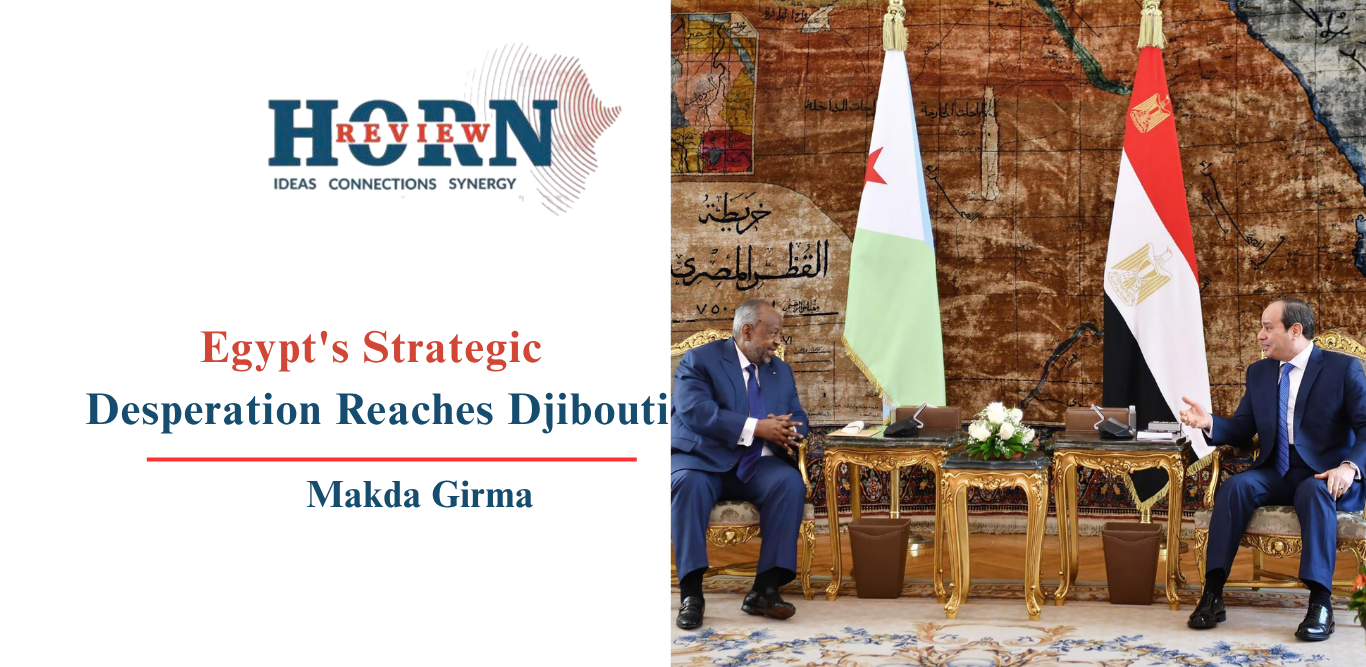
Egypt’s expanding involvement in Djibouti’s maritime infrastructure has acquired renewed geopolitical significance following discussions held on October 12, 2026, between Djiboutian port authorities and an Egyptian delegation. The talks advanced plans for a major container terminal and a road corridor, building on agreements concluded in December 2025. Although the projects offer opportunities for greater commercial connectivity, their wider significance lies in the changing geopolitical environment of the Horn of Africa. Egypt’s growing presence near Ethiopia’s principal maritime gateway comes amid Cairo’s efforts to extend its political and economic influence across the region, reflecting growing strategic anxiety over Ethiopia’s expanding regional ambitions and the limitations of Egypt’s traditional diplomatic pressure over the Nile.
The December 2025 agreements established cooperation on port development, logistics and energy infrastructure, including a proposed terminal capable of handling five million containers annually. For Djibouti, the projects offer an opportunity to strengthen its position as a major logistics hub serving Ethiopia and the wider region. Its willingness to attract Egyptian investment is consistent with its broader strategy of economic diversification and international cooperation. For Cairo, however, Djibouti’s geographic importance introduces considerations extending beyond the commercial value of these projects. Egypt is establishing an additional presence in a country through which much of Ethiopia’s international trade passes, at a time when their rivalry has expanded beyond the Nile into questions of maritime security and regional political influence.
This expansion reflects a deeper transformation in Egypt’s approach to Ethiopia. For decades, Cairo relied heavily on diplomatic pressure, historical water allocation arrangements and its relationships with international powers to defend its position on the Nile. The construction and eventual completion of the Grand Ethiopian Renaissance Dam fundamentally altered that equation. Despite sustained Egyptian opposition, Ethiopia proceeded with a project that strengthened its electricity generation capacity and position as a major upstream stakeholder. Cairo’s inability to prevent the dam’s development demonstrated the limitations of its longstanding approach. Egypt continues to seek legally binding commitments concerning the dam’s operation, but Ethiopia’s growing ability to utilise its water resources has reduced Cairo’s capacity to determine outcomes through diplomatic pressure alone.
Against this background, Egypt’s expanding engagement across the Horn can be understood as an attempt to recover strategic leverage in a relationship whose underlying balance has changed. Rather than concentrating exclusively on negotiations within the Nile Basin, Cairo has increasingly cultivated political, economic and security relationships around Ethiopia. Its deepening cooperation with Somalia, Eritrea and Sudan’s military leadership illustrates the geographic expansion of this approach. The intensity of these efforts suggests a growing sense of urgency, raising questions about whether Cairo is attempting to compensate for its diminishing ability to influence developments on the Nile itself.
Ethiopia’s pursuit of maritime access has further complicated Egypt’s calculations. The January 2024 memorandum of understanding between Ethiopia and Somaliland introduced the possibility of Ethiopian commercial and naval access to the Gulf of Aden. The agreement generated strong opposition from Somalia, creating an opportunity for Egypt to deepen its political and security relationship with Mogadishu. Yet the subsequent Ankara Declaration of December 2024 demonstrated that Ethiopia and Somalia could pursue a diplomatic settlement based on respect for sovereignty and mutually beneficial maritime arrangements. The declaration acknowledged the potential economic benefits of reliable Ethiopian access to the sea, complicating the assumption that disagreements between the two neighbours would necessarily develop into enduring regional divisions.
Egypt’s response to Ethiopia’s maritime ambitions reveals another dimension of its strategic concerns. For Ethiopia, expanding maritime access is closely connected to economic development, trade competitiveness and long term national security. Its dependence on a limited number of external corridors creates structural vulnerabilities that greater connectivity could help address. For Cairo, however, an economically stronger Ethiopia with greater maritime independence could represent a more influential regional actor. Egypt’s growing engagement along Ethiopia’s maritime approaches can consequently be interpreted as an effort to preserve its position within a regional order that Addis Ababa is increasingly seeking to reshape.
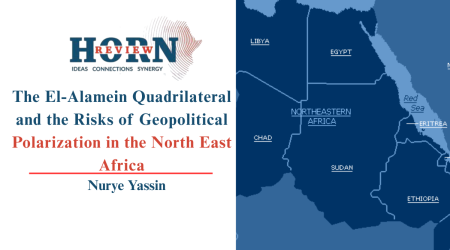
The October 4 El Alamein Declaration, bringing together Egypt, Eritrea, Somalia and Sudan’s military leadership, illustrates how Cairo is connecting these strategic questions. The declaration addressed Nile water cooperation, Somalia’s sovereignty and Red Sea governance, including the principle that responsibility for the maritime corridor rests with coastal states. Although these issues have distinct political and legal foundations, their inclusion within a common diplomatic framework is significant. Egypt has brought together countries with differing regional interests around positions that also touch upon Ethiopia’s major strategic priorities.
The timing of Egypt’s renewed engagement with Djibouti is therefore particularly relevant. Coming shortly after the El Alamein summit, the October discussions add a commercial dimension to Cairo’s expanding regional activities. Egypt’s port agreements with Djibouti and Eritrea have also attracted attention because of their potential implications for the Nile dispute and the regional balance of power. Nevertheless, Djibouti’s cooperation with Egypt is fundamentally grounded in its own economic interests. The country maintains an indispensable commercial relationship with Ethiopia, whose trade contributes substantially to its maritime economy. Its strategic importance also derives from its ability to maintain productive relationships with diverse international partners. Egyptian investment should therefore be distinguished from political alignment, particularly as improvements in Djibouti’s infrastructure could strengthen regional trade rather than undermine it.
This distinction also exposes the limitations of Egypt’s wider approach. Establishing partnerships around Ethiopia does not necessarily translate into influence over Ethiopian decisions. Somalia has demonstrated a willingness to pursue diplomatic engagement with Addis Ababa, while Djibouti’s economic interdependence with Ethiopia creates incentives that cannot easily be overridden by external geopolitical competition. Even the countries participating in the El Alamein Declaration maintain different national priorities. Although Cairo may gain diplomatic visibility from these partnerships, political coordination does not automatically establish a unified regional strategy. The more Egypt attempts to connect its Nile dispute with broader regional questions, the more its approach depends on whether neighbouring states share its objectives.
The contradiction becomes more apparent when Egypt’s Nile diplomacy is considered alongside its maritime activities. Cairo has consistently emphasised consultation, cooperation and the prevention of harm as essential principles governing shared water resources. Yet its expanding political and security relationships around Ethiopia raise questions about whether these partnerships could eventually become instruments of pressure in a dispute primarily concerned with the Nile. The concern is not Egypt’s legitimate pursuit of commercial interests or maritime security, but the possibility that economic cooperation could become entangled with efforts to constrain Ethiopia’s independent development choices. Cairo’s increasingly extensive regional engagement suggests that its concerns extend beyond the operation of a single dam to Ethiopia’s growing capacity to shape its economic and geopolitical environment.
For Ethiopia, the most consequential response lies in strengthening the economic foundations of its regional position. Preserving strong relations with Djibouti remains essential, particularly as both countries benefit from stable transport connectivity and commercial integration. At the same time, expanding access through Berbera, Kenya’s Lamu corridor and other commercially viable routes would reduce the vulnerabilities associated with concentrated maritime dependence. Such diversification would complement existing partnerships while giving Ethiopia greater flexibility in navigating regional political developments. More fundamentally, sustained economic development, diplomatic engagement and internal stability would strengthen Ethiopia’s capacity to navigate external pressure without allowing its strategic priorities to be determined by the calculations of competing regional powers.
Against the backdrop of the recent El Alamein Declaration and renewed Egypt and Djibouti infrastructure cooperation, Cairo’s expanding regional presence reflects its growing determination to counter Ethiopia’s influence beyond the Nile. Yet these developments also expose the limits of Egypt’s strategy, as regional partnerships do not necessarily translate into leverage over Addis Ababa. With Ethiopia continuing to pursue greater maritime access and economic independence, Egypt’s increasingly assertive diplomacy appears driven as much by the urgency of preserving its regional influence as by the fear of losing it.
By Makda Girma, Researcher, Horn Review