The federal government of Somalia under Hassan Sheikh Mohamud faces a legitimacy crisis of its own making in the South West State and its response has followed a predictable pattern with the militarization of an internal political dispute, the securitization of a regional rival and the externalization of blame on to neighbouring states. The sequence of events beginning in March 2026 and culminating in the territorial collapse around Baidoa in October reveals a structural failure within Somalia’s federal system rather than an externally orchestrated conspiracy. The rhetorical turn against Kenya and Ethiopia functions less as an accurate diagnosis of the crisis than as a mechanism of political damage control and the evidence suggests that the core dysfunction is internal to Somalia’s constitutional order rather than located in the behaviour of its neighbours.
The origins of the current confrontation are domestic and constitutional. In late March 2026 federal forces entered Baidoa and forcibly removed South West State President Abdiaziz Laftagareen following a dispute over election timing and constitutional revisions. Laftagareen had defied Mogadishu’s electoral plans and organized a snap re election prompting the federal government to deploy military reinforcements from Buur Hakaba into the regional capital. The intervention succeeded tactically with Laftagareen resigned and departed for Nairobi and by June a loyalist Aden Madobe had been installed through a regional parliamentary vote. What Mogadishu did not secure however was the political legitimacy of the replacement administration or the acquiescence of Laftagareen’s constituency. This distinction between tactical success and political consolidation is central to understanding everything that followed because it exposes a structural gap in the federal government’s theory of change that the assumption that control of the capital and the installation of a pliant administration constitute effective governance. That assumption is empirically false in federal systems where regional authority rests on locally embedded legitimacy rather than central appointment.
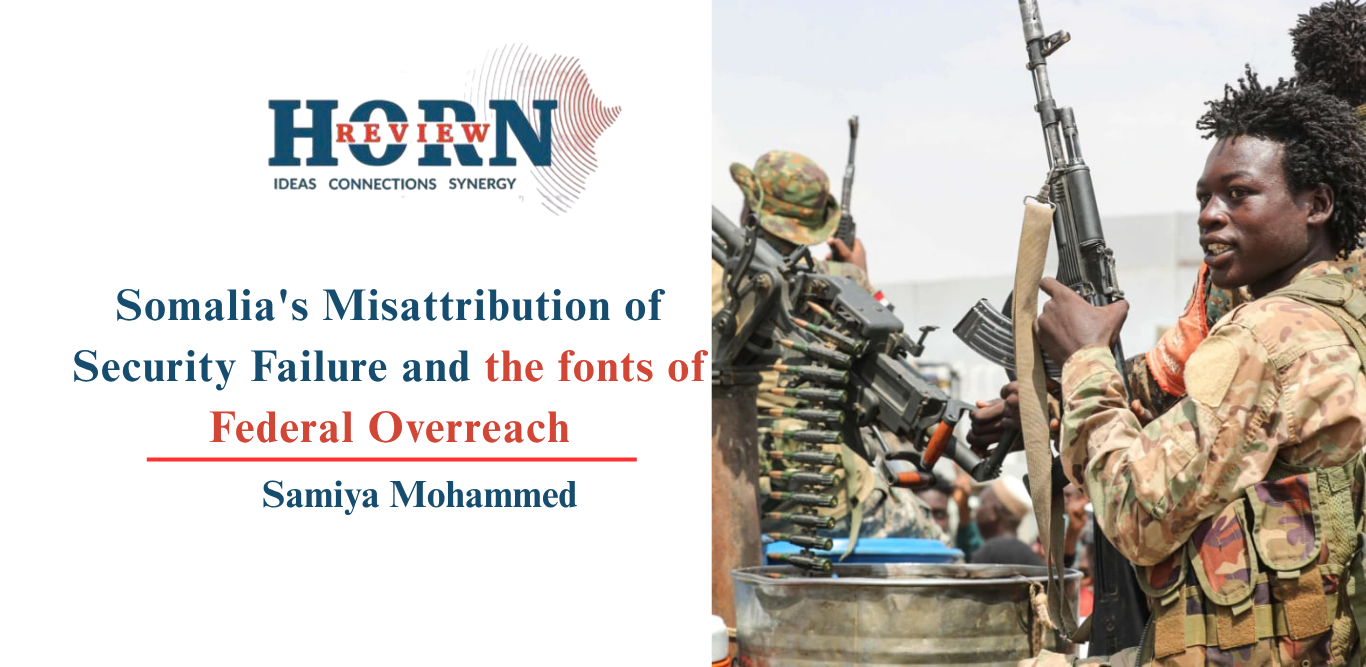
The consequences of that legitimacy deficit became visible in mid October. Forces loyal to the ousted leader rapidly seized several key towns in the Bay region including Buurhakaba, Qansaxdheere, Berdale, Dinsoor and Awdinle. Most of these advances encountered minimal resistance with local officials reportedly fled to African Union bases and Ethiopian troops stationed nearby did not intervene. Baidoa itself is now effectively isolated. The speed of the collapse indicates not that Laftagareen commands a formidable military machine but that the federally installed administration in Baidoa lacks rooted local support. When a regional government can be displaced from most of its territory within days by a force that was until recently in exile, the problem is one of political legitimacy rather than external aggression. The territorial reversals are a symptom of a governance deficit, not a military one and the causal mechanism runs from legitimacy to territorial control rather than in the reverse direction.
Mogadishu’s response to this reversal has been to reframe a political setback as a counterterrorism emergency. The National Committee for Combating Money Laundering and Countering the Financing of Terrorism added Laftagareen, former Custodial Corps commander Mahad Shub and eight others to a financial sanctions list over suspected links to Al Shabaab. The committee stated that the designations were based on assessed evidence of financial support for the militant group but the published decision did not disclose the specific evidence against each individual. This evidentiary opacity is not incidental and it is structurally necessary to the deflection strategy. A sanctions regime that operates without public evidentiary standards allows the government to impose material costs on political rivals while maintaining the rhetorical cover of counterterrorism. The designation functions as a political instrument dressed in security terminology and its effectiveness depends precisely on the absence of the evidentiary transparency that would ordinarily accompany criminal or terrorist designation.
The externalization of blame followed immediately. Parliamentary Speaker Abdikadir Jama criticized Ethiopia for allegedly standing by as forces seized towns where Ethiopian troops were deployed and accused Kenya of hosting sanctioned individuals. The speaker demanded that the federal government seek explanations from Ethiopian troops serving under AUSSOM and questioned how Al Shabaab could capture areas where Ethiopian forces were present. These accusations perform a specific political function: they shift the locus of accountability from Mogadishu’s failed intervention to the supposed negligence or complicity of its neighbours. In structural terms, this is a classic externalization move in which domestic institutional failure is recoded as foreign sabotage. The move is analytically distinguishable from a genuine security assessment because it proceeds without a corresponding investigation, without evidentiary disclosure and without any adjustment to the federal governments own operational posture in the affected areas.
The reality of the neighbouring states positions is considerably more mundane and does not support the conspiracy narrative. Kenya has historically served as a political space for Somali actors across the spectrum and no bilateral extradition treaty exists between Nairobi and Mogadishu. Kenyan authorities have resisted pressure to hand over Laftagareen but this reflects a policy of hosting Somali political figures rather than a deliberate campaign to destabilize Somalia. kenya’s posture is consistent with its regional role as a venue for Somali political accommodation not with active sponsorship of insurgency. Ethiopian commanders in the Bay and Bakool regions have reportedly declined to join the political war against Laftagareen citing their counterterrorism mandate under AUSSOM. The Ethiopian position is that its troops are deployed to fight Al Shabaab not to adjudicate Somali elite power struggles. This is a defensible reading of a peace enforcement mandate not evidence of hostile intent. Neither neighbour is actively running the insurgency and both are declining to fully subordinate their mandates to political objectives. The distinction between non subordination and hostility is crucial because the federal government’s rhetoric systematically collapses the two.
The structural dimensions of the crisis extend beyond South West State. Puntland and Jubaland have both expressed opposition to Mogadishu’s constitutional and electoral reforms and the pattern of central overreach followed by regional resistance is replicating across federal member states. The South West intervention was not an isolated act of strong governance and it was the first major expression of a broader centralizing impulse that treats federalism as an obstacle to be managed rather than a constitutional framework to be negotiated. When the federal government chose military force over political negotiation it signaled that the constitutional division of powers was subordinate to presidential preference. This precedent has implications beyond Bay and Bakool because it establishes a template for center region relations that other federal member states can reasonably expect to face. The replication pattern suggests that the South West episode is not an aberration but a structural feature of the current federal government’s approach to center region relations.
The labeling of political rivals as terrorists is a familiar structural move in states where institutional mechanisms for resolving intra government disputes are weak or absent. When the constitutional order provides no effective forum for negotiating power sharing between the center and regions and when electoral processes are manipulated or rejected by the center, the incentives for securitizing political opposition become overwhelming. The federal government’s sanctions list and its parliamentary speaker’s accusations against Kenya and Ethiopia should be read in this light. They are not analytical descriptions of the conflict but they are instruments in it. The securitization of domestic opponents serves three functions simultaneously, it delegitimizes rivals, it justifies coercive measures that would otherwise require judicial process and it creates an external scapegoat for outcomes that are internally generated. Each of these functions is separable from the others and each can be evaluated on its own terms but their combination produces a self reinforcing cycle in which political failure generates securitization, securitization generates external blame and external blame generates further political failure by foreclosing negotiation.
The core problem is not Kenyan or Ethiopian machination. It is a federal system in which the center has demonstrated a willingness to use military force against regional leaders has installed replacement administrations with shallow local roots and has then attributed the predictable consequences of those choices to foreign interference. The anti Kenya and anti Ethiopia rhetoric is damage control, an attempt to reframe a self inflicted political crisis as a story of external betrayal. Kenya and Ethiopia are not actively running the insurgency and they are simply refusing to fully subordinate themselves to Mogadishu’s political goals and that refusal is being recoded as hostility. Until Mogadishu confronts the structural deficiencies in its approach to federalism , the absence of genuine negotiation, the reliance on coercion and the legitimacy gap of its installed allies, the pattern will repeat. The towns around Baidoa are not the last to be lost to this logic and the neighbours will continue to serve as convenient explanations for failures that originate closer to home.
By Samiya Mohammed, Researcher, Horn Review