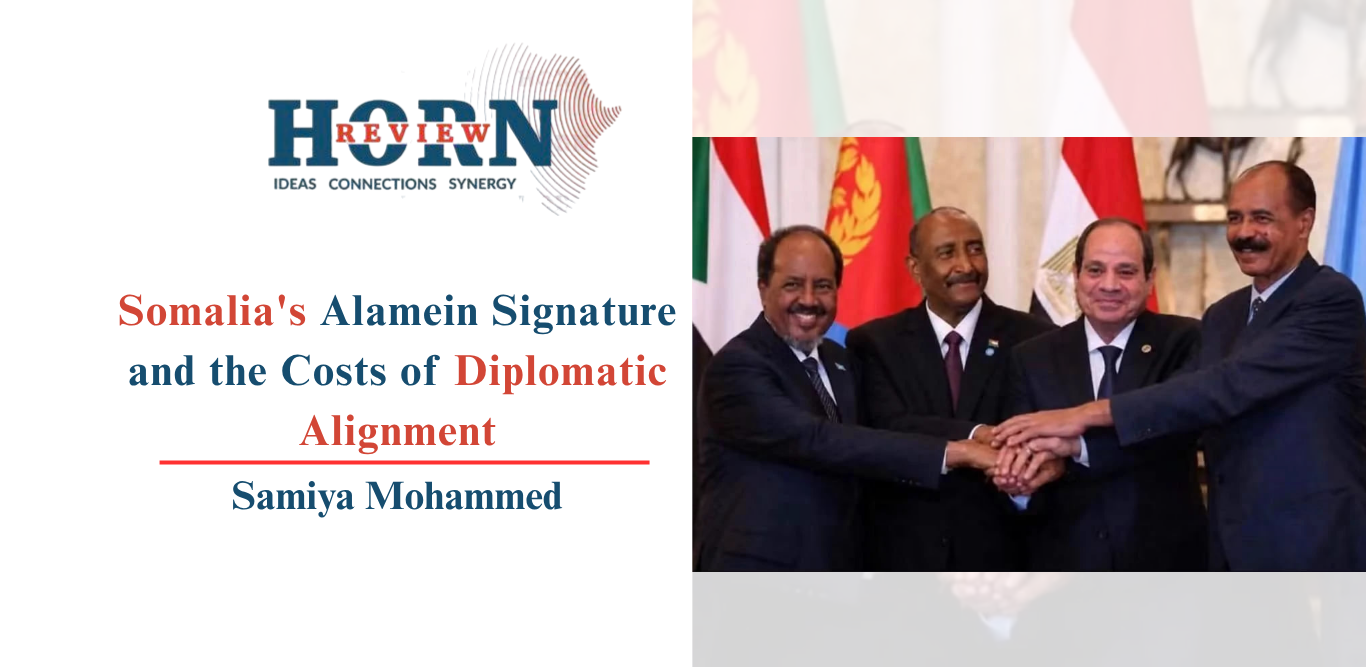
The Alamein Declaration between Egypt, Sudan, Eritrea and Somalia is a statement of regional principle concerning the governance of the Red Sea and the Nile. The Somali signatory possesses no Red Sea coastline and contributes no measurable discharge to the Nile system yet appended its signature to provisions governing both. The declaration thus commits Somalia to a downstream veto over a basin it does not share while its own agricultural survival depends on the very upstream state the declaration is structured to constrain. The Alamein text is not a coherent legal position but an exchange for recognition language on Somaliland and funding language on AUSSOM purchased with a Nile clause aimed at Ethiopia.
Somalia possesses no Red Sea coastline and its maritime frontage lies entirely on the Gulf of Aden and the Indian Ocean. The Bab el Mandeb strait, the Gulf of Aden and the Red Sea security involve the northern Somali coastline only indirectly and the declaration’s language concerning Red Sea governance addresses a maritime domain in which Somalia is not a littoral participant. The specific clause reserving Red Sea governance to littoral states excludes non littoral states while including among its signatories a state with no Red Sea coastline. The structural selectivity is apparent. Eritrea whose contribution to Nile flow is negligible signed language that tracks downstream Nile claims concerning upstream development. Somalia which contributes no Nile discharge signed the same language.
The declaration’s internal contradiction is not just a matter of diplomatic inconsistency. It establishes a coherence problem. If protection of existing downstream uses is interpreted as giving Egypt and Sudan an effective veto over Ethiopia’s upstream development then the declaration converts a principle intended to balance competing interests into an instrument for preserving historical advantage. Existing use may be relevant to the assessment of transboundary water rights but it cannot logically become a permanent entitlement that freezes the distribution of benefits and prevents meaningful development by an upstream state. If the alternative principle is equitable and reasonable utilization then Ethiopia’s development interests must be treated as part of the same legal equation as the interests of Egypt and Sudan. The declaration does not resolve this tension Instead it emphasizes downstream restraint while leaving the corresponding implications for Ethiopia’s right to development underdeveloped. The result is not a coherent legal theory but a diplomatic position in which one side’s interests are presented as established uses and the other side’s interests are presented primarily as potential harm.
The asymmetry is complete with the declaration’s Nile language is framed around downstream existing uses and upstream restraint. Somalia’s signature endorses that formula Yet Somalia’s own trans boundary river position is not addressed. The principle cuts both ways and Somalia selected the direction convenient to its diplomatic alignment. That is not a legal vindication however it is a selective application.
The Alamein Declaration contains two provisions of direct material to the Somali signatory. The first rejects any recognition of or support for Somaliland characterising such recognition as an infringement of Somalia’s sovereignty and territorial integrity. This language addresses the Ethiopia and Somaliland memorandum of understanding which Somalia has rejected as a violation of its constitutional order and international law. The declaration provides Egypt’s and Eritrea’s endorsement of Somalia’s position on this question. The second provision calls on regional and international partners to provide adequate, sustainable and predictable funding for the African Union Support and Stabilisation Mission in Somalia. AUSSOM’s financing has been a persistent concern with the United States hesitant to commit additional resources and European partners facing fiscal constraints.
The Nile clause cost Somalia nothing in hydrological terms. It possessed no Nile interests to compromise. The Somaliland language and the AUSSOM funding appeal offer diplomatic returns. The exchange is structurally legible with a Nile provision aligned with downstream Nile positions signed by a state with no Nile stake in return for support on two questions of direct Somali concern.
The declaration’s internal contradiction is not just a matter of diplomatic inconsistency. It establishes a coherence problem. If the principle governing transboundary rivers is that downstream states possess a veto over upstream development that harms existing uses, then that principle has implications beyond the Blue Nile. If the alternative principle is that sovereign development of water rising on a state’s territory is legitimate then Somalia has rejected that principle for Ethiopia on the Nile. Neither position is sustainable as a coherent legal theory. Each is a diplomatic alignment dressed in the language of international law. The text does not resolve this and it applies one principle to the Blue Nile and leaves the alternative unaddressed elsewhere.
The coverage of the Alamein Declaration has generally reported it as a statement on Nile and Red Sea governance without noting the hydrological position of the Somali signatory. The omission is structural and it permits the signature to appear as regional solidarity rather than what it is when a transactional alignment in which Somaliland and AUSSOM language are exchanged for a Nile clause aligned with downstream positions. The text does not require Somalia to have a Nile stake but it requires only a signature.
The Alamein text is not international law however a coalition building around Nile and Red Sea positions packaged as principle. The hydrological realities of the signatories Somalia’s absence from the Nile basin, Eritrea’s negligible Nile contribution, Ethiopia’s position as an upstream state are the facts that the declaration’s language is designed to obscure. The document’s structure reveals its purpose. It assembles a coalition of states whose hydrological positions are incongruent with the principles they endorse. Eritrea and Somalia does not possess a direct interest in the declaration’s Nile provisions. Their signatures are not expressions of riparian interest but of diplomatic alignment purchased with language on questions unrelated to the watercourses the declaration purports to govern.
The Alamein Declaration thus stands as a case study in the instrumentalisation of hydrological principle. It invokes the language of international water law no harm, prior notification, consultation, consensus while applying that language selectively to a basin in which two of its four signatories possess no stake. It reserves Red Sea governance to littoral states while including among its signatories a state with no Red Sea coastline. It rejects unilateral measures harming downstream existing uses while its Nile clause is endorsed by states without existing Nile uses. These are not the marks of a coherent regional position. They are the marks of a diplomatic instrument assembled for purposes that its water related language is designed to disguise.
The structural logic of the Alamein text is therefore not legal but transactional. The Nile clause serves Egypt’s and Sudan’s interest in advancing downstream positions on the Blue Nile. The Red Sea clause serves Egypt’s and Eritrea’s interest in shaping the security of the maritime corridor. The Somaliland language serves Somalia’s interest in resisting recognition. The AUSSOM funding language serves Somalia’s interest in sustaining international financial support for its security operations. The currency of exchange is language and the language is hydrological principle. But the principles invoked are not applied consistently because their application would harm the interests of the signatories themselves. Somalia cannot apply the downstream veto principle to the Blue Nile without inviting its application to other basins. Eritrea cannot assert a Nile interest without exposing the fiction of its riparian standing. The declaration therefore relies on the selective invocation of principle which is to say on the absence of principle.
This is the structural defect of the Alamein Declaration. It is not a legal instrument but a political one. It is not a statement of regional water governance but a coalition assembled around specific alignments. It is not a principled position but a transaction. The hydrological realities that its language obscures are the facts that expose the declaration for what it is. A document that invokes principle while applying it selectively is not a document of principle. It is a document of convenience and its convenience is purchased at the expense of the coherence it claims.
By Samiya Mohammed, Researcher, Horn Review