
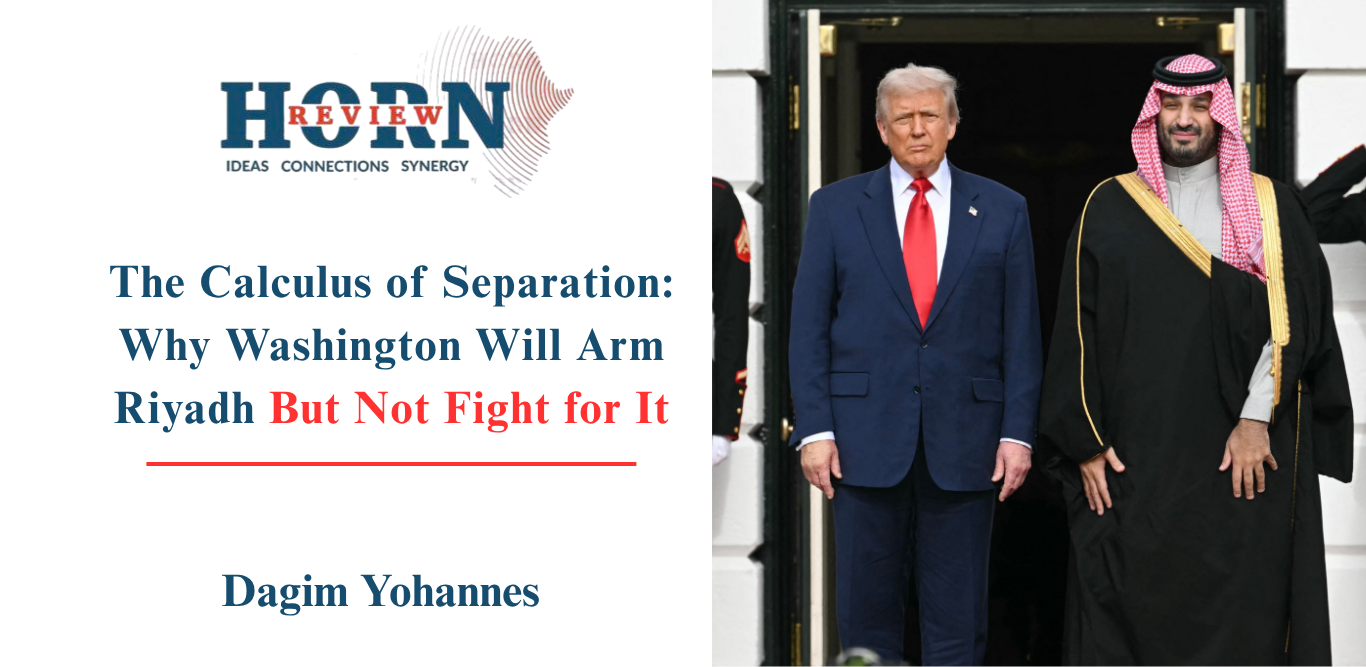
The Calculus of Separation: Why Washington Will Arm Riyadh But Not Fight for It
The episode reveals a distinction in the U.S.-Saudi security relationship that is becoming increasingly difficult to ignore: Washington remains willing to assume strategic risk on Riyadh’s behalf, but not operational risk. In the same week that it moved to sell Saudi Arabia its most sensitive airframe despite objections from its own intelligence community, Washington refused to fly a single sortie against the group that had just shut down the kingdom’s last working oil export route. That is not indifference. It is a relationship being recalibrated across two different currencies, with Washington still willing to spend on weapons, intelligence, and long-term strategic positioning while withholding the one form of support Riyadh was actually asking for: American combat commitment.
The sequence is instructive precisely because of how tightly it is compressed. On September 7, drones launched from Iraqi territory hit pump stations on the East-West pipeline, Saudi Arabia’s only crude export route that bypasses a Strait of Hormuz Iran has effectively closed. Mohammed bin Salman asked Trump directly for military help against the Houthis, who had spent the preceding days seizing the Red Sea port of Mokha and a chain of islands commanding the Bab el-Mandeb. Trump declined strikes and offered intelligence and targeting assistance instead, dispatching CENTCOM’s Admiral Brad Cooper rather than aircraft. Washington described itself as focused on core national security interests, chiefly freedom of navigation, and framed its role as empowering regional partners to take the lead. Nine days later, the report said that American officials had been secretly meeting Houthi leaders in Oman even as Washington declined Saudi Arabia’s plea for direct military support, sending Riyadh to France, Pakistan and Egypt to replenish missile interceptors it had depleted through months of strikes. By September 18, with the kingdom publicly acknowledging an interceptor shortage, Trump was instead occupied with plans to convene Middle Eastern leaders over postwar arrangements, an administration official noting that the approaching midterm elections were weighing on its calculus.
Read in isolation, that is the story every wire service ran last week: an ally in crisis, a patron unmoved. It becomes a different story once the F-35 sale is placed alongside it. Riyadh had been pursuing the jet for years without success. Trump reversed course in November 2025, publicly promising Saudi officials the Foreign Military Sale process would move within about a day. It did not move that fast but it did move, and it moved through resistance. Congressional Democrats Representatives Courtney, Krishnamoorthi and Norcross warned the administration on November 19, 2025 that Saudi Arabia’s expanding ties to Huawei and China Telecom created a real risk Beijing could access F-35 technology through the kingdom’s own government-services infrastructure, citing the precedent of Turkey’s expulsion from the program over its S-400 purchase from Russia. The Pentagon’s own Defense Intelligence Agency echoed that warning, questioning whether Saudi Arabia could keep Chinese personnel away from facilities housing F-35 technology and whether Chinese-made telecommunications equipment could be stripped from infrastructure connected to the jets. None of that stopped the deal. The State Department notified Congress of the $24.3 billion package for 48 aircraft on September 17, one day after the DIA warning became public, and in the same week Washington was declining to fly a single mission for Saudi Arabia against the Houthis.
That timing is the argument. A patron unwilling to underwrite its client’s war finds it can still underwrite its client’s air force, because the two decisions cost Washington entirely different things. Combat support means American pilots over a warzone the United States would then own. The political liability sits with the White House the moment a helicopter goes down or a strike kills civilians, a cost that is unrecoverable eight weeks before an election. It is also, on the evidence, a cost with a poor payoff: comparable air campaigns against the Houthis failed to change their behavior under the Biden administration in 2024 and under this one in 2025, which gives Washington a reason to withhold strikes. An arms sale, by contrast, means a $24.3 billion transfer that flows into Lockheed Martin’s order book and congressional employment figures. The risk there is deferred, diffuse, and denominated in something as abstract as future intelligence compromise rather than present casualties. Washington is not weighing how much it owes Saudi Arabia. It is weighing two unrelated ledgers, a political and operational cost due this quarter, and a strategic cost due over a decade and Riyadh’s plea for combat support landed on the ledger Washington is least willing to touch before November.
The F-35 sale itself is not one motive but at least three, and they do not carry equal weight. The weakest is the industrial-base case its defenders lean on, the Lockheed order book, the jobs attached to it because it was Congress’s own members, not the administration, who raised the loudest objections; jobs alone do not explain overriding your own party’s national-security committee. Stronger is relationship currency: a sale that locks Saudi Arabia’s air force into American systems, training pipelines and spare-parts dependency is a cheaper way to hold Riyadh inside the American orbit than combat support would be, especially with Pakistan, Turkey and China all competing for the same runway space. Stronger still is leverage on an entirely separate negotiation, Axios has reported that Israel did not oppose the sale as actively as it has opposed past transfers, on condition the deal be linked to progress toward Saudi-Israeli normalization. Read that way, the F-35 is less a consolation prize for the Houthi refusal than a chip Washington is spending on the deal it actually wants, with the Houthi refusal simply revealing which commitment was negotiable and which was not.
The record from the past four months reads less like abandonment absorbed and more like distance chosen on both sides. In May, Trump moved toward reopening the Strait of Hormuz by force under a plan reported as Project Freedom. Saudi Arabia constrained the operation by restricting American access to Prince Sultan Air Base and key airspace corridors, judging the plan under-considered and escalation-prone. That is not the behavior of a client waiting on its patron. It is a government actively vetoing the one thing that might have reopened its own chokepoint, because it feared where American escalation would lead more than it feared continued blockade. Gulf capitals, at the time, were less interested in exporting regional stability than in avoiding the domestic costs of a war Washington might drag them into.
That reluctance to be pulled in only sharpens the puzzle of why Riyadh is now asking to be pulled in further. A request for intelligence-sharing and interceptors is a different order of entanglement than a request to reopen a shipping lane by force. Riyadh wants American firepower applied narrowly, against Houthi missile and drone capability threatening its own territory, not applied broadly against Iran with all the regional combustion that implies. Which makes Washington’s answer more telling, not less: Riyadh asked for the smaller, safer version of American involvement, and still got intelligence sharing instead of strikes.
The clearest sign Riyadh does not fully trust its own diversification either is what it did not do after an earlier attack. When a Saudi refinery was hit just forty-eight hours after the August 2026 signing of the trilateral Mecca defense pact with Pakistan and Turkey, Riyadh did not invoke it. The one precedent for invocation, a symbolic Pakistani deployment of eight thousand troops, sixteen jets and a single air-defense battery during the broader US-Iran war was a token, not a shield. The more charitable reading is that the Mecca pact was never designed as a rapid-response mechanism for a rolling drone-and-missile campaign; it is a slower-moving defense framework, and skipping formal invocation after one strike may say more about the pact’s design than about Riyadh’s confidence in it. That reading has real force, but it does not survive a second test. A kingdom that saw genuine, fast-usable value in the pact would at minimum have opened consultations under it after the pipeline strike, short of a full deployment request and there is no reporting that it did. Twice declining even to start that process, rather than twice declining full activation, is harder to explain by design alone. It reads more like proof of optionality kept deliberately unused, so its credibility with Washington is never actually tested and its limits with Islamabad and Ankara are never actually found.
There is a second, smaller tell in how each side is narrating the crisis to outsiders. Vice President Vance told reporters that Washington was in direct conversations with the Houthis and was “on top of” the deteriorating situation. The Houthi political bureau denied any direct contact. Two days later, reports came out that the secret Oman meeting had, in fact, happened. Someone in that exchange was being imprecise, and the imprecision runs in a specific direction: Washington’s public language to reporters and its private diplomatic channel are not the same channel, and Riyadh is not in either room. The likeliest explanation is that Washington’s objective in Oman is narrower than Riyadh’s objective in the war, not a Houthi defeat or a restoration of Saudi-backed territorial control, which is what Riyadh is fighting for, but keeping the Bab el-Mandeb open enough that global shipping, not only Saudi shipping, keeps moving. Trump’s own framing supports this: he has noted that most vessels still transit the strait, with Saudi-flagged ships the exception, which is the language of someone managing a chokepoint problem, not someone managing an ally’s war. A patron working toward its client’s war aims loops that client into its outreach to the client’s adversary. A patron working toward a narrower aim of its own does not need to, and apparently didn’t.
It is worth placing Riyadh’s request inside the wider war it is a symptom of, not a cause of. The Houthi advance is not self-generated; it is riding an Iranian-aligned supply architecture, including a shadow tanker fleet built to resupply Houthi forces, that predates this month’s pipeline strike and that Tehran has every incentive to keep active while it fights the United States on a separate front. Riyadh’s plea, in other words, was not simply a request for help against the Houthis. It was a request to be defended on one flank of a conflict Washington is simultaneously trying to wind down on another, which makes Washington’s caution more comprehensible even if it does nothing to make it more comforting to Riyadh: any US strike inside Yemen right now risks reopening the broader Iran confrontation Washington has spent months trying to contain, not merely aiding a Gulf partner.
Riyadh is not reading these signals alone. The UAE and Qatar pressed Washington to pause the broader confrontation with Iran earlier this year for similar reasons, and Qatar’s own comparative ease in securing a formal US security commitment last year offered, critics noted at the time, more readily than anything Riyadh had received is part of why Saudi Arabia has pressed its own case as hard as it has. The mismatch on display here is not a Saudi-specific grievance. It is the shape the American security relationship now takes across the Gulf: generous with hardware and diplomatic cover, cautious with anything that risks American lives.
The standard objection is that none of this is new. Trump declined to retaliate after drones knocked out half of Saudi Aramco’s Abqaiq output in 2019; there was never a NATO-style treaty to violate; burden-shifting rhetoric is standard fare for any administration managing an expensive Gulf commitment. On this reading, Washington has not downgraded anything, because it never signed anything more specific than an understanding that flexes with each president and the National Security Strategy’s burden-shifting language, published in January, months before this crisis, shows the posture was locked in well before any midterm pressure existed. That last point cuts two ways. It confirms the refusal was not an improvised midterm calculation but a standing doctrine applied as written. It does not explain the F-35 sale moving forward on the same doctrinal watch, over the objections of Washington’s own intelligence agencies. The doctrine’s language did not change between 2019 and 2026; what changed is the relative price Washington attaches to the two currencies in play. Combat risk has only gotten more expensive as the region has gotten more combustible, while technology risk, the same category of concern that held up a comparable UAE sale for years, has apparently gotten cheap enough to clear in a week. A pure burden-shifting doctrine would counsel caution on both fronts. Washington split the difference in exactly one direction, which is the detail doctrine alone does not predict and interest does.
What ties the strands together is not a single act of American neglect but a structural mismatch nobody involved wants to name directly. Washington is willing to be Saudi Arabia’s supplier and its intelligence partner; it is not willing to be its air force. Riyadh is willing to buy the mismatch’s tools, the jets, the diversified pacts, the backup interceptor sources without fully trusting any of them enough to bet its territory on one. Neither government has broken with the other, nor fully reaffirmed the old terms. The plea did not fail because Washington stopped listening. It succeeded exactly as much as an ally that will not fight your war but will sell you the plane was always going to let it succeed and the F-35 notification landing the same week as the refusal is the clearest evidence yet of where that line actually sits.
Dagim Yohannes, Researcher, Horn Review

RELATED
Posts
21
Sep
Saudi Arabia’s Increasing Isolation Against the Houthis
Saudi Arabia’s renewed confrontation with Yemen’s Houthis has exposed how...
21
Sep
Yemen Between Britain and Saudi Arabia
The Houthi advance along Yemen’s Red Sea coast has exposed...
21
Sep
The Cairo-Ankara Rapprochement: A Tactical Mirage of Two Separate Hedges
The recent run of headlines out of Cairo and Ankara,...
20
Sep
The African Union Was Designed to Stand Outside Sudan's War
Every time Sudan's war comes up in public discussion, mentioning...
2
Sep
A Decade of Saudi Miscalculation in Yemen
On March 26, 2015, Mohammed bin Salman, then a thirty-year-old...
31
Aug
Mahamat Déby or Burhan: Who Can Win the US?
On August 20, 2026, Sudanese warplanes and drones pursued a...
27
Aug
What the Decline of Multilateralism Could Mean for Africa
Multilateralism is weakening just as African states need it most....
19
Aug
Who Gets a Seat in Saudi Arabia’s Red Sea Security Order?
Saudi Arabia’s new maritime defence architecture exposes a contradiction at...
18
Aug
Asymmetric Attrition in Hormuz: Decoding the Escalation Against State Energy Assets
The attacks on ADNOC vessels in the Strait of Hormuz...
17
Aug
Egypt Skipped the Mecca Pact Because It Lacks the Leverage to Join
Egypt’s continued absence from the Mecca collective-defense pact reflects a...