The Horn of Africa sits beside one of the most important maritime corridors in the world. Somalia, Djibouti, Ethiopia and Eritrea lie close to the Gulf of Aden, Bab el Mandeb and the Red Sea, the route that links the Indian Ocean to the Suez Canal and European markets. For Pakistan, this is not a distant strategic theatre. Ships leaving Karachi or Gwadar and heading west eventually pass through the same waters now shaped by piracy, instability in Yemen, competition among regional powers and periodic disruption to commercial shipping.
Its approach has been quieter. It has relied on defense diplomacy, naval cooperation, training and institutional support. Somalia has gradually become the clearest example of this strategy. Pakistan’s connection with Somalia is not new. During the collapse of the Somali state in the early 1990s, Pakistan became one of the important contributors to United Nations peacekeeping operations there. Pakistani troops served under UNOSOM, and more than twenty Pakistani peacekeepers were killed during fighting in Mogadishu in June 1993. What has changed is the nature of the relationship. In the 1990s, Pakistan operated mainly through a UN mission. Today, its engagement is increasingly bilateral and focused on strengthening Somali institutions directly.
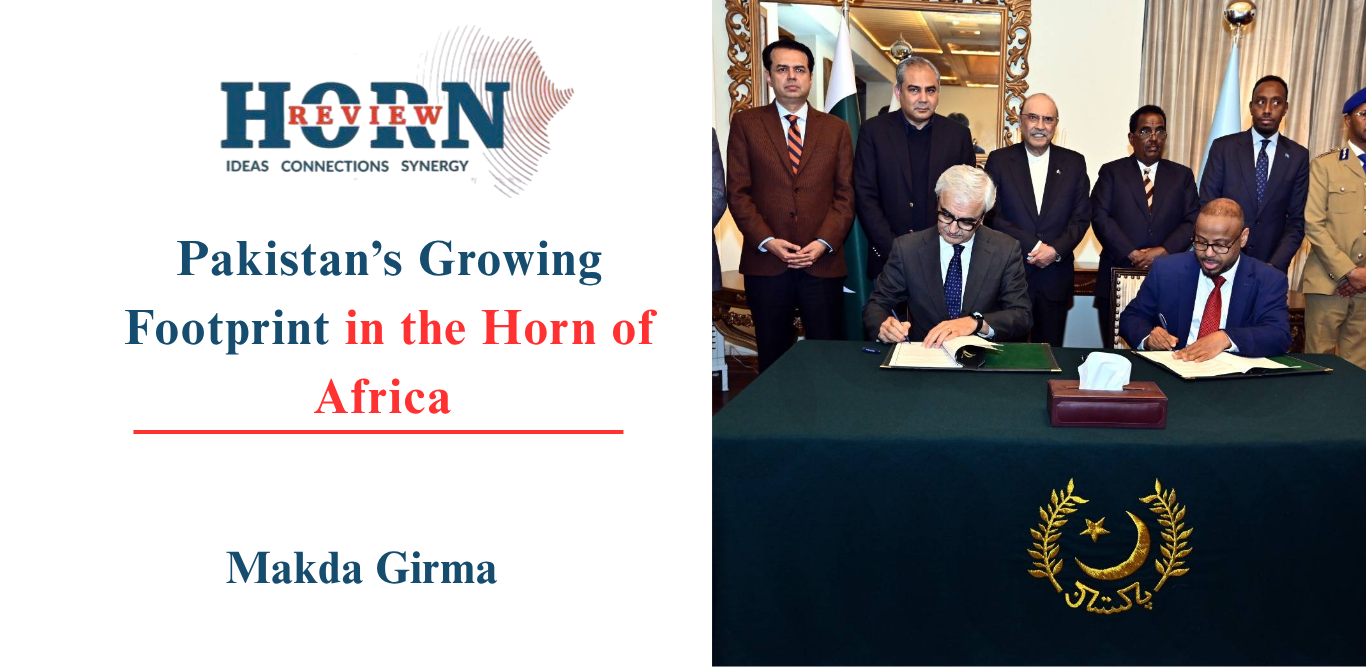
That shift starts on August 2026. Somali Defence Minister Ahmed Moallim Fiqi and Pakistani Defence Minister Khawaja Muhammad Asif signed a defense cooperation memorandum in Islamabad on August 4. The agreement covered counterterrorism, military training, exchanges of expertise and the development of Somali defense capabilities. Fiqi later met Pakistan’s senior military leadership, including Field Marshal Asim Munir, with both sides discussing regional security and Somali military capacity. Pakistan also stated that it would support the strengthening of Somalia’s security institutions.
The relationship quickly moved beyond political meetings. In September 2026, a senior Pakistan Air Force delegation travelled to Mogadishu for talks on air defense, training and the rebuilding of Somali air capabilities. Somali officials described the visit as part of an effort to deepen cooperation between the two air forces. This gives Somalia a particular place in Pakistan’s wider Horn engagement. Ethiopia is more important as a commercial and diplomatic partner, while Djibouti is more directly tied to the Bab el Mandeb. Somalia, however, is where Pakistan’s military, maritime and security interests are starting to overlap.
The naval side of the relationship predates the 2026 defense agreement. Pakistan has operated for years in the Gulf of Aden and around Somali waters through the Combined Maritime Forces. In January 2025, Pakistan took command of Combined Task Force 151, the multinational force responsible for counter piracy operations in the Gulf of Aden and Somali Basin. Pakistani warships later conducted patrols near Somalia. These deployments gave the Pakistan Navy practical experience in the waters linking South Asia with the Horn and helped make Somalia relevant to Pakistan’s wider maritime security thinking.
Piracy is only part of the problem. Illegal, unreported and unregulated fishing has become a serious concern for Somalia, whose long coastline and weak maritime institutions make enforcement difficult. An International Maritime Organization program held in Mogadishu in 2025 identified illegal fishing alongside piracy as one of the main threats facing Somali maritime governance. Somali naval officials have also identified the protection of marine resources as one of the responsibilities of the rebuilt Somali Navy.
This gives naval capacity building an economic dimension as well as a security one. A stronger Somali Navy or Coast Guard would be useful not only against pirates and armed groups, but also in protecting the country’s Exclusive Economic Zone and fish stocks. Pakistan has not announced a specific anti illegal fishing mission in Somali waters, so it would be inaccurate to present that as an existing operation. Still, training, surveillance support and institutional development would strengthen Somalia’s ability to police its own waters. For Pakistan, that kind of cooperation could also create closer maritime information sharing with a country sitting directly across the Gulf of Aden from Yemen.
That location has become even more important since the Houthi attacks on shipping intensified after late 2023. Missile and drone attacks in the Red Sea and around Bab el Mandeb disrupted commercial traffic and forced shipping companies and regional navies to reconsider how they operate in the area. By 2026, the conflict had a direct human cost for Pakistan. In August, three Pakistani nationals were killed in an attack on the cargo vessel Tihamah near Bab el Mandeb.
The Somali coastline has become more strategically valuable in that environment. Somalia lies on the African side of the Gulf of Aden, opposite Yemen. Better maritime awareness, stronger relationships with Somali authorities and closer naval cooperation all matter more when the southern Red Sea is unstable. This helps explain why Pakistan’s recent engagement with Somalia cannot be separated from the wider security breakdown around Bab el Mandeb.
The Gulf states add another layer. Saudi Arabia sees the Red Sea as part of its immediate security environment and has supported regional cooperation through the Council of Arab and African States Bordering the Red Sea and Gulf of Aden. The grouping includes Somalia, Djibouti, Eritrea, Sudan, Egypt, Jordan and Yemen alongside Saudi Arabia. Riyadh has also been working on broader maritime security arrangements covering the Red Sea and Bab el Mandeb.
Pakistan’s defense relationship with Saudi Arabia makes this relevant. Islamabad has long maintained close military ties with Riyadh, and those ties have deepened further through new defense arrangements. Pakistan’s growing role in Somalia therefore develops alongside, rather than outside, Saudi Arabia’s wider interest in Red Sea security. That does not mean Pakistan is acting on Saudi instructions. But it does mean that Islamabad’s activities on the African side of the Gulf of Aden are becoming part of a strategic space that Saudi Arabia also considers increasingly important.
The UAE creates a more complicated problem. Abu Dhabi has built a strong economic and security presence in parts of Somalia outside the direct control of the federal government. DP World has invested heavily in Berbera in Somaliland and has also operated in Bosaso in Puntland. These relationships have frequently caused tension with the federal government in Mogadishu, particularly because Somaliland continues to seek international recognition as an independent state.
Pakistan has taken a much clearer position on this issue. Islamabad has repeatedly stated that Somaliland remains part of Somalia and has backed the territorial integrity of the Somali Federal Republic. In January 2026, Pakistan warned that recognition of Somaliland could worsen instability in the Horn and Red Sea region.
This creates a diplomatic balancing problem for Islamabad. Pakistan has important relations with the UAE, but its support for Somalia’s federal government puts it closer to Mogadishu’s position on questions of sovereignty. As Pakistan expands defense cooperation with Somalia, it will have to avoid being drawn too deeply into disputes involving Somaliland, Puntland or the Gulf states.
The same caution applies to Ethiopia. Relations between Somalia and Ethiopia deteriorated after Addis Ababa signed an agreement with Somaliland in January 2024 concerning access to the sea. Somalia viewed the move as a violation of its sovereignty. Türkiye later mediated the Ankara Declaration, which helped reduce tensions and reopened negotiations between Ethiopia and Somalia. Pakistan has been improving relations with Ethiopia at the same time that it has strengthened its defense partnership with Mogadishu. That makes neutrality in internal Horn disputes especially important.
Other outside powers are already deeply established in the region. Türkiye has major military training infrastructure in Somalia and a long term defense agreement with Mogadishu. China maintains a military support base in Djibouti. India has conducted counter piracy operations in the Gulf of Aden for years. Pakistan does not have the resources to compete with these actors on the same scale, and there is little evidence that it is trying to.
Its advantage lies somewhere else. Pakistan has military training institutions, counterterrorism experience and a navy already familiar with the Western Indian Ocean. These are assets that can be offered without the cost of building a large permanent presence abroad. Somalia benefits from access to training and institutional support, while Pakistan gains stronger relationships in a maritime space that matters to its own trade and security.
The limits are still clear. Pakistan faces domestic economic constraints, Somalia remains politically fragmented, and Al Shabaab continues to pose a serious threat. Deep involvement would expose Islamabad to local rivalries that it has little reason to inherit. A lighter footprint based on training, naval cooperation and institutional support is therefore more realistic than a large military presence.
Pakistan’s emergence in the Horn should not be measured by bases or troop numbers. It is better seen in the accumulation of smaller moves: naval patrols, defense agreements, officer training, air force cooperation, political backing for Somalia’s sovereignty and closer engagement with the maritime security problems of the Gulf of Aden.
Somalia sits at the center of that process. Its location links Pakistan’s interests in the Arabian Sea with the Red Sea and Bab el Mandeb. Piracy, illegal fishing and the Houthi maritime campaign have all made that connection harder to ignore. Pakistan is still far from being a major Horn power, but its security horizon is clearly moving westward. What began as occasional naval activity and diplomatic engagement is becoming a more structured relationship, with Somalia providing the strongest foothold.
Makda Girma, Researcher, Horn Review