
Saudi Arabia’s Increasing Isolation Against the Houthis
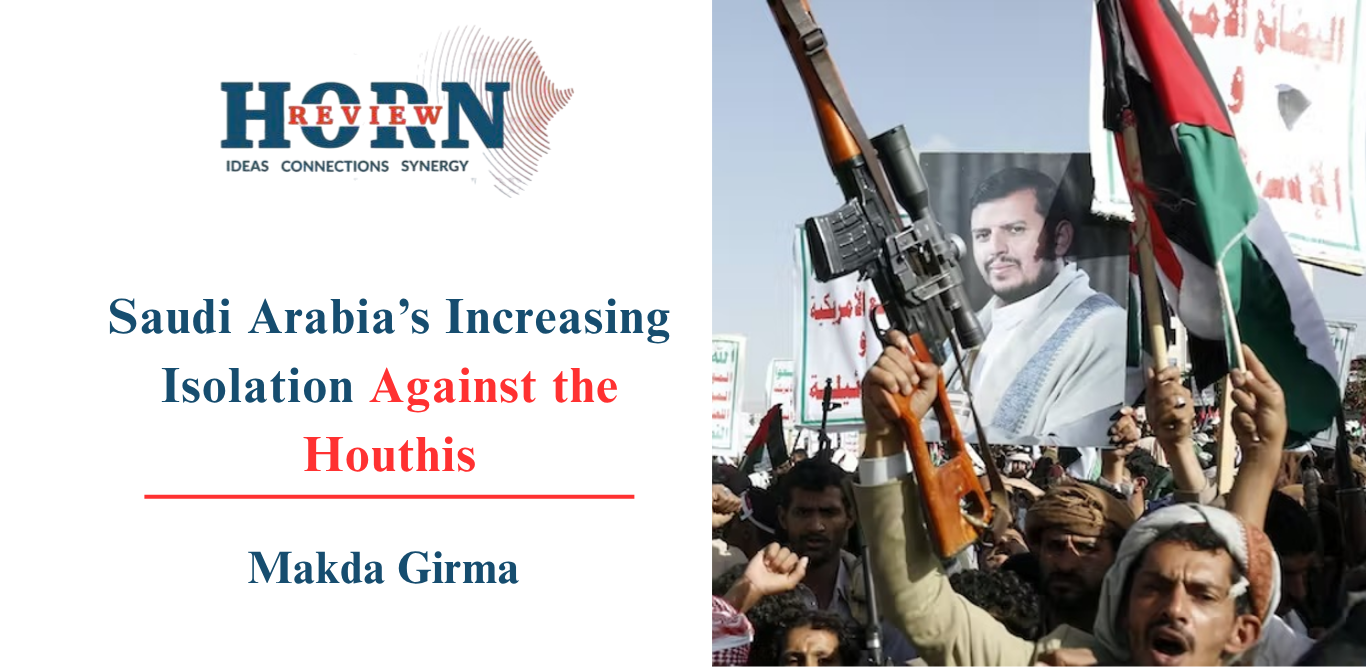
Saudi Arabia’s renewed confrontation with Yemen’s Houthis has exposed how much the regional balance has changed since Riyadh first intervened in Yemen in 2015. The kingdom is not without allies. Washington still shares intelligence. London openly backs Saudi Arabia’s right to defend itself. Cairo describes Saudi and Gulf security as part of Egyptian national security. Abu Dhabi has repeatedly condemned Houthi attacks on Saudi cities and infrastructure.But none of that has produced what Riyadh once had: a coalition prepared to fight the Houthis on Yemeni territory.
That difference has become harder to ignore as Houthi forces have pushed down Yemen’s Red Sea coast and taken positions around the Bab el Mandeb Strait. Their capture of Mokha and Mayun Island, also known as Perim, placed Houthi forces directly alongside one of the world’s most sensitive maritime corridors. Associated Press reported the seizure of Mayun on September 11, 2026, after the earlier fall of Mokha.
Bab el Mandeb is hardly a Saudi waterway. Ships passing through it connect the Indian Ocean and Gulf of Aden to the Red Sea, Suez Canal and European markets. Around 12 percent of world trade normally passes through the strait, according to AP. Egypt depends heavily on the traffic continuing north toward Suez. European economies depend on it. Asian exporters use it. The United States has spent considerable military resources keeping it open.
Yet when the question changes from protecting ships passing through the strait to removing the Houthis from the territory surrounding it, Saudi Arabia suddenly finds far fewer volunteers. That is the central problem facing Riyadh. The international community is willing to defend the Red Sea. It is much less willing to fight another Yemen war.
The Houthis’ roots lie in the Zaydi revival movement in northern Yemen, and the group fought the Yemeni government repeatedly from 2004 onward before capturing Sanaa in 2014. Their advance south the following year prompted the Saudi led intervention. Riyadh entered Yemen then with a much broader military structure behind it: the UAE became deeply involved on the ground, Yemeni forces fought alongside coalition forces, Sudan contributed troops, and the United States provided various forms of support. The war never produced the decisive result its architects expected. Over time, Saudi and Emirati priorities diverged, Yemen’s anti Houthi forces fragmented and the Houthis emerged with a much larger missile and drone arsenal, aided significantly by Iran. A decade later, Riyadh faces a stronger adversary with a thinner coalition.
The American position shows where the line has moved. The United States has already demonstrated that it is prepared to deploy substantial military power to protect navigation in the Red Sea. Operation Prosperity Guardian, established in December 2023, brought together a multinational naval coalition under Combined Maritime Forces to protect commercial shipping in the southern Red Sea and Gulf of Aden. The Pentagon explicitly described the mission as defensive. Ships patrolled maritime lanes, reassured merchant vessels and intercepted threats.
Even the strikes conducted by the United States and Britain against Houthi missile sites were formally separated from Prosperity Guardian. The Pentagon made that distinction itself in 2024: the maritime coalition protected shipping, while strikes against missile facilities, command centres, radars and drone infrastructure constituted a separate operation.
Prosperity Guardian eventually ended in May 2025, according to US Navy records, but Europe continues its own defensive maritime mission. EUNAVFOR Aspides operates through the Red Sea, Bab el Mandeb and adjoining waters. Its mandate is deliberately narrow: accompany merchant vessels, maintain maritime awareness and defend ships from attack. The EU describes Aspides as “purely defensive,” and its mandate specifically excludes strikes on land. By May 2026, the mission said it had supported more than 1,960 merchant vessels and provided protection to more than 650.
There is already an international security architecture in the Red Sea, in other words. It simply was not designed to reconquer Yemen.
That helps put Washington’s latest response to Riyadh into perspective. Mohammed bin Salman sought direct American military assistance as the Houthi offensive intensified. President Donald Trump declined to authorize US strikes, while Washington agreed to provide intelligence and targeting assistance. CENTCOM commander Admiral Brad Cooper also travelled to Saudi Arabia for consultations.
The United States did not walk away. It drew a boundary.
Intelligence can help Saudi aircraft identify targets. American surveillance can improve warning times. Naval forces can protect commercial vessels. Missile defence can reduce the effectiveness of Houthi attacks. None of those measures requires Washington to assume responsibility for taking Mokha back, landing forces on Mayun or rebuilding a front line across western Yemen.
There is a good reason for the caution. Years of American, British, Saudi, Emirati and later Israeli strikes have shown that destroying Houthi launchers is easier than destroying the organization. Missiles can be replaced. Drones can be dispersed. Command structures can move underground or into populated areas. Airpower can punish a movement without producing a government capable of replacing it.
Saudi Arabia has historically supported Yemen’s internationally recognized government and, today, the Presidential Leadership Council. The UAE developed separate relationships with southern and western Yemeni armed groups, most importantly the Southern Transitional Council, or STC. Those forces opposed the Houthis but did not necessarily agree with Riyadh over Yemen’s political future. Some favour an independent south rather than the unified Yemeni state Saudi Arabia has traditionally supported.
The anti Houthi camp therefore became less of a single front and more of a collection of forces with overlapping enemies and different political projects. Even though Abu Dhabi strongly condemned Houthi missile and drone attacks against Saudi Arabia and reaffirmed support for measures taken to protect Saudi security, Saudi Arabia and the UAE no longer appear able or willing to reproduce the military division of labour that existed during the earlier stages of the war.
That matters because Emirati influence along Yemen’s southern and western coast was once a major element of the campaign against the Houthis. Riyadh can have excellent relations with Abu Dhabi while still finding that its former coalition partner has different local allies, different political priorities and a different appetite for returning to a large-scale Yemen campaign.
Then there is Egypt. Mohammed bin Salman’s September 15 trip to Cairo attracted attention precisely because Egypt has so much at stake. The meeting included a closed bilateral session between MBS and President Abdel Fattah el Sisi before wider talks between their delegations. Egypt’s official account was unusually strong. The two leaders stated that Saudi and Gulf security formed an integral part of Egyptian national security, rejected threats to Saudi sovereignty and emphasized the security of navigation through the Strait of Hormuz, Bab el Mandeb and the Red Sea. Sisi explicitly supported measures taken by Saudi Arabia to safeguard its security and stability.
For Cairo, that is not empty rhetoric. The Red Sea crisis has already cost Egypt heavily. Egyptian authorities said Suez Canal revenue in 2024 dropped by more than 60 percent compared with 2023, producing losses of nearly $7 billion as ships diverted away from the Red Sea and Bab el Mandeb.
If any country outside the Arabian Peninsula has a direct economic reason to worry about Houthi control around Bab el Mandeb, Egypt does.
Still, the Cairo meeting produced no public commitment of Egyptian ground troops, no announced air campaign and no declaration that Egyptian forces would join Saudi Arabia in retaking Houthi held territory. That caution is understandable, but it also exposes a gap between how seriously Cairo describes the threat and how much of the burden it is prepared to carry. Egypt’s own statement paired strong support for Saudi security with a call for a “comprehensive and sustainable political solution” to Yemen.
Egypt wants Bab el Mandeb secure. For now, however, it appears more willing to affirm that interest politically than to share the military cost of defending it.
Britain is taking much the same position from farther away. The Foreign Office condemned the renewed Houthi attacks on September 10, said Britain stood with Saudi Arabia and Yemen’s internationally recognized government, and affirmed their right to defend their sovereignty. London specifically identified the danger to the Red Sea and Bab el Mandeb trade routes. The statement promised work with partners on regional stability and humanitarian access. It did not announce British participation in a campaign to retake territory.
The emerging pattern is not especially complicated.
Saudi Arabia’s partners have settled on a menu of comparatively limited containment: intelligence sharing, naval protection, missile interception, defensive deployments and, under some circumstances, strikes on Houthi launch sites and weapons infrastructure. What they have not embraced is the sustained air and ground campaign that would be required to strip the Houthis of their new territorial gains.
The distinction is easier to understand after eleven years of war. A destroyer can shoot down a missile approaching a container ship. It cannot govern Mokha the next morning.
Retaking territory means finding Yemeni forces capable of seizing it, supplying them, coordinating air support, protecting civilians, preventing rival anti Houthi factions from fighting each other and then establishing an authority capable of holding the ground. The military campaign ends only if the political problem can be solved behind it. That was difficult in 2015. Yemen’s internal divisions have not made it easier.
Iran adds another constraint. The Houthis are a Yemeni movement, not an organization manufactured in Tehran, but Iranian weapons, technical expertise and support have helped transform their ability to threaten shipping and Saudi territory. Their missile and drone capabilities now give Iran an aligned armed actor positioned beside the southern entrance to the Red Sea.
Saudi Arabia consequently sees the Houthi problem differently from many of its partners. For Washington, striking the group harder might weaken an Iranian aligned force, but it could also open another active front in a wider confrontation with Tehran. The cost calculation looks different in Riyadh because Saudi territory is already inside the firing range.
The pressure has become even sharper because Saudi Arabia’s alternative energy routes are under stress at the same time. The East West Pipeline, which carries crude from eastern Saudi Arabia toward Yanbu on the Red Sea and allows exports to bypass the Strait of Hormuz, was recently attacked and temporarily shut down. Reuters reported that the pipeline normally moves roughly four to five million barrels per day and has become especially important as traffic through Hormuz has faced severe disruption.
Mayun sits at the other end of that strategic equation.
Saudi Arabia spent decades creating an oil export option that reduced its dependence on Hormuz by moving crude west toward the Red Sea. If Hormuz is insecure while Houthi forces simultaneously gain leverage around Bab el Mandeb, the kingdom’s geographic redundancy begins to look less reassuring.
Egypt loses Suez revenue when vessels stay away. Britain and Europe pay through longer routes, higher shipping costs and disrupted supply chains. Washington worries about energy markets and regional escalation.
Saudi Arabia gets all of those problems plus missiles landing on Saudi territory. The burden is not equal, so neither is the willingness to fight. Riyadh cannot currently assemble a group of states willing to take joint responsibility for reversing the Houthi territorial advance.
That leaves Saudi leaders with a narrower set of choices than they had in 2015.
One path is prolonged containment: better missile defence, hardened energy infrastructure, naval security and enough military pressure to make further Houthi expansion costly. It accepts that the movement will remain a powerful actor across the border.
Another is political. Saudi Arabia spent years trying to negotiate its way out of the Yemen war after the 2022 truce. A renewed diplomatic track would mean dealing, directly or indirectly, with the Houthis and with Iran while seeking guarantees around Saudi territory and maritime navigation. That approach carries its own problem: negotiation under military pressure risks institutionalizing some of the territorial and strategic gains Riyadh wants reversed.
A third possibility would be rebuilding a Yemeni military balance capable of challenging the Houthis over time. That would require repairing the fractures among the Presidential Leadership Council, southern forces and other anti Houthi formations rather than expecting foreign airpower to substitute for functioning local forces. Such a project would take years, not weeks.
None offers the clean outcome Riyadh sought when the intervention began in 2015.
And that may be the hardest lesson of the current crisis. The international response is not collapsing. Ships are still being protected. Intelligence is still being shared. Governments from Cairo to London continue to say Bab el Mandeb matters.But protection of the waterway and defeat of the force threatening it have become two separate policies.
Saudi Arabia increasingly owns the second problem.
By Makda Girma, Researcher, Horn Review

RELATED
Posts
21
Sep
Yemen Between Britain and Saudi Arabia
The Houthi advance along Yemen’s Red Sea coast has exposed...
21
Sep
The Cairo-Ankara Rapprochement: A Tactical Mirage of Two Separate Hedges
The recent run of headlines out of Cairo and Ankara,...
20
Sep
The African Union Was Designed to Stand Outside Sudan's War
Every time Sudan's war comes up in public discussion, mentioning...
2
Sep
A Decade of Saudi Miscalculation in Yemen
On March 26, 2015, Mohammed bin Salman, then a thirty-year-old...
31
Aug
Mahamat Déby or Burhan: Who Can Win the US?
On August 20, 2026, Sudanese warplanes and drones pursued a...
27
Aug
What the Decline of Multilateralism Could Mean for Africa
Multilateralism is weakening just as African states need it most....
19
Aug
Who Gets a Seat in Saudi Arabia’s Red Sea Security Order?
Saudi Arabia’s new maritime defence architecture exposes a contradiction at...
18
Aug
Asymmetric Attrition in Hormuz: Decoding the Escalation Against State Energy Assets
The attacks on ADNOC vessels in the Strait of Hormuz...
17
Aug
Egypt Skipped the Mecca Pact Because It Lacks the Leverage to Join
Egypt’s continued absence from the Mecca collective-defense pact reflects a...
12
Aug
How the Iran and Israel Conflict Recalibrates the Algeria-Morocco Structural Antagonism
The direct hostilities between Iran and Israel have generated effects...