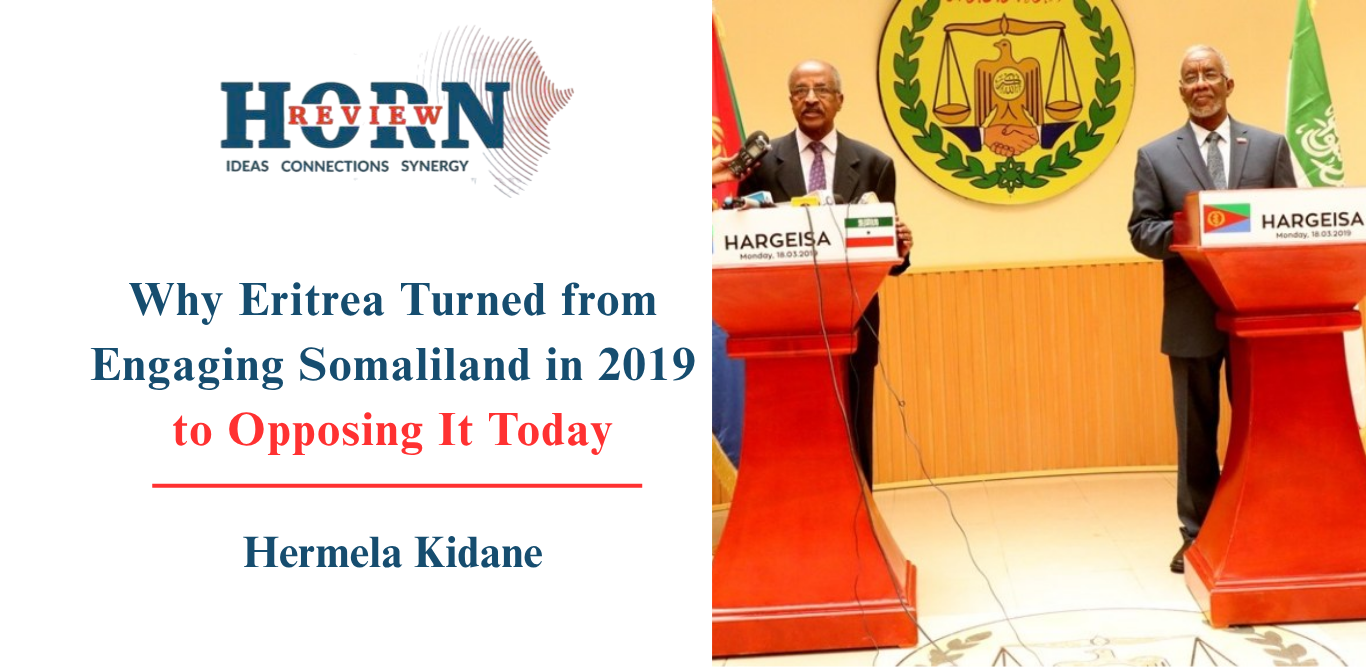
In March 2019 Eritrean Foreign Minister Osman Saleh accompanied by presidential adviser Yemane Gebreab led a high level delegation to Somaliland. The visit came in the optimistic aftermath of the 2018 Ethiopia and Eritrea peace agreement when President Isaias Afwerki saw Prime Minister Abiy Ahmed as an important partner in Eritrea’s regional reintegration. Eritrea described the visit as part of its effort to promote regional peace and begin engagement with Somaliland with discussions focused on strengthening bilateral relations. The significance of the visit was not formal recognition. It was the willingness of the Eritrean leadership to deal with Somaliland as a functioning political counterpart at a time when its relationship with Ethiopia was improving.
That history poses a basic question. If Eritrea was prepared to engage Somaliland in 2019 why did it later make Somali territorial integrity such a prominent principle? The change is difficult to separate from the collapse of the Ethiopia and Eritrea rapprochement. Somaliland itself had not suddenly acquired a different legal status. What changed was its context. As relations between Eritrea and Ethiopia deteriorated the relationship between Ethiopia and Somaliland became increasingly tied to the question of maritime access. Somaliland was no longer simply a neighboring political entity with which Eritrea could explore relations. It was becoming relevant to Ethiopia’s search for alternatives along the Red Sea.
That distinction became sharper after Ethiopia and Somaliland signed their January 2024 memorandum on sea access. The agreement transformed Somaliland from a peripheral diplomatic question into part of a much larger dispute over access, influence and strategic depth. Eritrea subsequently aligned itself more openly with Somalia. At the October 2024 Asmara summit, Eritrea, Egypt and Somalia emphasized sovereignty, territorial integrity and opposition to unilateral actions while also agreeing to strengthen coordination on Somalia and the Red Sea. The importance of the summit was therefore not simply its language on international law. It placed Eritrea within a regional alignment whose interests increasingly converged around limiting Ethiopia’s strategic room for action.
The external dimension makes Eritrea’s reversal over Somaliland more revealing. Asmara has long resisted the establishment of foreign strategic presence along the Red Sea. The UAE’s military presence at Assab established in 2015 was followed by Eritrea’s rejection of deeper Emirati involvement including a reported proposal for a facility in the Dahlak Islands that would have been shared with Israel. This history gives particular significance to the UAE’s position in Berbera where its commercial presence has expanded at the same time that Somaliland has become central to Ethiopia’s search for maritime access.
Saleh’s September 2026 remarks reveal how Asmara has come to interpret the convergence around Somaliland. He described the UAE’s regional port network as port imperialism argued that the UAE and Israel had converged on Somaliland and portrayed Ethiopia’s pursuit of sea access as part of a similar expansionist strategy. However this framing brings together relationships that remain distinct Ethiopia’s search for maritime access reflects the structural constraints of its landlocked position the UAE’s role in Berbera is based primarily in its commercial and logistical interests and Israel’s engagement with Somaliland reflects its own regional equations. Their interests may overlap but overlap does not establish a coordinated project nor does external support for Ethiopia’s maritime ambitions make those ambitions equivalent to Israel’s regional strategy. Saleh’s argument therefore says more about how Eritrea constructs the emerging regional risks than it demonstrates about the intentions of the actors involved. By linking Ethiopia the UAE and Israel into a single expansionist narrative Eritrea reframes the question of Ethiopian sea access from a concrete strategic and economic issue into a broader challenge to be resisted.
Afwerki’s statements make the wider anxiety more visible. In 2025 he described Ethiopia’s pursuit of sea access as a project with geopolitical dimensions and argued that external powers were behind it. He specifically linked Ethiopia’s interest in Somaliland to a wider effort to reshape the regional balance and pointed to the UAE’s role in building a network of ports. His rhetoric is revealing not because it should be accepted at face value but because it shows how Asmara conceptualizes the problem. The issue is presented not as a narrow dispute over Somali sovereignty but as a question of who is gaining strategic depth and who is losing it.
This also helps explain the apparent contradiction in Eritrea’s own policy. Somaliland was engageable when its political status did not directly intersect with Eritrea’s central concerns. Once its relationship with Ethiopia became connected to maritime access the same territory acquired a different meaning. Eritrea’s position hardened accordingly. The sequence suggests that the change was by a change in the strategic value of Somaliland.
The same pattern appears in Eritrea’s broader regional diplomacy. Its alignment with Somalia and Egypt its hostility toward arrangements that could expand Ethiopia’s maritime options and its growing criticism of foreign port networks all point to a foreign policy increasingly concerned with the distribution of access across the Red Sea. Somalia’s territorial integrity became particularly useful within that structure because defending it also created political and diplomatic space to challenge arrangements linking Ethiopia to Somaliland.
The broader implication is therefore not that Eritrea’s sovereignty position is simply a pretext. It is that sovereignty has become intertwined with a struggle over maritime access and regional influence. The 2019 Somaliland engagement and the post 2024 opposition are best understood as two different responses to two different regional configurations. When Ethiopia and Eritrea were cooperating Somaliland could be approached as a potential partner. When Ethiopia’s maritime ambitions Somaliland’s external partnerships and the wider competition over Red Sea influence converged Somaliland became problematic for Eritrea .
Hermela Kidane, Researcher, Horn Review