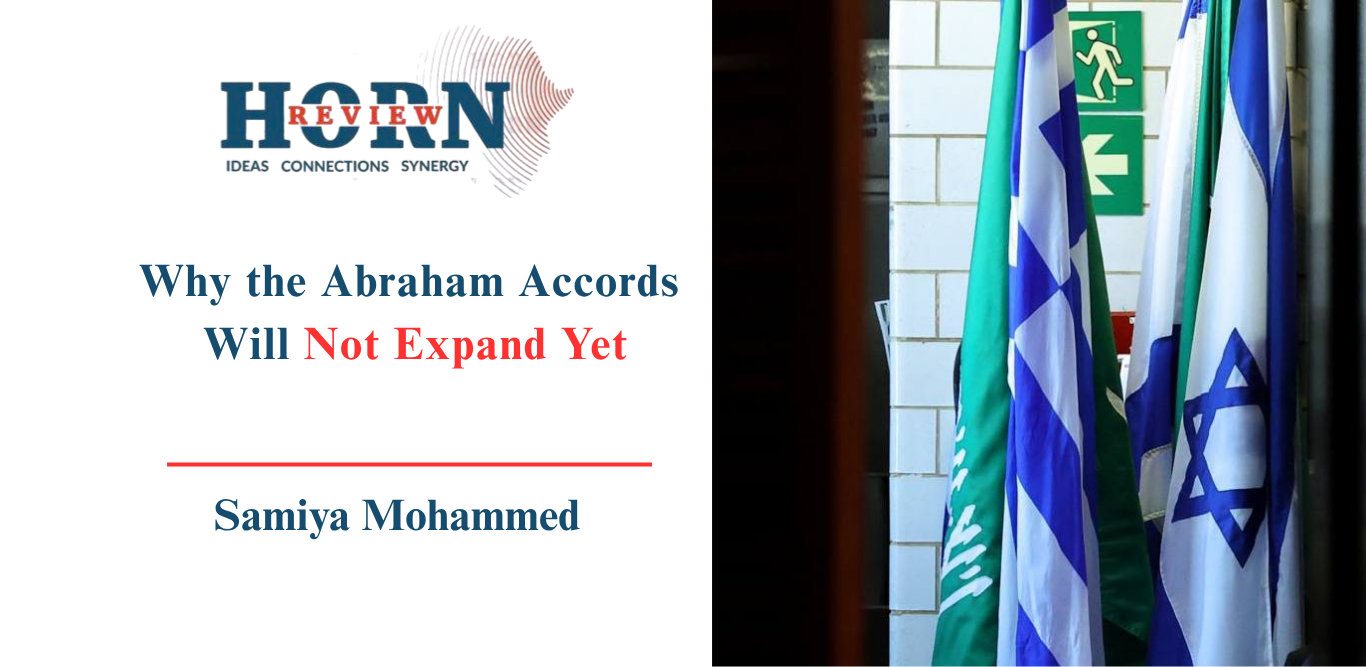
The claim that Israel is unlikely to find an opening to improve relations with Saudi Arabia even as Saudi expands intelligence sharing and military assistance in its campaign against the Houthis holds up on the formal level. But it tells only part of the story. However of public declarations and diplomatic rituals a quieter alignment already exists. Tactical convergence has become the default condition while formal ties are still the exception. Saudi vulnerability and not Israeli opportunity drives this cooperation. And the Palestinian question still overrides the logic of a shared adversary. The old assumption that a common enemy would accelerate quiet ties has yielded to domestic and regional legitimacy concerns. Washington remains the indispensable hinge providing political cover, targeting tools and mediation. Israel and Saudi Arabia are already co belligerents of convenience against the Houthis through American channels. That cooperation can and likely will deepen under fire because the alternative is Houthi control of a point that harms both economies and Saudi prestige. Yet formal relations, embassies, open defense pacts or expansion of the Abraham Accords remain blocked by Saudi public opinion, the Palestinian condition, Israeli domestic politics and mutual distrust of each other’s regional ambitions.
The Houthis have made their largest territorial gains in years seizing Mokha, Perim and Mayun Island and positioning themselves to threaten the Bab al-Mandab. They have struck Saudi oil pipelines causing partial shutdowns, hit a mosque near the border and targeted civilian sites. Saudi vessels face effective blockade risks. Saudi has been seeking help through direct appeals to Egypt and Gulf states, pressure on Washington for more than the roughly one hundred to two hundred American advisers already providing targeting and geospatial support and an indirect approach to Israel routed through CENTCOM. Multiple regional diplomatic sources report talks on Israeli intelligence assistance focused on Houthi deployments, intentions, and the maritime picture. Some reporting indicates that assistance is already flowing.
This is not a new phenomenon since Leaked CENTCOM documents and prior reporting show Saudi Arabia participating in the American brokered Regional Security Construct that included intelligence sharing with Israel on Iran, the Houthis, Syria, and ISIS even during the Gaza war. The Houthis themselves have claimed and staged confessions about a joint Saudi-American-Israeli spy network operating from Saudi soil. Israel has independently penetrated Houthi leadership through decapitation strikes in 2025 and has operational experience. The current request is an escalation of existing practice under acute pressure and not a sudden breakthrough.
So why will formal relations still not improve? Every Israeli foreign policy move is currently refracted through domestic elections. Any visible Israeli help would be spun for coalition optics. Saudi Arabia needs the opposite and deniability for its own public. The Gaza war, images of destruction and Israeli operations beyond Gaza have hardened saudis line into a non-negotiable demand for a Palestinian state on the 1967 lines with East Jerusalem as its capital. That demand is now stated as principle, not bargaining chip. Saudi media and officials have framed association with Israel as a strategic liability that imports instability without giving saudi control.
The Yemen campaign since 2015 exposed limited independent military capacity. Ranking high on paper firepower indexes has not translated into results against an Iranian proxy. Turning publicly to Israel would advertise that weakness and risk domestic legitimacy costs that Vision 2030 cannot absorb. So the statement is accurate on the formal opening. It is incomplete on the quiet reality that both sides are already exploiting. No romantic shared destiny narrative survives contact with these constraints.
The deeper truth is that Saudi Arabia does not need a public alliance with Israel to get what it wants. It needs intelligence, targeting data, and maritime awareness. The United States has the channels to move them without a single photograph, handshake, or embassy opening. This is the paradox of the current moment with the more dangerous the Houthi threat becomes, the more Saudi Arabia and Israel cooperate in the shadows and the less likely they are to acknowledge it in daylight. Formal ties would expose saudi to accusations of betrayal from its own citizens and from across the Muslim world. Quiet ties deliver the same operational benefits without the political cost.
The common enemy logic that once accelerated quiet ties has been subordinated to domestic and regional legitimacy. The Houthis are a shared threat but they are not a shared cause. Saudi Arabia fights them to protect its borders, its oil, and its prestige. Israel fights them to protect its shipping lanes and to weaken the Iranian network. Washington fights them to keep the Red Sea open for global trade. These interests overlap but they do not merge. The result is a tactical convergence that is real, operational and deniable. It is not a political alliance. It is a marriage of convenience conducted through American intermediaries.
The future of this alignment will be determined by events on the ground. If the Houthis continue to gain territory and threaten shipping, Saudi Arabia will need more Israeli intelligence and not less. If the Gaza war ends and a credible political process emerges, saudi might reconsider its public stance. If Israel’s domestic politics shift toward moderation, the distrust might ease. But none of these things are guaranteed. What is guaranteed is that the quiet channel will remain open as long as the threat remains shared. Formal relations will remain blocked as long as the Palestinian question remains unresolved. And the United States will remain the indispensable broker between two parties that cannot afford to be seen together.
In the final analysis, Saudi Arabia and Israel already function as co belligerents against the Houthis. Intelligence is shared through American channels with maritime security coordination and targeting support are underway and the two states are aligned against a shared adversary. Yet they are neither allies nor partners, nor even friendly interlocutors. They remain two sovereign actors whose interests overlap in limited domains while their political systems, domestic constraints and regional ambitions remain fundamentally incompatible. Each engages the other instrumentally when operational necessity demands it and maintains deniability when political costs rise. Such an arrangement does not constitute a foundation for durable peace. It produces, instead, a structure of permanent strategic ambiguity in which an equilibrium that, under present conditions in the Middle East may represent the most stable outcome available.
Samiya Mohammed, Researcher, Horn Review