
The Real Houthi Weapon Was Mobilization, Not Missiles
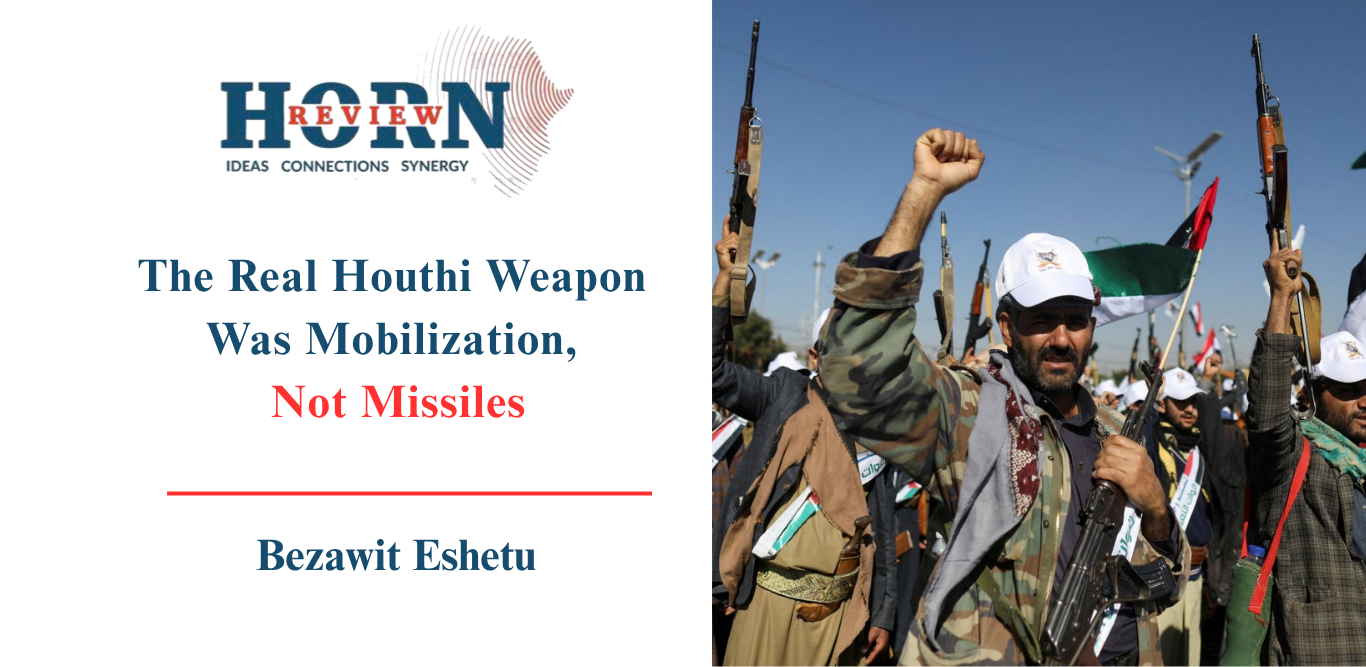
Fatima Abo Alasrar frames the Houthi ground strategy as a deceptive strategic pivot in which external maritime escalation created cover for an extensive process of internal military consolidation. While international defense efforts concentrated on countering anti-ship ballistic missiles and unmanned aerial vehicles in the Red Sea, Ansar Allah used the distraction to build a mass ground force through what its internal discourse described as the Red Death campaign. Her central insight is that the movement transformed the society under its control into a mobilization system capable of sustaining large-scale infantry operations even as external pressure degraded its more sophisticated military capabilities. The September 2026 coastal offensive represented the operational release of that system.
Israeli precision strikes had already eliminated critical figures within the Houthi military hierarchy, including Chief of Staff Mohammed al-Ghamari, while naval interdiction and sanctions weakened the supply networks that had supported the movement’s more advanced missile and drone capabilities. As those systems became increasingly vulnerable to blockade and airstrikes, the Houthis shifted greater weight toward manpower. The population itself became the movement’s most resilient military resource. What emerged was a deeply institutionalized mobilization apparatus that penetrated civilian life across northern and central Yemen.
Universities, water utilities, telecommunications offices, airports, sports federations, and tribal structures became recruitment and registration points. Attendance was documented and monitored through neighborhood supervisors and local leaders who effectively operated as a permanent census network. Refusal could expose individuals to accusations of collaboration, reinforced by highly publicized espionage investigations that helped generate the climate of fear required for compliance. Mandatory courses carrying the name Al-Aqsa Flood further embedded recruitment within a wider narrative of permanent confrontation by appropriating the designation Hamas used for its 7 October 2023 attack on Israel.
The result was a force organized around a pronounced internal hierarchy. A trusted Zaydi core retained control over intelligence, technical capabilities, strategic decision-making, and the movement’s remaining links to Iranian Revolutionary Guard Corps networks. A much larger outer layer consisted of coerced Shafi’i and Sunni recruits, particularly from governorates such as Raymah and Ibb, who provided the manpower required for mass ground operations. This structure enabled the leadership to conserve scarce technical expertise while drawing on a broad pool of personnel for large-scale offensives.
Mobilization also extended beyond formal recruitment. Official holidays were repurposed, new commemorations were established, and public space was increasingly organized around military symbolism. Sports tournaments carried the names of martyrs, public events required visible displays of allegiance, and participation was frequently recorded. Access to subsidized cooking gas, food rations, and commercial permits became linked to demonstrated compliance. Over time, this produced a system in which political loyalty was performed continuously and dissent became progressively costlier, eroding social trust and normalizing permanent mobilization.
During this period, the movement also appears to have exercised deliberate restraint in its missile campaign. Limiting high-profile launches helped conserve an increasingly vulnerable arsenal and reduced exposure among surviving commanders while preserving the wider economic effects of maritime insecurity. Shipping delays and elevated insurance costs continued to impose pressure on adversaries even when Houthi missile expenditure remained relatively limited. The pause therefore generated strategic leverage at comparatively low military cost, allowing the movement to preserve its maritime threat while concentrating resources on the ground.
This asymmetry is central to Abo Alasrar’s argument. International security institutions remained heavily focused on the maritime theatre, where the visible problem involved missiles, drones, commercial shipping, and the security of a major global chokepoint. Inside Yemen, however, the deeper strategic process concerned territorial and administrative consolidation. Maritime attacks drew foreign military attention toward the sea while providing the Houthis with an anti-imperialist narrative that could strengthen domestic legitimacy. The international focus on the Red Sea consequently gave the movement greater room to develop its internal military infrastructure.
When the infantry force reached operational maturity, the September offensive demonstrated what the Houthi mobilization system had been built to accomplish. The advance down Yemen’s western coast rapidly connected the movement’s mass ground capacity to control of the country’s most strategically valuable maritime approaches. The capture of Mokha, Dhubab, and other coastal positions, followed by the seizure of Perim, Zuqar, and the Hanish Islands, gave them a contiguous position stretching from the western mainland into the Bab el-Mandeb. The significance of the offensive therefore lies in the geographic system these gains created. The Houthis emerged with territorial depth on land and physical positions around the southern entrance to the Red Sea.
That outcome transformed the military value of the force assembled through the Red Death campaign. Mass infantry enabled the movement to overrun fragmented coastal defenses, while control of the resulting territory converted battlefield gains into a maritime instrument. Perim sits inside the Bab el-Mandeb and divides the strait into two channels, while positions around Dhubab and Mokha provide access to the approaches from the Yemeni coast. The Hanish and Zuqar islands extend that reach farther into the Red Sea. Together, these positions give the Houthis greater capacity to monitor maritime traffic and threaten disruption, allowing a ground force generated through domestic mobilization to acquire significance well beyond the territory it captured.
The speed of that breakthrough points directly to the strategic failure that made it possible. Riyadh spent years containing the Houthis through a Yemeni political order built around competing armed factions rather than a unified national security structure. Saudi Arabia faced a persistent dilemma between limiting Houthi power and preserving a Yemeni order that remained responsive to Saudi interests. Managing that balance produced a fragmented anti-Houthi camp in which Saudi- and Emirati-backed formations retained separate command structures, territorial priorities, and local loyalties. By the time the Houthis deployed their newly mobilized infantry force along the western coast, the forces facing them lacked the cohesion and centralized command required to absorb the assault.
The contrast with earlier Saudi policy is significant. During the six Saada wars, Riyadh generally backed a centralized Yemeni government capable of pushing the Houthis toward their northern stronghold. In the subsequent phase, Saudi influence contributed to a more fragmented political and military order in which rival armed factions competed for resources, territory, and external patronage. The resulting fragmentation gave the Houthis a growing organizational advantage as their own command structure became more centralized and their mobilization system expanded.
The Presidential Leadership Council, established in Riyadh in 2022 as an eight-member body intended to unify anti-Houthi factions under a common executive authority, illustrates the problem. Its members reflected competing Saudi and Emirati relationships as well as divergent local interests. Riyadh funded rival formations rather than integrating the anti-Houthi camp into a unified defense structure. Tariq Saleh’s National Resistance Forces drew heavily on northern networks and faced limited organic legitimacy among many coastal communities. The UAE-backed Giants Brigades, composed largely of southern Salafi forces, were more focused on southern security priorities and retained limited incentives to operate under a northern command structure. Tihama communities, for their part, often viewed both the Houthis and northern-led formations as external forces pursuing their own territorial interests.
This fragmented military architecture suffered from weak cohesion and uneven local legitimacy. Reports of ghost troops and patronage-based recruitment further reduced battlefield reliability. Psychological operations could therefore exploit pre-existing distrust, as demonstrated by the circulation of AI-generated audio purporting to show Tariq Saleh ordering retreats. The Houthis entered the confrontation with a more centralized command structure and a mobilization system designed to generate manpower on a national scale. Saudi efforts to strengthen its influence after the Southern Transitional Council’s expansion and later rollback in late 2025 and early 2026 also diverted attention and resources from the western coast as the Houthi ground force was reaching operational maturity.
The regional consequences are especially significant for Saudi Arabia because the Bab el-Mandeb and Strait of Hormuz connect two separate theatres of vulnerability. Iranian capabilities around Hormuz and Houthi control of the Yemeni side of the Red Sea create pressure on different parts of the kingdom’s maritime environment. The strategic relationship between those pressures does not require direct operational coordination. Tehran and the Houthis retain distinct interests, yet their respective positions can reinforce the broader constraints facing Saudi Arabia and its partners.
Iran has consistently rejected portraying the Houthis as a force under direct Iranian command, while Tehran has emphasized the movement’s independent Yemeni motivations. Yet the relationship extends well beyond political alignment. Iran has supplied weapons, training, intelligence, and technical assistance through the IRGC, accelerating the development of capabilities the Houthis could not have built as quickly on their own. That support has strengthened a movement whose organizational structure and political objectives remain distinctly Yemeni while connecting it to a wider strategic network. Its significance lies in the way Iranian assistance has amplified a domestically generated military system, allowing the Houthis to translate mass mobilization into power that reaches across Yemen and toward the region’s most critical maritime corridors.
The September 2026 offensive exposed the full strategic value of that combination. Years of internal mobilization had produced a large and increasingly institutionalized manpower base, while centralized command preserved the movement’s strategic and technical core. Iranian support reinforced these capabilities, and fragmentation within the anti-Houthi camp created the conditions for their conversion into territorial gains. The result is a Houthi system whose military power rests on the integration of society, territory, and strategic geography. Control of the western coast and the islands around the Bab el-Mandeb has extended that power into the maritime domain, giving the movement leverage well beyond the territory it occupies. The Red Sea crisis thus provided the operating environment for a deeper process of military consolidation, one that has transformed Houthi control over Yemeni society and territory into sustained strategic leverage over a vital regional chokepoint.
Bezawit Eshetu, Researcher, Horn Review

RELATED
Posts
16
Sep
The Houthis Reached Zuqar Island: Can Eritrea Be a Neutral Observer?
The island of Zuqar sits in the southern Red Sea,...
15
Sep
What the UN’s Darfur Sanctions Rollover Reveals About the Next Phase of Sudan’s War
On paper, Resolution 2828 is a housekeeping measure. It...
14
Sep
Eritrea Can’t Secure the Red Sea. Here Is Why
When Saudi Arabia formed a coalition of states in...
14
Sep
Shadow Competition in the Horn, Saudi Training and Emirati Surveillance
The Horn is experiencing a shift in the character of...
14
Sep
Egypt's Rafale Rush Is What's Left After Washington Closed the Other Doors
Egypt is nearing a new deal with French company...
14
Sep
Why Has Ethiopia Become Egypt’s Exception on the Nile?
Egyptian officials have repeatedly made a revealing distinction about the...
14
Sep
The Houthi Advance and the Changing Strategic Geography of Bab el-Mandeb
The Red Sea crisis has largely been understood as a...
14
Sep
Egypt’s Diminished Regional Hegemony and the Structural Realities of the Saudi-Egyptian Axis
The geopolitics of the modern Middle East is frequently interpreted...
14
Sep
Wahhabism, Sunnism, and the Centralization of Saudi Political Authority
Saudi Arabia’s recent transformation is frequently presented as a movement...
12
Sep
Egypt’s Geopolitical Paradox on the Nile: Selective Partnerships as a Strategy of Containment
Egypt’s response to Ethiopia’s development and utilization of the Nile...