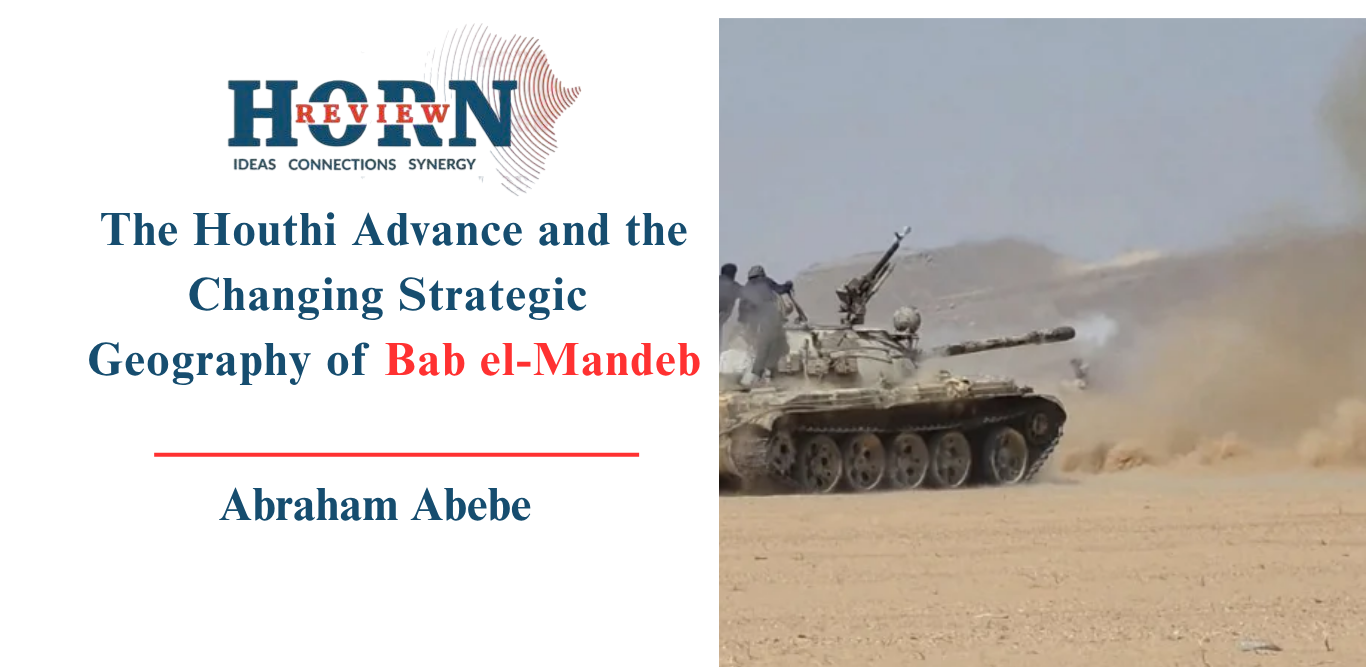
The Red Sea crisis has largely been understood as a problem of maritime disruption, but the Houthi advance along Yemen’s western coast is beginning to alter the strategic equation. The capture of Mocha on 10 September, followed by the reported movement into Dhubab and arrival on Perim Island on 11 September, places Houthi forces progressively closer to the physical approaches to the Bab el-Mandeb Strait. The significance is not simply that the Houthis can threaten another stretch of shipping. Territorial positions along this coastline could give the movement greater leverage over the access points to the strait, linking its land-based military presence with its longstanding maritime campaign. The crisis is thus shifting from a struggle to secure shipping to a struggle over control of the strategic geography that shipping must traverse.
That shift matters because geography can convert relatively limited military capabilities into strategic influence. Bab el-Mandeb connects the Red Sea to the Gulf of Aden and sits between Yemen and the Horn of Africa, while Perim Island is positioned within the strait itself. The Houthis therefore do not need to control every vessel movement to impose costs. The prospect of sustained attacks, selective restrictions or intermittent disruption can raise insurance premiums, encourage rerouting and alter the calculations of shipping companies and governments. With approximately 7% of global oil output passing through Bab el-Mandeb, the strategic value of the surrounding geography extends well beyond Yemen.
That leverage, however, should not be confused with control. The reported Houthi takeover of Perim does not amount to control of Bab el-Mandeb; rather, it gives the movement a more advantageous position from which to threaten the strait and its approaches. The more immediate strategic effect is the emergence of a geographically proximate capacity for sea denial. The Houthis do not need to close the waterway completely to make their territorial gains consequential. The ability to threaten, disrupt or raise the risks of passage may be sufficient to alter the behaviour of commercial operators and regional governments. The central question is therefore whether they can consolidate these positions and convert territorial proximity into sustained strategic leverage over the strait.
Whether that leverage becomes durable will depend partly on the response of Yemen’s internationally recognised government and the forces aligned with it. The speed of the Houthi offensive exposed serious weaknesses along the western coast, but the territorial outcome remains unsettled. Yemeni government forces have indicated plans to recover positions lost during the advance, after withdrawing from Perim and losing Dhubab to the Houthis. The immediate contest, therefore, is not simply over territory but over whether the Houthis can consolidate their new positions before government forces mount an effective response.
For Saudi Arabia, however, the timing is especially critical. The kingdom is already facing severe disruption in the Strait of Hormuz as the wider US-Iran conflict continues. That has made the Red Sea increasingly important as an alternative outlet for Saudi energy exports, particularly through the East-West pipeline to Yanbu. The Houthi advance now places that alternative under pressure as well, leaving Saudi Arabia exposed at both ends of its energy-export system.
That vulnerability became tangible on 12 September, when Saudi Arabia temporarily shut its 1,200-kilometre East-West oil pipeline following a drone attack. The pipeline carried between four and five million barrels of oil per day, equivalent to roughly 4 to 5% of global supply. No group has claimed responsibility for the attack, leaving its origin and motive unclear. Yet the timing was strategically significant: as the pipeline was disrupted, Houthi forces were consolidating positions around Bab el-Mandeb. The two developments were not necessarily operationally connected, but together they exposed the vulnerability of Saudi Arabia’s two principal alternatives for moving energy beyond the Gulf.
Riyadh’s strategic problem is therefore becoming one of constrained options. Diversifying routes may reduce reliance on a single chokepoint, but it cannot eliminate geographic vulnerability if multiple corridors remain susceptible to threats from the same regional conflict. The deeper concern is not simply that one corridor has become insecure, but that the alternatives designed to compensate for disruption elsewhere are themselves becoming increasingly vulnerable.
Iran stands to benefit strategically from this geography, although that does not mean Tehran exercises direct operational control over every Houthi decision. The advantage is broader: as Iran confronts the United States, the parallel Houthi advance toward Bab el-Mandeb creates additional pressure around a major regional energy chokepoint. The development gives Tehran potential leverage over both Hormuz and Bab el-Mandeb. The significance is therefore less about establishing an Iranian-controlled maritime system than about increasing the number of points at which regional energy and commercial flows can be disrupted.
This places Washington in a difficult position. The United States possesses the military capacity to strengthen the defence of Bab el-Mandeb, but preventing Houthi consolidation could require deeper involvement in Yemen. Washington has so far resisted direct military intervention on Saudi Arabia’s behalf, while offering intelligence support instead. A limited response may contain immediate maritime risks, but it does not solve the territorial problem developing along Yemen’s western coast. The dilemma, then, is not merely whether the United States can defend the strait, but whether it can do so without becoming further enmeshed in Yemen’s conflict.
The Houthi position also creates a potentially different model of maritime coercion. The movement has indicated that navigation can remain open to most shipping while restrictions apply to Saudi vessels. If such selective restrictions can be sustained, the strategic objective would not necessarily be to close Bab el-Mandeb completely. It would be to turn access to the maritime corridor into political leverage. That could be harder to counter than a conventional blockade because shipping could continue while remaining subject to politically selective restrictions and persistent uncertainty.
The consequences are already extending beyond maritime security. More than 76,000 people have been displaced in Yemen since July as fighting has intensified. IOM reported that approximately 18,500 people had been displaced in Taiz and Al-Hodeidah since hostilities escalated on 3 September. The scale of displacement points to a broader danger: the Houthi advance is not simply reopening a military front, but threatening the period of relative calm that followed the 2022 truce. A conflict increasingly tied to control of a global maritime chokepoint could therefore become harder to contain within Yemen’s borders.
For the Horn of Africa, the implications are immediate. The region sits directly across the Bab el-Mandeb from Yemen, making prolonged instability along Yemen’s western coast difficult to isolate from the wider maritime environment. Any sustained Houthi consolidation could increase pressure on shipping routes, ports and regional economies, transmitting the effects of a conflict on the Arabian side of the strait into the Horn. While the region may not be the primary theatre of conflict, its closeness to the advancing front makes it ever more challenging to regard the crisis as an issue contained within Yemen alone.”
The immediate question is whether the Houthi advance can be reversed. More importantly, the territorial gains have already changed the strategic environment around Bab el-Mandeb. Whether their control is secure or challenged, the movement’s proximity to the strait has amplified risks to regional energy routes, commercial shipping, and the wider maritime system. For the Horn of Africa, this demonstrates a broader reality of Red Sea security: instability around Bab el-Mandeb cannot be separated from the territorial politics surrounding it. A conflict that has already exposed vulnerabilities in Saudi energy routes, complicated Washington’s choices and generated further humanitarian pressure could become harder to contain if the Houthis consolidate their western-coast positions.
Abraham Abebe, Researcher, Horn Review