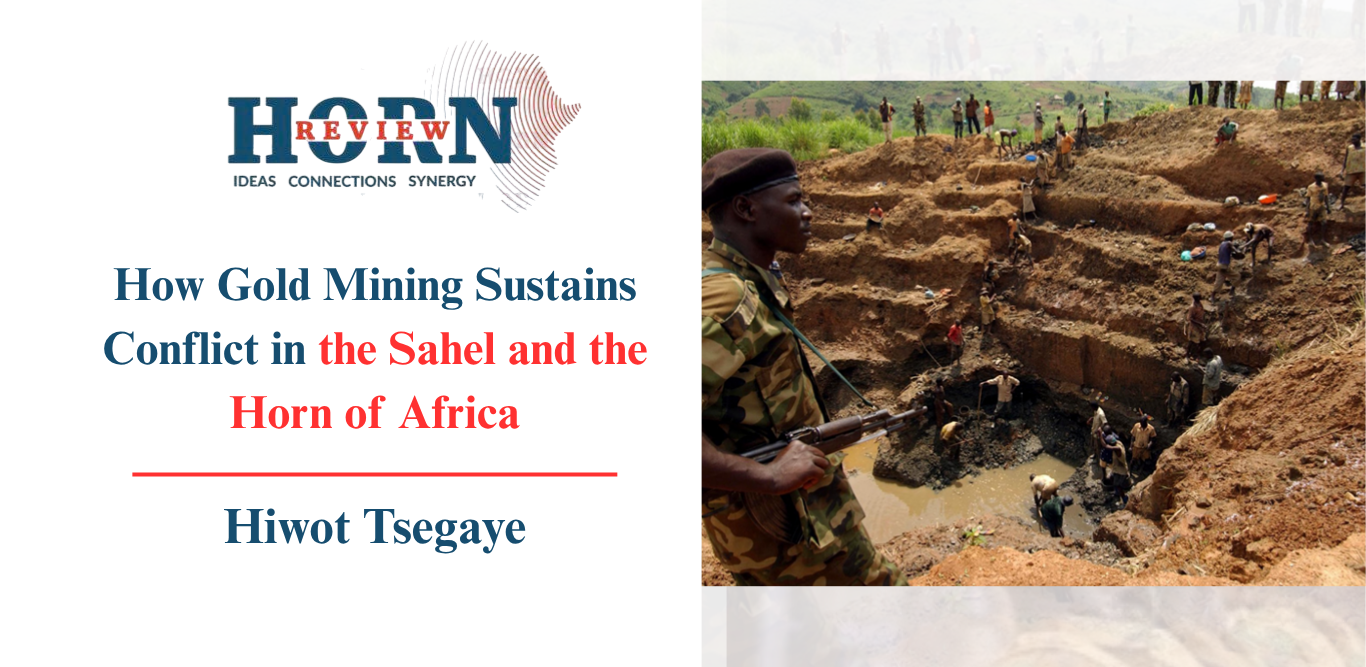
Across a stretch of Africa running from northern Mali to the Red Sea, informal gold trading networks have become one of the most durable sources of financing for armed conflict on the continent. The traders, brokers and cross-border trading networks that actually move the metal rarely appear in headlines about any single war, yet they are often the reason a war can keep paying for itself. Artisanal gold requires no factory, no fixed infrastructure and no single point of control. It can be dug by hand, carried in a pocket, and sold to whichever buyer is closest, qualities that have let a loosely organized, largely informal trade route grow from the Sahel through Chad and Sudan toward the Red Sea coast.
What makes this network worth watching closely is not any single armed group’s ambition but the informality of the system itself. Militants, paramilitaries and militias tax, extort or occasionally seize gold-producing areas, but the trade that actually carries the metal across borders runs largely through artisanal miners, small traders and long-established cross-border trading networks that predate most of today’s conflicts and will likely outlast them. That structure is what lets the trade stretch into new territory almost as soon as conditions allow it a fresh conflict, a newly porous border, a shift in security presence.
In the central Sahel, researchers have documented this pattern in detail. A July 2026 ACLED report examined more than 1,000 violent incidents recorded between January 2015 and June 2026 around industrial and artisanal gold sites in Burkina Faso, Mali and Niger. Jama’at Nasr al-Islam wal-Muslimin accounted for roughly two-fifths of these events. Gold-adjacent sites made up close to 90 percent of all recorded mining-related violence, most of it within ten kilometers of a mine. Burkina Faso accounted for the majority of these incidents for most of the period under review, while Mali and Niger have seen a clear increase since 2024 as the informal trading circuit continues to expand.
ACLED analyst have described mining zones as spaces that serve several purposes at once for armed groups: recruitment grounds, sources of intelligence, weapons storage, and a revenue stream. In parts of Mali, fighters have reportedly worked alongside miners at some sites, using the existing informal economy instead of building a parallel one. Burkina Faso has recorded the largest share of this violence since 2015, though Mali and Niger have taken on a growing portion in recent years. The same pattern of taxation and control is now appearing near gold sites along the borders with Benin, Togo and Côte d’Ivoire.
That circuit has started moving toward the West African coast. JNIM’s advance toward the borders of Senegal, Guinea, Ivory Coast and Ghana, together with activity in northern Benin and Togo, has drawn warnings that a pattern already familiar in the central Sahel could take hold farther south.
The same reasoning holds moving east. Nothing indicates that JNIM itself has any presence in Sudan or the Horn of Africa. But the informal trading structures that let its economic model take hold in the central Sahel family and ethnic-based networks that move gold, fuel and other goods across borders exist in a strikingly similar form along the corridor running through Chad and into Sudan. These networks, more than any single militant group, are what give the wider gold trade its capacity to stretch into new conflict zones.
Northern Chad illustrates the point well. Three communities the Tubu, the Goran and the Zaghawa have operated cross-border trading routes through the region for generations. Research by the Clingendael Institute has found that these networks move fuel, weapons, gold and people together along the same routes, often in the same vehicles.
The ISPI research institute has described the result as a set of militia-run “traffic loops” linking Libya, Chad and Sudan. A well-documented route carries gold mined at Jebel Amer in North Darfur through Kornoi to Tina on the Sudanese side of the border, across to its Chadian namesake, and on to Abéché and N’Djamena.
Sudan’s civil war has added enormous new volume to this system. The country ranks among Africa’s five largest gold producers. According to the world gold council only about 20 of the estimated 74.6 metric tons produced in 2025 passed through registered export channels.
Chatham House research has tracked how gold producers, traders and miners displaced by the war have carried their expertise across the border into northern Chad, southern Egypt and South Sudan. Egypt has become one of the most important outlets for this trade. Shortly after the war began in 2023, Cairo removed customs duties on gold imports. Researchers at Chatham House estimate that a majority of production from Sudan’s Northern, River Nile and Red Sea states now moves informally into Egypt rather than through official Sudanese channels. Once inside Egypt, the gold is often absorbed into formal trading circuits and continues toward international markets, effectively folding conflict-linked metal into a neighboring economy.
Wherever it starts, a considerable share of this gold eventually reaches Gulf trading hubs, particularly Dubai. Research groups including the Global Initiative Against Transnational Organized Crime have documented a market structure that makes tracing origin difficult by design. The Red Sea coast forms the eastern edge of the same corridor. Chatham House researchers list Eritrea among the transit points through which Sudanese gold is said to move.
The same informal logic has extended into Ethiopia, particularly in Tigray and the gold-bearing areas near the Sudanese border. Since the war in Tigray, artisanal and small-scale mining has expanded rapidly. Reports indicate that leaders linked to the Tigray Defense Forces, figures associated with the Tigray People’s Liberation Front, local businesspeople and some foreign nationals have all played roles in the informal extraction and trade. These networks connect Tigrayan sites to cross-border routes with Sudan and beyond, feeding into the same regional system.
None of this adds up to a single organization running gold from Kidal to the Red Sea. What connects the Sahel, Chad, Sudan and the Horn is a shared informal architecture family trading networks, artisanal miners, brokers and hawala dealers that predates the current wave of conflicts and has simply adapted to it. That same architecture is what makes the trade so difficult to interrupt. It is this informal layer, more than any one armed group, that deserves closer attention, because it is what allows the same commodity to keep financing whichever conflict is active along the corridor, and to move with little difficulty into whichever one comes next.
By Hiwot Tsegaye