On August 6, the Civil Democratic Alliance for Revolutionary Forces formally known as Somoud, submitted a set of observations to the Quintet Mechanism on the future of Sudan’s political process. The first thing worth noting is the timing as the memorandum arrived roughly a week after the quintet’s latest round of Addis Ababa consultations concluded with out an attendance from Somoud.
Written in the register of continued engagement, the document signals Somoud’s openness to meeting the Quintet and also be serves as a retrospective justification for its decision not to participate in the July round. It should therefore be read both as an expression of continued engagement and as a political explanation for Somoud’s absence, a pattern that has recurred often enough in Sudanese coalition politics over the past year to merit attention in its own right.
The Quintet which comprises the African Union, IGAD, the Arab League, the European Union, and the United Nations under the chairmanship of Mohamed Ibn Chambas, has been trying since the Berlin conference in April to build a preparatory committee that could organize a genuinely Sudanese-led political process that is distinct from the parallel security and humanitarian track carried by the US-led Quad structure.
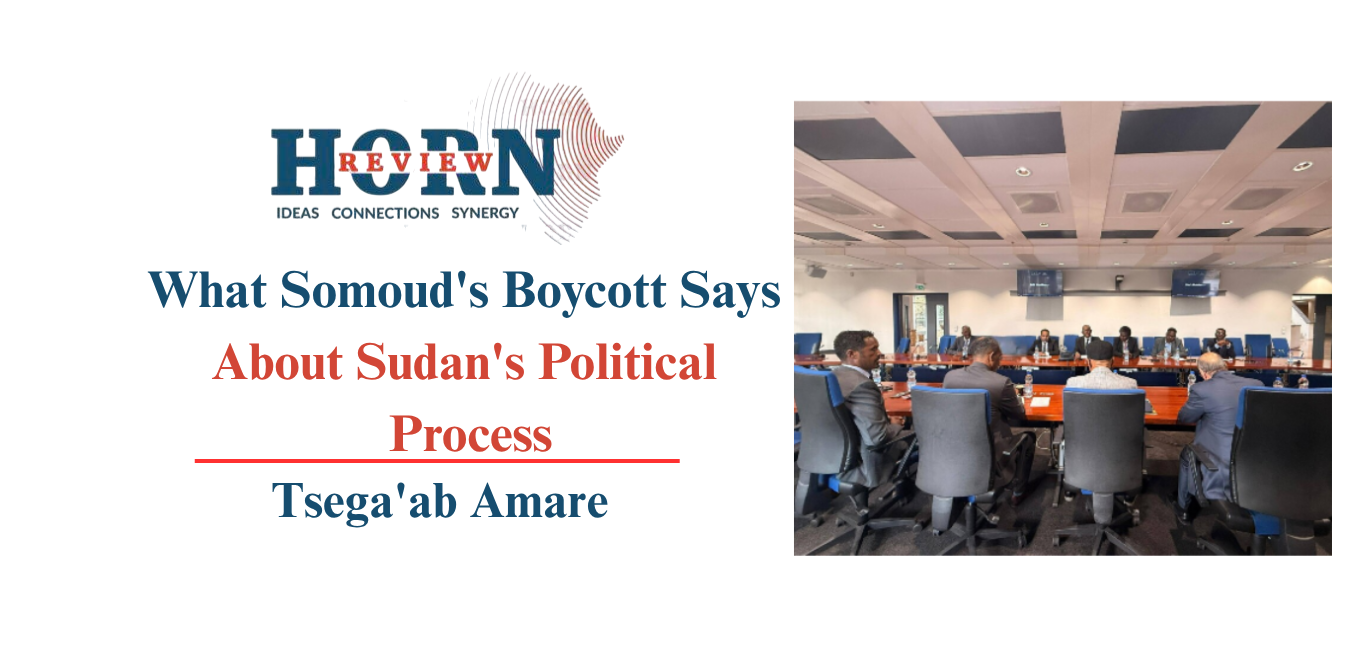
The first Addis Ababa round in early June produced written submissions from a range of Sudanese actors but did not resolve questions around the composition. The round that closed in late July, running from July 27 to July 31, aimed to move past that impasse. Somoud and the RSF-aligned Tasis coalition boycotted it separately each carrying objections that have tended to center on different grievances than the civilian anti-war blocs voices.
The National Umma Party however did attend, with a delegation led by Maryam El Sadig El Mahdi, and argued that any political process must be preceded by a ceasefire and humanitarian access rather than beginning with the representation questions Somoud foregrounds.
Read against that backdrop, the memorandum’s opening claim of a growing convergence among Sudanese political and civilian forces around an anti-war position asks the reader to see unity where the record shows fragmentation on tactics. Blocs share opposition to the war and to any political settlement that would rehabilitate the National Congress Party, but they disagree, sometimes sharply, on whether engaging the Quintet from inside the process or withholding participation from outside better serves that shared goal.
The introduction’s more consequential claim and the one the rest of the memorandum builds from, is not ultimately about representation. It is the premise that the design of a political process determines the outcomes that process can produce, and that flawed composition or unilateral scheduling cannot be corrected later by good outcomes. The claim has real grounding in Sudan’s own history. Both the 2019 transitional arrangement and the 2020 Juba Peace Agreement suffered from founding-stage exclusions that proved difficult to repair and that fed the fragmentation Sudanese politics has struggled with since. But the premise also has limits the memorandum does not acknowledge.
Process design cannot manufacture leverage that the underlying balance of power does not otherwise provide, and the claim that flawed process design predetermines political outcomes is ultimately difficult to test, since nearly any dissatisfied actor can argue that procedural shortcomings undermine the legitimacy of subsequent negotiations. The premise is best read as a genuine diagnosis of a real structural weakness in how the Quintet has organized these consultations, rather than as a complete explanation for why the political track keeps stalling.
The strongest point in the document is its insistence that any political settlement must foreclose a potential return for the National Congress Party and its Islamist networks, framed in the memorandum not as simple political exclusion but as a legal and security requirement tied to accountability for the war. It is worth noting that this demand is also the one point on which the fractured civilian and political landscape genuinely converges, even though disagreements remain about tactics and process. That convergence should not be read as merely convenient for Somoud.
Opposition to any NCP role in Sudan’s future has been central to the coalition’s identity well before the current process began. It is also, separately, the least costly demand Somoud could make in this particular memorandum. It aligns the coalition with language the Berlin Declaration and the Quad Roadmap have already normalized among Sudan’s international interlocutors, letting Somoud present itself as in step with the broader diplomatic consensus even as the rest of its memorandum at some points pushes back against the design of that same diplomacy’s flagship consultative process.
The more consequential and more self-interested section of the memorandum concerns representation. Somoud objects to being treated as a single seat at the table, arguing that a coordinating mechanism spanning a plurality of civilian and political voices cannot be compressed into one delegation without misrepresenting the constituency it claims to speak for. The principle is defensible in the abstract. It also comes from a coalition that has itself been accused of trying to narrow the field.
During the June consultations the Civil Front to Stop the War and Restore Democracy accused Somoud of pressuring the organizers to limit recognized blocs to three formations, excluding other political actors from the process entirely, a dispute that preceded the Civil Front’s own boycott. Read next to that history, the representation section of the August memorandum looks less like a disinterested defense of pluralism and more like an argument for more seats and more procedural weight for the coordination Somoud itself leads, dressed in the vocabulary of inclusion.
The memorandum’s bifurcation of the two tracks, leaving the warring parties to negotiate security arrangements through the Quad while insisting civilians alone should shape the political track, is coherent as a normative claim about who ought to build a democratic transition. It does not resolve the practical problem that has undercut every iteration of the Quintet process so far: political representatives and field commanders are answering to different incentives, and a civilian track that runs in parallel to a military track can as easily become a legitimizing shell for battlefield outcomes decided elsewhere as it can become the foundation of the citizenship-based state the memorandum invokes in its closing lines.
This memorandum is therefore best understood as a positioning document rather than a negotiating input. Its demand on Islamist exclusion draws on a genuine point of civilian convergence and is unlikely to meet resistance among Sudan’s international interlocutors. The memorandum’s implications extend past Somoud itself. It illustrates the broader dilemma confronting the Quintet, in which nearly every Sudanese civilian coalition professes support for an inclusive political process while a shifting subset of them rejects the procedural arrangements through which that process has actually been organized.
The task facing the Quintet is therefore not simply attracting participation from a wider set of actors. It is designing a framework that competing civilian actors, whose disagreements often have as much to do with each other as with the war itself, can each recognize as legitimate at the same time.
By Tsega’ab Amare, Researcher, Horn Review