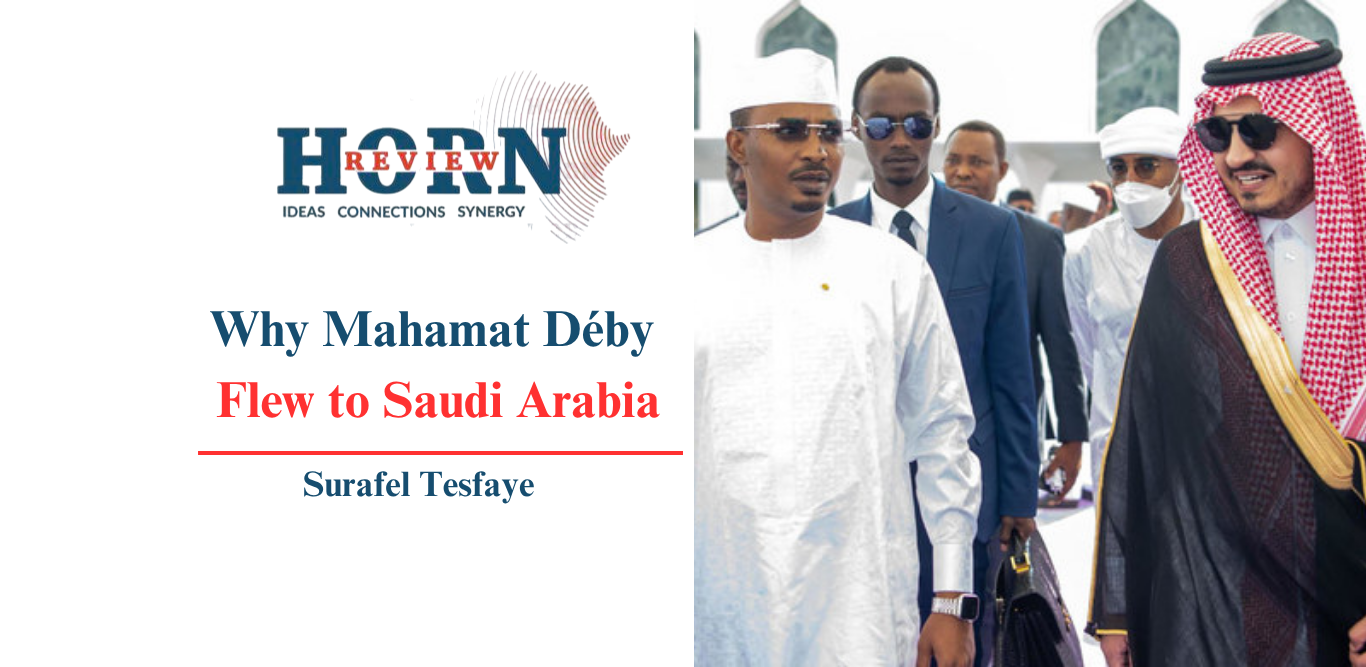
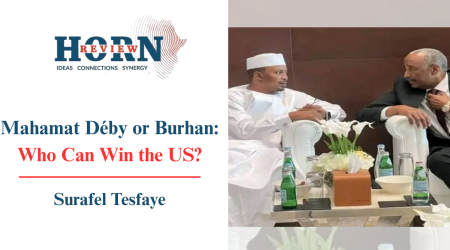
President Mahamat Idriss Déby Itno’s visit to Saudi Arabia during the Hajj season was officially framed as a religious pilgrimage, but the political calculations behind the trip ran much deeper. Déby arrived in Riyadh at a moment when Sudan’s war was no longer contained within Sudanese borders. The conflict had begun reshaping the entire Sahel, pulling in Gulf rivalries, cross-border militias, tribal realignments, and competing security networks from Darfur to Libya and the Red Sea.
For Chad, this shift was an existential threat. Over the past several years, N’Djamena became deeply enmeshed in the logistics of the Sudan war, particularly along the Chad–Darfur frontier. But as the fighting intensified, the blowback grew harder to manage. Drone strikes near the border, waves of refugees, armed smuggling corridors, and tribal fractures inside Chad’s own military left Déby in a dangerously fragile position. The war was no longer a neighbor’s problem. It was eating into Chad’s internal stability.
The primary catalyst for this move was the escalating crisis on Chad’s eastern border. In February 2026, heavy fighting in the border town of Tine spilled into Chad, killing five Chadian soldiers and three civilians. Following that incursion, intensive drone and missile strikes including SAF strikes on RSF positions along the border caused massive casualties and threatened Chadian territory. Déby responded by closing Chad’s eastern border with Sudan. But he knew that closure could not last forever. He could not seal himself off completely, nor could he afford to be drawn into a direct conflict with either Sudanese faction. One would attack him outright; the other would weaponize ethnic-affiliated groups inside his own army.
Déby knew the brutal math of his situation. He ran a weak state pressed between two heavily armed rivals. He could not project power, pick a clear side, or survive a cross-border war. This reality sat behind every diplomatic move he made.
A major driver of the crisis was the growing Saudi-Emirati competition over Sudan’s future. Both Gulf monarchies were widely believed to be funneling money and weapons to opposing factions, though always through covert channels and deniable intermediaries. The UAE was suspected of backing Hemedti’s Rapid Support Forces. Saudi Arabia was suspected of backing Burhan’s Sudanese Armed Forces. Chad’s geographic position made it strategically valuable to both. But that value came with a price. If Déby tied himself too closely to one Gulf power, he risked retaliation from the other and from the Sudanese general that power opposed.
That is why Déby was not trying to switch sides. He was trying to diversify Chad’s foreign ties before the Sudan war fully regionalized. He needed to avoid any overt shift that would trigger assumptions of realignment. Choosing a religious journey to Mecca provided the perfect mechanism: a ritual act that carried no political declaration but allowed him to move freely. By appearing in Saudi Arabia under the cover of the Hajj, he could engage Riyadh without signaling a rupture with Abu Dhabi.
Riyadh offered him political space because Saudi Arabia still played the role of a regional mediator while quietly backing Burhan. By leaning toward Riyadh, Déby hoped to reduce his vulnerability and keep any single actor from dominating his security decisions.
There was another layer to this strategy. For years, Burhan had repeatedly ignored Déby’s requests for direct talks. The Sudanese general believed that Déby was facilitating weapons to his enemy through Chadian territory. Nonetheless, Déby is extracting an opportunity. By using Saudi Arabia as an intermediary, he could create a secret backchannel to Burhan without the humiliation of begging for a meeting. The Hajj gave him the perfect excuse to be in Riyadh, where Saudi mediators could quietly arrange a closed-door encounter. This was not a shift in alliance. It was an opportunistic plan to open a hidden window of communication while preserving his existing relationships.
Chad’s own military made this delicate maneuver unavoidable. Déby depended on an army that was split down ethnic lines. On one side stood the Zaghawa, his own ethnic group. They formed the elite backbone of Chad’s military and intelligence apparatus. They watched the RSF slaughter their kin across the border in Darfur, and they demanded that Chad side with the SAF. On the other side stood Chadian Arab soldiers and commanders who shared deep blood ties with Hemedti’s RSF. If Déby ordered his army to fight the RSF, the Arab troops would mutiny or desert. If he ordered them to fight the SAF, his Zaghawa generals would stage a coup and kill him. The moment he commanded his army to cross the border, the Sudanese civil war would become a Chadian civil war.
Therefore, Déby could not use force. He had to use diplomacy. His absolute priority was to prevent a hot war from erupting on his eastern border. He knew that Chad’s military lacked the strength, cohesion, and unity to intervene in Sudan. Any attempt to strike either General Burhan or General Hemedti would trigger a chain reaction that would crush his regime.
If the SAF and RSF decided to turn the border zone around Adré, Tine, or Amdjaras into a full conventional battlefield, Déby would lose all control. Modern warfare brings drones, artillery, and rockets. A major battle near the border would drop missiles on Chadian villages and drag the country into the fight against its will. Millions of displaced Darfuris already huddled on the Chadian side. An explosion of fighting would send a chaotic flood of humanity across the frontier, carrying armed Sudanese rebels, RSF fighters, and Chadian dissidents ready to march on N’Djamena.
Chad had also faced intense international scrutiny and complaints at the International Criminal Court regarding its alleged role in the Sudanese civil war. Engaging directly with Saudi Arabia a chief mediator in regional conflicts gave Déby crucial diplomatic channels to navigate these border crises. Riyadh could help deflect or manage ICC pressure while providing a forum for backchannel negotiations.
This was where Saudi Arabia became essential. Riyadh offered Déby diplomatic cover. A direct meeting between Déby and Burhan would have been politically explosive. Burhan could not be seen embracing a leader who had allowed his enemy to be armed through Chadian soil. But if the Custodian of the Two Holy Mosques requested a meeting under the banner of Islamic unity and regional peace, both Burhan and Déby had political cover to participate. For Déby, this was the crucial advantage: he could engage Burhan without appearing desperate, and he could signal to the UAE that he had other options.
There is also a border regional calculation behind his visit. The sahelian order itself is fragmenting rapidly following coups, shifting alliance, and the erosion of traditional western security arrangement across Mali, Burkina Faso, and Niger. Therefore, Chad now stood as the last remaining Western and Gulf security anchor in the region. In that environment, chad increasingly present itself as one of the last strategic hinge states connecting Central Africa to the Red Sea and North Africa. The timing of Déby’s trip was no accident. He used the Hajj as a shield, leveraging Saudi anxiety about regional collapse to position Chad as an indispensable partner.
Riyadh wanted to prevent another failed state in this corridor, especially with instability spreading across Sudan and Libya simultaneously. Déby exploited that fear to boost his own geopolitical worth.
Still, the risks remained enormous, as two active fuses threatened to detonate Chad’s complete collapse. The first of these critical vulnerabilities lay along the northern border. The Front for Change and Concord in Chad, known as FACT, was the battle-hardened rebel group responsible for assassinating Déby’s father in April 2021. Later that year, the late president was unconstitutionally succeeded by his son, Mahamat Idriss Déby Itno, who installed a transitional military council for 18 month. This authoritarian transition regime has since struggled to manage a multitude of simultaneous crises, failing to contain northern rebellions, quell southern uprisings, tackle residual by Jama’atu Ahlis Sunna Lidda’awati wal-Jihad (JAS, commonly known as Boko Haram) in the Lake Chad Basin, or address persistent communal violence.
Against this backdrop, various insurgent groups including the UFR, CCMSR, and the MNJTF remain persistent adversaries. However, the Front for Change and Concord in Chad (FACT), led by Mahamat Mahadi Ali, poses the most significant threat due to its growing popular support. Stationed just across the northern border in Libya, FACT is waiting for a single opportunity: the distraction of the Chadian military. If a hot war breaks out on the eastern border with Sudan, President Déby will be forced to redeploy his elite forces, including the Presidential Guard and heavy armor, away from the capital and northern frontiers. The moment those northern defenses are compromised, FACT will almost certainly launch a lightning mechanized offensive toward N’Djamena, trapping Déby in a fatal pincer movement.
The second fuse was financial. If the UAE cut its funding and Saudi capital arrived too slowly, the Chadian military would go unpaid. Historically, every coup in Chad had been triggered by unpaid or disgruntled soldiers. The Saudis do not want a fragile Chad, so he will most likely secure financial backing from them, even if they don’t like what he has been accused of since 2023..
Déby’s trip to Riyadh was not a pilgrimage. It was a desperate, highly calculated defensive maneuver. He used the prestige of the Hajj and the diplomatic weight of Saudi Arabia to build a political firewall around his borders. By playing the two Gulf powers and the two Sudanese generals against each other, he hoped to keep the fighting deep inside Sudan, far from his own doorstep. He was a fragile dictator sandwiched between warring giants, and he was betting that this firewall could buy his regime another day.
By Surafel Tesfaye, Researcher, Horn Review