Sudan has two governments. Neither deserves the name.
Since April 2023, the Sudanese Armed Forces and the Rapid Support Forces have prosecuted a war that produced the world’s largest humanitarian crisis and displaced over twelve million people. Both belligerents have launched a deliberate race to dress military conquest in the language of statehood, and this race may prove more consequential than the battles that preceded it.
In May 2025, the SAF appointed former UN official Kamal Idris as prime minister from Port Sudan, unveiling what it branded the “Hope Government.” Months later, the RSF-backed Tasis alliance announced its own rival “Government of Peace and Unity,” headquartered in Nyala in RSF-held Darfur.
On paper this move aimed to represent and legitimize two governments, but in practice it’s just two militaries using civilian facades to launder their legitimacy. The international community must not be swayed by either, or more critically, neither should be allowed to use the question of legitimacy as a justification for continuing to wage war.
The Civilian Façade as a Weapon
Both formations share a structural logic that has nothing to do with democratic governance. As Hamid Khalafallah, Tahrir Institute for Middle East Policy, observes “ these structures are not governments in a meaningful sense; rather, they are ‘power-sharing arrangements between armed actors with a decorative civilian presence appended for optics.”
The SAF’s technocratic cabinet was announced not out of commitment to democratic transition, but because the recapture of Khartoum in March 2025 created a political opportunity to consolidate international standing. The RSF’s Tasis government was announced just three days before a new round of peace talks, a deliberate move to force itself into negotiations not as a militia subject to disarmament, but as a political stakeholder deserving a seat at the table.
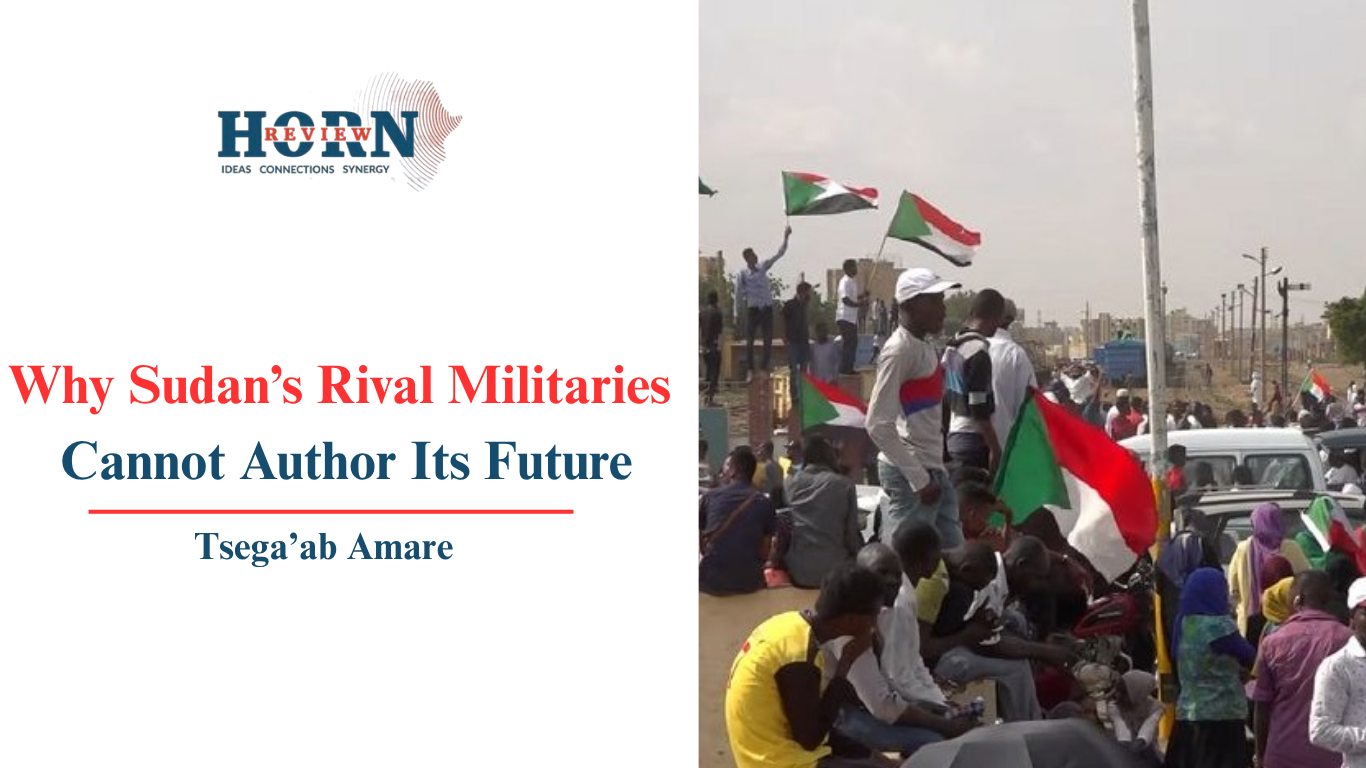
This will not lead to any form of civilian governance. This is a competition between two-armed establishments over who can better perform the appearance of legitimate statehood, and it is a competition the Sudanese people were never invited to participate in.
What makes this doubly dangerous is the precedent it sets. When armed groups see that announcing a government structure earns diplomatic relevance, it incentivizes proliferation. As conflict analyst Kholood Khair has noted, the formation of these rival governments has catalyzed the emergence of additional armed factions, each jockeying for a post in one administration or the other. Showcasing Sudan’s move not towards governance but towards a permanent institutionalization of armed patronage.
A necessary but often avoided point must be stated clearly: both the SAF and the RSF are state institutions, or at least they began as such. The SAF is the constitutional army of Sudan, born of the same post-colonial state structures that carried the country through independence. The RSF was formally integrated into state architecture following the 2019 Constitutional Declaration and the Juba Peace Agreement of 2020.
This acknowledgment matters, not to rehabilitate their claims, but to understand the particular gravity of their crimes. These are not foreign invaders or spontaneous warlords. They are organs of the Sudanese state that turned the instruments of that state against the Sudanese people. The targeting of civilians, the documented mass atrocities, the sieges of hospitals, the displacement of millions: these are not the incidental costs of war between two outside forces. They are the deliberate choices of institutions that held public trust and violated it completely. That institutional origin amplifies their accountability; it does not diminish it.
A sustainable political settlement remains impossible without comprehensive accountability for both the SAF and the RSF. Verification of external complicity such as Sudan’s 2025 filing against the UAE at the International Court of Justice is necessary, yet the primary domestic actors cannot be permitted to escape scrutiny. The RSF’s documented campaigns of sexual violence, targeted killings, and its siege of El-Fasher stand alongside the SAF’s systematic denial of humanitarian access, attacks on civilians and reliance on militias tied to the former Bashir regime, with a strong affiliation to the Muslim brotherhood; both constitute severe violations of international humanitarian law. Legitimizing one-armed actor under the guise of statehood while treating the other strictly as an irregular militia creates an uneven standard of accountability, rendering justice secondary to geopolitical calculation.
Legitimacy as a Tool for Peace
Here lies the most consequential analytical reframing this crisis demands: the question of legitimacy must be decoupled from the war effort entirely.
Both the SAF and RSF have been using legitimacy arguments to justify continued military operations. The SAF presents itself as the guardian of national sovereignty, invoking state legitimacy to frame its operations as the restoration of constitutional order. The RSF invokes marginalization narratives and its own governance structures to portray itself as a liberator of peripheral Sudan. These are legitimacy claims in service of war, and they must be rejected on those terms, regardless of which party advances them.
Under international frameworks, from the African Union’s Constitutive Act to the UN Charter’s norms on self-determination, legitimacy is not a reward for military victory. It is not something a general can manufacture by appointing a prime minister. It flows from the consent of the governed, expressed through genuine participatory processes.
The Responsibility to Protect framework is equally instructive. Both parties have not only failed to protect civilians; they have been the primary agents of civilian harm. This forfeits any moral standing either side might otherwise claim. A belligerent cannot invoke sovereignty as a shield while systematically destroying the population that sovereignty exists to protect.
The legitimacy question should instead be preserved and activated for one purpose only: structuring a peace process in which the Sudanese people, not their armed captors, negotiate a new social contract. This means centering Sudan’s civil society infrastructure: the resistance committees, professional associations, women-led organizations, and regional civic networks that led the 2018-2019 revolution and have continued to document atrocities and sustain community life throughout this war. These are the legitimate interlocutors of Sudan’s future.
Policy Recommendations
The AU, IGAD, and all international mediators must formally distinguish ceasefire negotiations from political transition negotiations. Armed parties may engage on narrowly defined security terms. They must not be permitted to define, lead, or veto Sudan’s post-war political order.
The international community should not extend formal diplomatic recognition to either the SAF’s “Hope Government” or the RSF’s “Government of Peace and Unity.” Recognizing either formation in the absence of a civilian mandate institutionalizes military capture as a legitimate pathway to state authority.
Humanitarian and reconstruction funding should be conditioned on the meaningful inclusion of Sudan’s organized civilian constituencies in governance planning. Resistance committees, professional associations, and women-led networks represent a legitimate political infrastructure that has been systematically excluded from every formal process.
The UAE, Egypt, and Turkey must face coordinated diplomatic pressure linking arms transfers and material support to accountability obligations. States that simultaneously fuel the conflict and sponsor peace talks cannot be treated as neutral parties in those same talks.
And a final and major proceeding is to make accountability non-negotiable. A credible transitional justice mechanism addressing atrocities by both the SAF and RSF must be built into any settlement framework from the outset, not deferred as a post-war aspiration. A signed ceasefire does not eliminate impunity; rather, it enshrines it as the foundation for future conflict.
The SAF and RSF did not create Sudan, and they must not be permitted to dictate its future. While the war has already been catastrophic, a peace settlement that merely cement the power of two-armed establishments over a traumatized population would be a greater tragedy. Sudan’s civilians, having paid the highest price in blood, displacement, and starvation, must transition from the primary victims of this conflict to the authors of its resolution; any peace that fails to center them will not end the violence, but simply reload it.
By Tsega’ab Amare, Researcher, Horn Review