
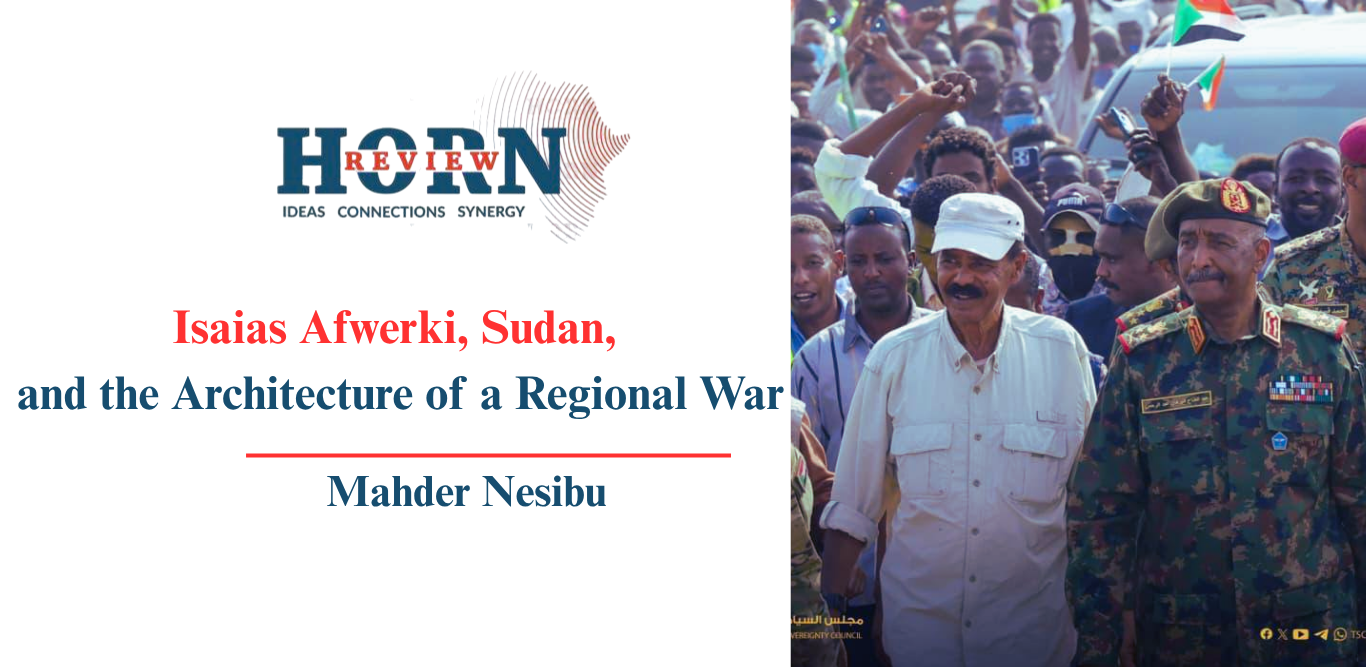
Isaias Afwerki, Sudan, and the Architecture of a Regional War
Eritrea’s long-time president, Isaias Afwerki, has for decades possessed an appetite for what many analysts describe as the role of kingmaker in the Horn of Africa. The struggle for regional primacy and Isaias’s desire to acquire a pivotal role for the regime dominate political vision in Asmara. That desire has now found its most consequential expression yet, in a Sudan descending into civil war and a region whose fault lines are deepening by the day.
Eritrea is, by conventional measures, a small state. Its population is estimated at 3.5 million, its economy severely constrained, with limited presence in global trade. Yet it is, by any serious reckoning, a hypermilitarized one. The vast majority of the population falls under national service obligations, giving the state the capability to mobilize at scale. This hyper militarization is inseparable from the regime’s foreign policy culture. The official justification, much of it deliberate state propaganda, holds that Eritrea faces a permanent state of threat from its neighbours and from an international system hostile to it. The result is a symbiotic relationship between internal authoritarianism and external aggressiveness, each reinforcing the other.
Much of Eritrea’s interventionist behaviour, however, is attributed less to structural necessity than to Isaias’s own political psychology. His is a foreign policy built on two durable instruments. The first is the authoritarian grip over Eritrea proper, which has allowed the regime to maintain a monopoly of force inside its territory and rendered it relatively impregnable to foreign interference. The second is the systematic use of proxies. Isaias has, for decades, cultivated regional instability as a strategic resource. The Horn’s fractured state structures and proliferation of armed groups, far from being problems for Asmara, have been assets. From Ethiopia to Sudan, Somalia, and Djibouti, Eritrea has capitalized on political grievances by supporting and directing armed groups to advance its foreign policy objectives. Eritrea’s geographic positioning has served as a conduit for arming these groups, while its hypermilitarized apparatus has made it capable of training and mobilizing them.
The reach of this apparatus extends deep. Eritrea’s National Security Office and its special unit dedicated to neighbouring states give Isaias a wide operational footprint. At the height of the war on terror, Asmara found the means and the capability to arm and support the Union of Islamic Courts and, later, Al-Shabaab, the Horn’s most consequential terrorist organization. This was a calculated decision: Eritrea was at odds with both the Somali state and Ethiopia, the primary force combating terrorism in the region at the time, and backed Al-Shabaab precisely to undermine their efforts. The logic was cynical and consistent. Instability in the neighbourhood is leverage for Asmara.
That logic now operates through Sudan.
Sudan’s descent into civil war in April 2023 arrived, for Isaias, at a moment of strategic necessity. The end of the Tigray conflict had not produced the regional dividend Asmara had sought, and the deterioration of Eritrea-Ethiopia relations since 2022 has generated mounting threat perceptions on both sides, with dynamics on the ground offering little prospect of de-escalation.
The Eritrea-Sudan relationship carries its own layered history. When Eritrea emerged as a state, it quickly found itself at a standoff with the National Islamic Front (NIF) and the government of Omar al-Bashir. Asmara responded by deploying its familiar tools: it used its historical influence over the communities along the shared border to pressure Khartoum, and backed rebel movements across the south, west in Darfur, and the eastern borderlands through the Beja Congress, sustaining pressure on the NIF across the 2000s.
Those dynamics have since been fundamentally reconfigured. Although Isaias carried the same adversarial posture into his early dealings with the Sudanese Armed Forces (SAF), particularly during the Tigray conflict of 2020 to 2022, Eritrea’s rupture with Addis Ababa forced a strategic reassessment. The result has been firm and deliberate alignment with the SAF since war broke out between the army and the Rapid Support Forces in 2023.
Isaias’s calculus is multi-layered. At the broadest level, the SAF now forms part of a constellation of forces hostile to Ethiopia, and General al-Burhan’s mounting need for military capability has given Isaias an opening to simultaneously intensify pressure on Addis Ababa and deepen Asmara’s footprint across a war-torn Sudan. Beyond that, Eritrea’s alignment with the SAF has inserted it into the network of regional middle powers backing the army, among them Saudi Arabia, Iran, and most consequentially Egypt, the SAF’s primary external patron. The deepening strategic convergence between Cairo and Asmara on the Sudan file carries weight well beyond the immediate conflict.
For General al-Burhan, Isaias offers several specific utilities. Eritrea has functioned as a transit corridor for the SAF’s various external backers to move arms into Sudan, with open-source evidence pointing to Asmara’s instrumental role in this supply architecture. Al-Burhan also requires Eritrea’s influence to draw the communities of eastern Sudan into the SAF bloc, communities that carry longstanding grievances against Khartoum and would resist alignment without external pressure. Eritrea has additionally provided direct military training capacity, with internal sources indicating Asmara now operates six training installations inside Sudan, drawing on a military establishment that has, at various points, trained armed groups and the armies of other states, including Somalia.
For Isaias, the returns are correspondingly significant. Sudan offers insertion into a broader network of consequential regional actors. It provides the eastern territory that serves as an indispensable corridor in the proxy architecture Asmara is assembling against Ethiopia. And it has progressively given Eritrea substantial leverage over the SAF itself. Leverage, in the logic of Isaias’s political psychology, translates into structural influence over post-war Sudan, whatever configuration that ultimately takes.
The Eritrea-Sudan border, and the longer frontier Sudan shares with both Eritrea and Ethiopia, has been a defining space in the political evolution of all three states. Its core feature is the communities that straddle it.
Since the late twentieth century, armed movements have used this shared borderland to pursue political objectives inside their own countries. The Eritrean Liberation Front (ELF) and the Eritrean People’s Liberation Front (EPLF) both relied on Sudan as a base and transit route during their decades-long insurgency against successive Ethiopian governments. Sudan served as a corridor for the ELF’s arms supplies from its Communist and Arab backers, including Egypt, at the height of the Cold War in the 1960s. It also functioned as a site of political and military organization. When a young Isaias Afwerki joined the ELF in 1966, he did so in Kassala, eastern Sudan, then the movement’s primary organizing ground. The Tigray People’s Liberation Front (TPLF) similarly relied on Sudanese territory and geography to sustain its insurgency against the Derg and ultimately to grab power in Addis Ababa.
The dynamic operated in the other direction as well. Sudanese rebel movements, fighting Khartoum across different periods and with varying capacity, drew on support from both Ethiopia and Eritrea, with the shared border proving essential to what eventually became South Sudan’s emergence as an independent state.
Central to Eritrea’s current operational role is its extensive influence over the cross-border communities, primarily the Beja people and their Beni Amer subgroup, who inhabit the Kassala and Red Sea regions of Sudan and the Gash Barka, Anseba, and Northern Red Sea regions of Eritrea. The Beja carry a long history of antagonism toward Khartoum, a product of Sudan’s enduring centre-periphery problem, in which the Nile Valley’s arabized communities have historically dominated the state at the expense of peripheral populations who have accumulated deep structural grievances as a result. Eritrea has exploited those grievances across multiple episodes of tension with Khartoum.
There is also a security dimension to Eritrea’s interest in these communities that predates the current war. After the EPLF defeated the ELF in the early 1980s, it inherited the latter’s shadow presence along the border. The ELF’s composition, predominantly Muslim lowlanders from the shared borderlands, placed it in fundamental tension with the Tigrigna Christian highland base of the EPLF. Even after independence, ELF remnants maintained a presence in Sudan and harboured ambitions of challenging the People’s Front for Democracy and Justice (PFDJ). The regime’s response was to impose draconian control over these territories, foreclosing any significant consolidation of ELF remnants or Muslim-based Eritrean opposition. That control, built and refined over decades, has proved useful in maintaining influence in eastern Sudan.
According to high-level Sudanese sources within the civilian political space, Isaias’s intervention in Sudan is oriented toward a broader design for conflict with Ethiopia. Eritrea’s limited conventional military capacity and its longstanding reliance on irregular and proxy warfare have produced a strategy centred on assembling a constellation of armed actors, with Sudan functioning as the staging ground.
The architecture of this strategy is becoming legible. There is increasing operational coordination between non-state actors inside Ethiopia, among them TPLF armed factions and Fano, and Asmara. Sudan has become a base of operations for these groups. A recent gathering in Port Sudan brought together factions operating under the alliance known as Tsimdo. Sudan hosts TPLF liked groups and is simultaneously functioning as a transit corridor for moving weapons into Ethiopia’s Amhara region. More significantly, Egypt and Eritrea, both invested in the SAF and maintaining pressure on Ethiopia, are coordinating on the Sudan file, together forming two of the primary pillars of the broader Tsimdo alignment.
Within this architecture, the East Sudan Liberation Movement has emerged as a notable actor. An ESLM commander recently issued a public statement, touching on both Eritrea and Ethiopia, a signal of its positioning within the broader alignment Asmara is constructing.
Sudan is already engulfed in a civil war inflicting catastrophic damage on the fabric of the Sudanese state. Into that destruction, Eritrea has inserted itself, not to stabilize, but to exploit the vacuum in service of Asmara’s regional agenda and Isaias’s ambition to exercise decisive influence over the political trajectories of Eritrea’s neighbours.
Left unchecked, the trajectory Isaias is constructing points toward something far more dangerous than a bilateral confrontation. The convergence of Sudan’s hyper-militarization and accelerating arms proliferation, the coordinated alignment of non-state actors across borders, the deepening involvement of regional middle powers, and the sustained erosion of the Ethiopia-Eritrea relationship are together generating conditions for what would constitute a total war scenario: a multi-layered, multi-actor conflict engulfing Ethiopia, Eritrea, and Sudan simultaneously, with consequences that would reach well beyond any one of them.
By Mahder Nesibu, Researcher, Horn Review

RELATED
Posts
16
Sep
The Real Houthi Weapon Was Mobilization, Not Missiles
Fatima Abo Alasrar frames the Houthi ground strategy as...
16
Sep
The Houthis Reached Zuqar Island: Can Eritrea Be a Neutral Observer?
The island of Zuqar sits in the southern Red Sea,...
15
Sep
What the UN’s Darfur Sanctions Rollover Reveals About the Next Phase of Sudan’s War
On paper, Resolution 2828 is a housekeeping measure. It...
14
Sep
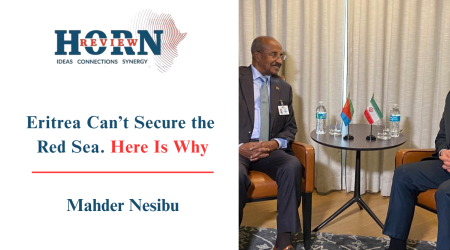
Eritrea Can’t Secure the Red Sea. Here Is Why
When Saudi Arabia formed a coalition of states in...
14
Sep
Shadow Competition in the Horn, Saudi Training and Emirati Surveillance
The Horn is experiencing a shift in the character of...
14
Sep
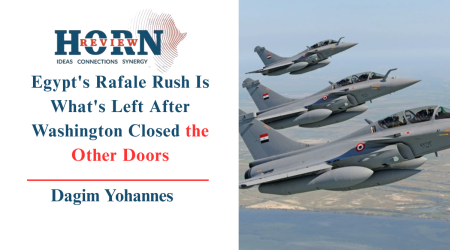
Egypt's Rafale Rush Is What's Left After Washington Closed the Other Doors
Egypt is nearing a new deal with French company...
14
Sep
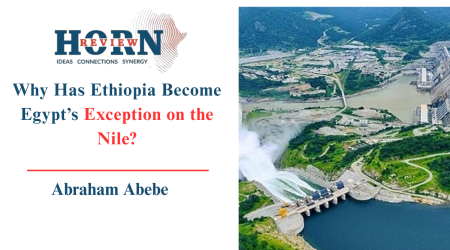
Why Has Ethiopia Become Egypt’s Exception on the Nile?
Egyptian officials have repeatedly made a revealing distinction about the...
14
Sep
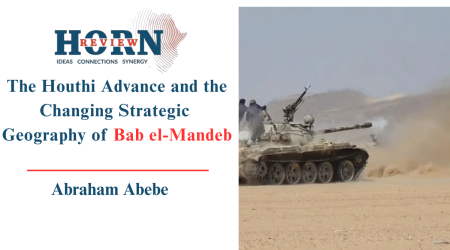
The Houthi Advance and the Changing Strategic Geography of Bab el-Mandeb
The Red Sea crisis has largely been understood as a...
14
Sep
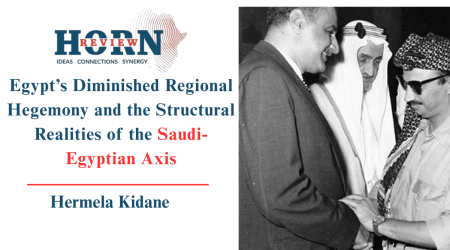
Egypt’s Diminished Regional Hegemony and the Structural Realities of the Saudi-Egyptian Axis
The geopolitics of the modern Middle East is frequently interpreted...
14
Sep
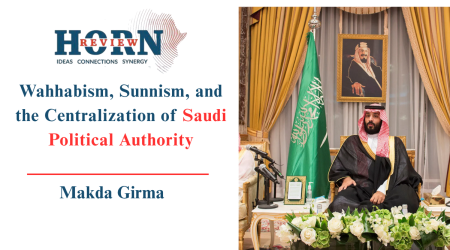
Wahhabism, Sunnism, and the Centralization of Saudi Political Authority
Saudi Arabia’s recent transformation is frequently presented as a movement...