In post-conflict modern societies elections are viewed as the final milestone of a democratic transition. In South Sudan, however, election is increasingly being viewed as a trigger for renewed exclusion and a final step towards a full-blown conflict.
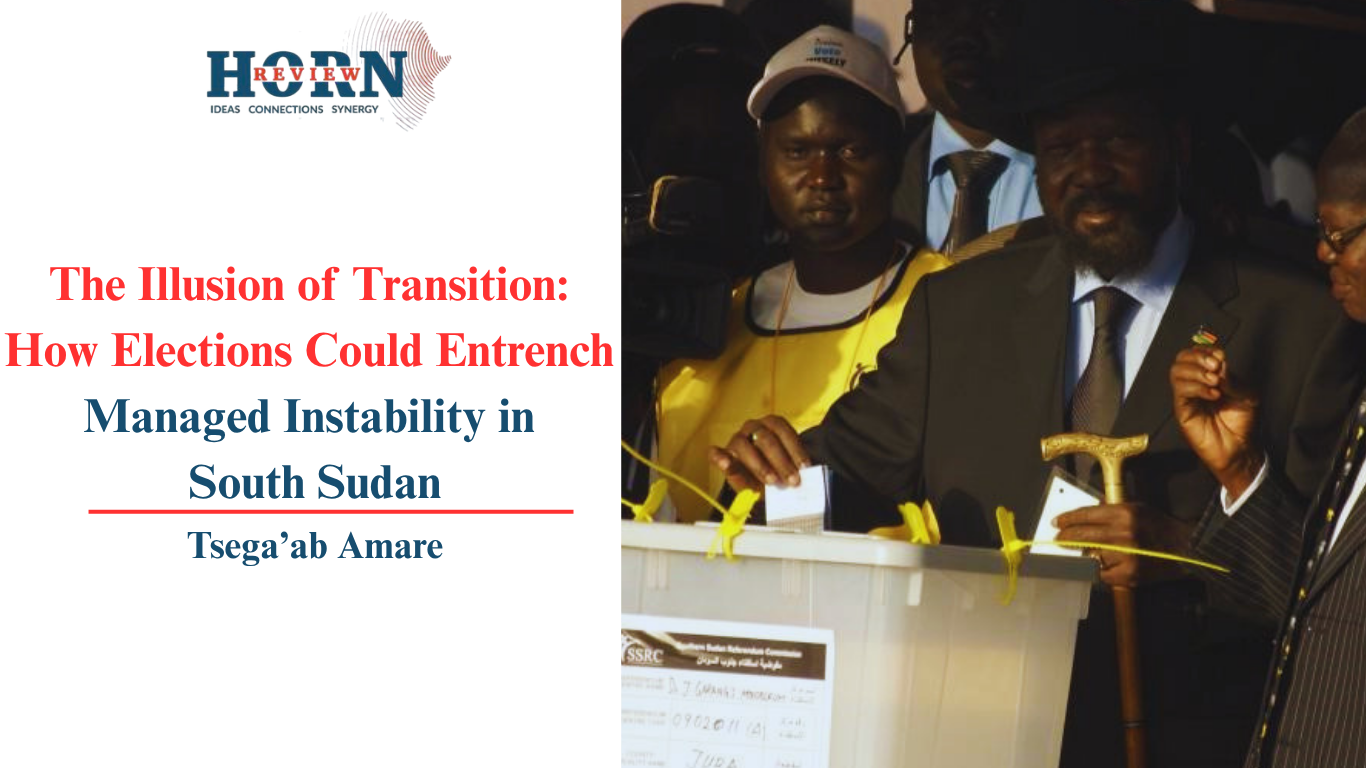
South Sudan stands at a precarious stage as it approaches its first general election since its independence in 2011. Scheduled for December 2026, the election has the potential to legitimize the Revitalized Agreement on the Resolution of the Conflict in the Republic of South Sudan (R-ARCSS) that was signed in 2018. Yet repeated delays, arrest of official figures, and extension of transitional period have eroded trust and raised questions on the possibility and fairness of a structured, transparent, and timely election to be held. The government, however, has extended the transitional government’s mandate amid incomplete envisioned reforms, leading to the ‘final straw’ of the December election.
The timing of the election has a tactical utility, by maintaining the current security architecture and avoiding a comprehensive census, the government under Salva Kirr wants to leverage existing support and patronage networks to ensure a favorable outcome. For the opposition, Rick Machar’s side however, the election is a tool to shed the ‘transitional” label and govern with the authority of “mandate” leaving no regard to the poll’s procedural integrity.
The historical rivalry between President Salva Kiir and former vice president Riek Machar is entering its lopsided final chapter. South Sudan’s political-security nexus has successfully shifted from a battlefield to courtroom and administrative office in an effort to fully control the existing governmental architecture. Since late 2025, Machar has been transformed from a Partner for Peace to Defendant awaiting legal charges. This coupled with restriction of movement have fractured the SPLM-IO, leading to high number of defections to the Salva Kiir’s side. Machar’s imprisonment resulted in his inability to campaign and or provide for his commanders has rendered the SPLM-IO to a ghost of its former self.
As the formal opposition weakens, the political vacuum that is created is being filled with “Non-Signatory” groups, like the National Salvation Front which is being led by Thomas Cirilo. These groups represent the only remaining outlet for those who had begun to view the election only as a sham. Their exclusion from the electoral process makes them the primary spoilers of any post-election potential of “stability.”
On the economic side, South Sudan’s survival is deeply tethered to a crumbling pipeline. As a petro-state that relies on oil for more than 90% of its revenue, the current civil war in Sudan has created a catastrophic fiscal bottleneck that threatens the overall functionality of the nation.
The destruction of pumping stations in the Sudanese territories has effectively halted the flow of oil, the flow of wealth, to Juba. And without these funds, the political marketplace of South Sudan collapses. With the absence of oil revenue, the government has struggled to pay its security forces. When the central state cannot buy or sustain loyalty local warlords seek alternative sponsors, even looking across the border towards the warring factions in Sudan further intensifying and internationalizing the conflict next door. In addition, it also led to the decentralization of predation where soldiers tax the population at localized roadblocks.
Furthermore, the influence of external actors has shifted the discourse in South Sudan from peace building to stability seeking, with different powers following divergent strategies.
China’s Strategy in South Sudan centers on stability at any cost, aiming to protect its significant investments. Beijing has prioritized infrastructure development projects support in exchange for long-term resource security. Therefore, the interest of China lies in the stability of South Sudan compared to the potential process of peace building based on consensus which is harder to achieve and has more risk of regression to conflict.
The United State in contrast, although remaining as the primary humanitarian and food donor, has lost its political leverage. Its rhetoric and call for “conditionality” are increasingly being ignored by a regime that views western demand as an existential threat highly elevating the fragility and limiting Washington’s rhetorical condemnations.
Russia, emerging as a powerful alternative to western pressure aims to provide support, offered electoral training, and pledged diplomatic support to the existing structure of South Sudanese governance. Moscow views and validates the “managed” election model as a viable path towards a transition to a unified and consolidated state structure for South Sudan.
Uganda, the relatively ‘stable neighbor,’ views Juba as a vital buffer zone. Museveni’s military support for Salva Kirr remains the ultimate insurance policy for the current regime. Kampala hopes and works to ensure the survival of the incumbent, acting as the security guarantor.
The post-December trajectory of South Sudan will likely be defined by three competing realities. The most probable outcome is a “Sham” Consolidation, where the government conducts a rushed, flawed election to secure a massive “mandate.” In this scenario, Riek Machar is legally sidelined or barred, and a weary international community, desperate to avoid a total security vacuum, grudgingly accepts the stability of a one-party state. However, this is a hollow victory; it risks fueling persistent, low-level insurgencies across the Equatoria’s and Upper Nile led by disenfranchised youth and ethnic militias.
Alternatively, the country faces a Pre-Election Relapse. Should the failure to unify the “Necessary Unified Forces” (NUF) trigger a tactical clash in Juba, echoing the tragedies of 2013 or 2016, the election would be postponed indefinitely. This would condemn South Sudan to a state of “Permanent Transition,” surviving on emergency aid and sporadic oil exports. A third, darker possibility is the Regional Proxy War. In this scenario, South Sudan becomes a secondary theater for the Sudanese conflict, with factions in Juba aligning with the SAF or RSF, dragging the world’s youngest nation into a transnational great war.
While the elites in Juba debate the nuances of the National Elections Act and constitutional amendments, 75% of the population remains tethered to humanitarian aid. There is a fundamental, perhaps fatal, disconnect at play: the “future” is being discussed in terms of ballots, while the “present” is defined by bread and basic safety. The 2026 election, therefore, serves not as a bridge to democracy but rather as a ritual for the survival of the regime.
To address this spiral, regional and international stakeholders must pivot from “stability-seeking” to “structural accountability,” conditioning any recognition of the 2026 results on a verified, inclusive security roadmap rather than mere ballot completion. High-level mediation should prioritize the immediate decoupling of state survival from crumbling oil revenues by establishing transparent, non-partisan oversight of remaining fiscal flows to ensure security forces are paid through institutional channels rather than patronage networks. Without a synchronized effort to bridge the chasm between Juba’s “electoral ritual” and the population’s “survival reality,” any post-election government will lack the domestic legitimacy required to prevent further fragmentation and the eventual “proxy-ization” of the state.
In Juba, the clock is not ticking toward a new era of governance, but toward the next expiration of a fragile peace. For the people of South Sudan, the tragedy remains unchanged: whether the election proceeds or fails, the underlying architecture of ethnic patronage and oil-dependent statecraft remains untouched.
By Tsega’ab Amare, Researcher, Horn Review