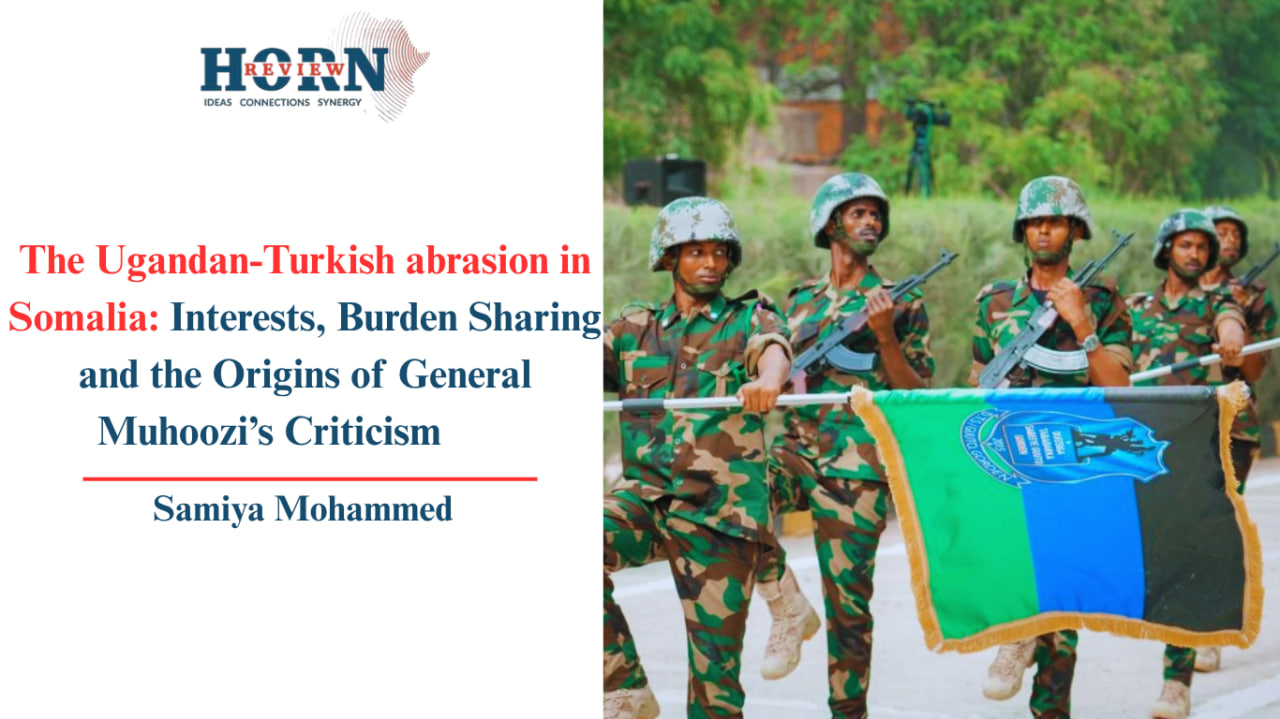
Recent public statements have drawn renewed attention to the intricate relationships among Uganda, Somalia and Turkey in the context of Somalia’s security challenges. On Somalia’s Army Day, President Hassan Sheikh Mohamud suggested that the Somali National Army was increasingly capable of assuming full responsibility for national security encasing the presence of Ugandan forces as one that Somalia could now begin to phase out with appreciation for past contributions. These remarks came shortly after General Muhoozi Kainerugaba Uganda’s Chief of Defence Forces issued a series of pointed criticisms directed at Turkey pointing perceived imbalances in roles and benefits within Somalia. At the same time Turkey has expanded its involvement through military training programs, drone operations and most visibly the recent arrival of the deep sea drilling vessel Cagri Bey in Somali waters to commence operations at the Curad-1 site. At their core lie differing perspectives on burden sharing, the recognition of contributions and the respective roles in supporting Somalia’s security and development.
Uganda’s military commitment in Somalia stands out for its scale and duration. Estimates indicate that the Uganda People’s Defence Force maintains more than 12,000 troops in the country, comprising approximately 4,500 personnel under the African Union Support and Stabilization Mission in Somalia and over 8,000 operating under bilateral security agreements with the Somali government. This makes Uganda the largest single foreign troop contributor by a considerable margin. The bulk of these forces focus on safeguarding critical infrastructure in Mogadishu including the seaport and Aden Adde International Airport where the Halane Compound accommodates a growing number of diplomatic missions, United Nations offices and humanitarian agencies. Beyond static protection duties, Ugandan battle groups have extended their operations outward. In recent months, UPDF units working alongside Somali forces have conducted offensives that displaced Al-Shabaab militants from three key bridge towns along the Shabelle River. These operations while tactically significant in securing supply routes and establishing a buffer around the capital involved close quarters engagements and resulted in reported heavy Ugandan casualties. Turkish military assets provided some aerial support, including drone surveillance and limited strikes though Turkish personnel did not deploy ground forces in these specific actions.
From Uganda perspective the current arrangement imposes a disproportionate load. Ugandan commanders have noted that their forces are now not only conducting offensive operations but also holding newly captured territory and manning multiple forward operating bases in the Shabelle region. This hold and build role extends the original mandate of providing combat support to the SNA. A promised Egyptian deployment intended to relieve pressure by stationing troops in the coastal town of Adale in the Shabelle region has yet to materialize fully with reconnaissance activities ongoing but brigade level presence still pending. Ugandan officials have expressed frustration that official narratives frequently emphasize Turkish contributions such as training programs, drone capabilities and development initiatives while giving comparatively less acknowledgment to the sustained sacrifices Ugandans.
Somalia for their part has framed President Mohamud’s Army Day comments within a narrative of growing national self reliance. The remarks acknowledged Ugandan sacrifices and the historical partnership while signalling that the SNA is maturing and that Somalia seeks greater sovereign control over its security institutions. Mogadishu has simultaneously highlighted deepening cooperation with Turkey presenting initiatives such as the Cagri Bey drilling mission as tangible steps toward economic sovereignty and long term stability. Turkish engagement is consistently described as supportive of Somali led development rather than substitution for local forces. Turkey has invested substantially in military training for Somali police and gendarmerie units, operated drone strikes in coordination with Somali authorities and pursued infrastructure and energy projects without indicating any intention to commit large scale ground combat battalions for territorial holding or forward base operations.
The operational and strategic realities on the ground show the complexity of these interdependencies. The Somali National Army continues to contend with internal challenges, including clan-based divisions, inconsistent resourcing, logistical constraints and the persistent risk of Al-Shabaab infiltration into its ranks and institutions. No other external actor currently possesses the combination of scale, experience, and positioning to replicate the UPDF’s role in securing Mogadishu and the Shabelle corridor. A sudden or complete withdrawal of Ugandan forces would create a significant security vacuum.
At the same time Uganda’s regional standing as a reliable security partner is closely tied to its sustained role, while Turkey’s economic and strategic investments in Somalia presuppose an environment of relative calm that Ugandan forces help maintain. The public rhetoric contains performativity dimensions calibrated for distinct domestic audiences. In Uganda General Muhoozi’s statements resonate with nationalist sentiments and with a military rank and file that perceives itself as overextended and underappreciated after nearly two decades of continuous deployment. In Somalia, President Mohamud’s comments address a constituency eager to see tangible progress toward sovereignty and reduced foreign military presence. Turkey in turn has emphasized its economic and developmental contributions without engaging in direct military rebuttals. It could be cautioned against reading these exchanges as harbingers of imminent rupture noting that all parties appear to recognize the mutual disadvantages of a precipitous breakdown.
The situation thus presents itself not as an impending divorce but as a renegotiation of roles within the partnership. Core issues include more equitable burden sharing arrangements, fuller recognition of contributions across African and extra regional actors and a balanced distribution of benefits where the high costs of providing battlefield security are weighed against gains in influence, energy contracts and geopolitical positioning. Uganda has leveraged its ground presence to press for adjustments such as more reliable aerial and ground support from partners and greater acknowledgment of African sacrifices in official narratives. Somalia for its part seeks to accelerate the professionalization of its own forces while preserving the stability that external partners continue to underwrite. Turkey maintains its focus on capacity building and investment framing its role as complementary to Somali sovereignty.
What is evident is that the grievances are structurally in the realities of two decades of uneven contributions and shifting regional alignments. The imbalance has now been articulated openly altering the terms of discussion even as the fundamental dependencies persist. In this environment sustained dialogue among the countries will be essential to ensuring that Somalia’s security gains are consolidated without undermining the cooperative frameworks that have made them possible.
By Samiya Mohammed, Researcher, Horn Review