
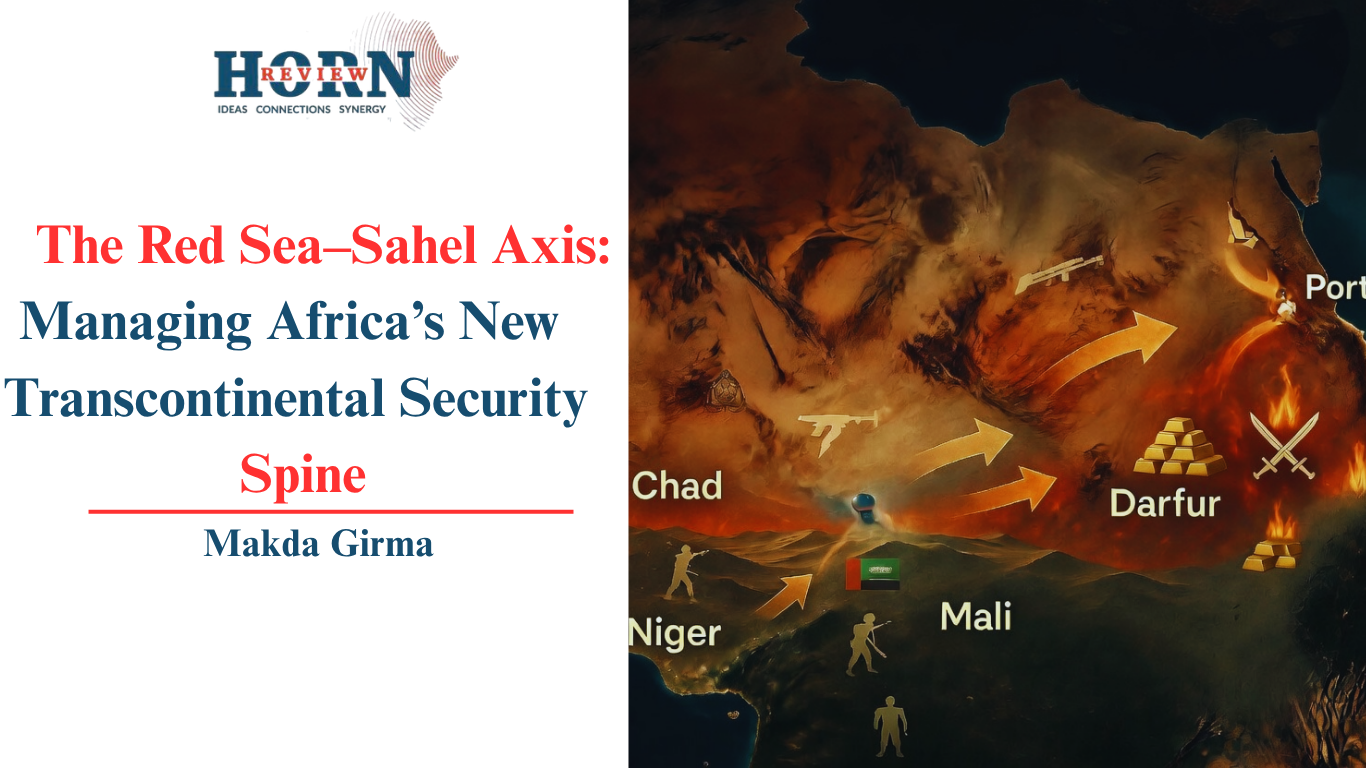
The Red Sea–Sahel Axis: Managing Africa’s New Transcontinental Security Spine
A contiguous transcontinental security-economic system now stretches from the Red Sea coast through Sudan and across the Sahel, linking Horn of Africa maritime dynamics with Sahelian state collapse. The ongoing Sudanese civil war, now entering its fourth year with no resolution in sight, is the strategic keystone that has fused these previously siloed theaters. Illicit gold flows, arms smuggling, mercenary networks, and mass displacement have created self-reinforcing war economies that external powers exploit for resources and influence. With more than ten million people displaced internally and over two million seeking refuge across borders, the conflict has already claimed tens of thousands of lives and generated a humanitarian catastrophe on a scale rarely seen in modern Africa.
Evidence indicates these are no longer isolated crises but a single contagion corridor fueled by Russia’s Africa Corps, Gulf proxy competition, and reactive Western policies. The international community must abandon fragmented regional strategies. Policymakers should immediately establish cross-regional stabilization frameworks, appoint dedicated envoys for the Red Sea–Sahel Corridor, disrupt transnational smuggling networks, and synchronize security and economic assistance, starting with Chad as the critical buffer state,to prevent further escalation into the Horn and Mediterranean migration routes. Failure to do so will not only prolong the suffering of millions but also cede strategic advantage to powers seeking to reshape the continent’s security architecture in their favor.
For decades, policymakers and analysts have viewed the Horn of Africa and the Sahel as separate strategic spaces, each with its own unique set of challenges and responses. The Horn has been approached primarily through the lens of maritime security and great power competition around the Red Sea, while the Sahel has been framed as a theater of counter-terrorism and migration management. This division, while convenient for bureaucratic organization, has proven dangerously inadequate in the face of the fluid realities on the ground. Traditional maps separating “East Africa” from “West Africa” no longer reflect operational reality. Illicit economies and militant logistics treat the Sahara-Sahel-Red Sea belt as a single corridor that defies these artificial divisions. Gold mined in Sudan’s Darfur and Kordofan regions finances armed groups on both sides of the conflict; much of it is smuggled northward through Chad or westward via porous borders into Niger and Mali.
The process is facilitated by longstanding trade networks that predate the current war, now repurposed for conflict financing: raw gold is mined by artisanal workers under the control of armed factions, refined in makeshift facilities, and then transported in small convoys or even by camel caravans across the desert borders. Once in Chad or Niger, it is exchanged for weapons or cash, feeding a vicious cycle that sustains fighting thousands of kilometers away. These same routes carry weapons, fuel, vehicles, and fighters in the opposite direction, sustaining a decentralized but highly efficient conflict economy that operates with remarkable resilience even amid intense fighting.
The system’s connective tissue is visible in Chad’s northern borderlands, now a pivotal hub linking Libyan arms pipelines, Sudanese gold, and Sahelian battlefields. Chadian militias and traffickers redistribute materiel to Darfur’s Rapid Support Forces while facilitating fighter movements that ripple into Niger and Mali. This traffic does not stop at national frontiers: Russian-linked networks extract gold in the Central African Republic and Sudan, then route proceeds through UAE hubs, underwriting operations that destabilize European migration routes and global shipping lanes. Climate change and resource scarcity have only intensified these linkages, as desertification pushes nomadic communities into competition with settled populations, creating new recruitment pools for armed groups and further complicating border management.
The result is a vertically integrated security complex where local violence directly threatens Red Sea commerce, Sahelian governance, and Mediterranean stability. What once appeared as disconnected regional problems has evolved into a self-perpetuating system that exports instability in every direction, making any attempt to address one end of the corridor without considering the other inherently incomplete.
At the heart of this fusion lies Sudan itself. Its geography, bordering seven states and straddling the Red Sea, Horn, and Sahel, makes its collapse the linchpin of regional fusion. The Sudanese Armed Forces versus Rapid Support Forces war has transformed Darfur and Sudan’s western provinces into a porous corridor that exports instability westward while importing external patronage eastward. What began as an internal power struggle between two rival factions has rapidly evolved into a regional security crisis with transcontinental ramifications. On the Horn side, the conflict directly imperils Red Sea maritime security through control of Port Sudan, a vital node for international shipping and aid delivery.
It exacerbates Ethiopian border tensions, where Rapid Support Forces-aligned militias have reportedly used Ethiopian territory for logistics, raising risks of spillover amid unresolved Grand Ethiopian Renaissance Dam disputes and Ethiopia’s push for Red Sea access. Eritrean strategic alignments have shifted toward the Sudanese Armed Forces, including training camps and airspace arrangements, further entangling the eastern theater. Experts warn that a single spark in Ethiopia could ignite a proxy war spanning both sides of the Red Sea, potentially drawing in neighboring states and disrupting one of the world’s busiest maritime chokepoints. The stakes here extend far beyond local borders: any escalation would threaten global trade routes that carry oil, commodities, and goods essential to European and Asian economies, turning a regional conflict into a matter of international economic security.
Westward, Sudanese collapse has turned the Chad-Sudan border into a supply artery for Sahelian fragility. Over a million Sudanese refugees have already crossed into Chad, straining the country’s resources and social fabric while arms and mercenary flows accelerate instability in Niger and Mali.
The influx has not only overwhelmed local services but also altered demographic balances in border regions, leading to heightened tensions between host communities and newcomers. Chad, historically the Sahel’s most stable buffer, now faces domestic spillover risks that could merge the Sudanese and Sahelian crises into one unbroken arc of collapse. If Chad succumbs to these pressures, the entire western flank of the axis could unravel, creating a continuous zone of instability from the Atlantic to the Indian Ocean. This westward expansion is particularly concerning because it connects directly to fragile states already grappling with jihadist insurgencies, turning what might have remained contained conflicts into a cascading failure across multiple borders.
Compounding the crisis is the involvement of external actors who treat the axis as a resource and influence marketplace. Russia operates through the Africa Corps, the successor to the Wagner Group, trading regime protection and counter-terror support for gold and uranium concessions across Mali, Niger, the Central African Republic, and Sudan. This model of transactional engagement allows Moscow to achieve multiple objectives simultaneously: securing valuable minerals to circumvent Western sanctions, establishing a military presence in strategically important locations, and undermining the influence of traditional Western partners. Russian networks have extracted billions in Sudanese and Central African Republic gold, much of it smuggled to bypass sanctions, while maintaining flexible ties to both Sudanese Armed Forces and Rapid Support Forces factions. Naval base ambitions on Sudan’s Red Sea coast reveal Moscow’s broader maritime objectives, which extend to challenging Western dominance in key sea lanes and projecting power into the Indian Ocean. The flexibility of these arrangements has allowed Russia to adapt quickly to shifting battle lines, positioning itself as an indispensable player in the region and demonstrating how great power competition can thrive in environments of prolonged instability.
The Gulf states drive proxy dynamics as well. The United Arab Emirates faces credible accusations, supported by UN panels, U.S. briefings, and battlefield evidence, of arming and financing the Rapid Support Forces, including via Chad corridors. These allegations point to a sophisticated supply chain involving air and sea routes that deliver advanced weaponry and financial support directly to RSF commanders. Saudi Arabia has shifted from mediation toward material support for the Sudanese Armed Forces, underwriting logistics and arms pipelines that sustain government operations in the east. This Riyadh-Abu Dhabi rivalry sustains the war and blocks unified diplomacy, even as both powers eye Sudan’s agricultural potential and Red Sea ports as long-term strategic assets. Their involvement reflects a broader competition for influence in the Red Sea region, where control over ports and fertile land translates into economic and geopolitical leverage far beyond Africa’s borders. The result is a proxy dynamic that keeps the conflict simmering, as each side calculates that a decisive victory for the other would shift the regional balance of power in ways that threaten their core interests.
Meanwhile, the EU and US maintain siloed postures: counter-terror and migration containment in the Sahel versus maritime security and diplomatic mediation in the Horn. This fragmented approach has left critical gaps in the overall response architecture. Humanitarian funding is drying up while needs surge; regional spillovers strain neighboring states without coordinated cross-axis responses. The result is a policy vacuum that external competitors have been quick to exploit, with Western efforts often appearing reactive rather than proactive. Without a unified strategy, even well-intentioned interventions risk being undermined by the interconnected dynamics of the axis, allowing the contagion to spread unchecked.
Yet the primary mandates for regional security and mediation rest squarely with African multilateral institutions, which have so far been paralyzed in their ability to bridge the Horn-Sahel divide and assert continental ownership. The African Union has repeatedly asserted leadership through its Peace and Security Council and the Quintet mechanism, coordinating with IGAD, the League of Arab States, the UN, and the EU, calling for humanitarian truces, inclusive Sudanese-led dialogue, and implementation of national peace initiatives.
Despite these efforts, the AU has struggled to translate resolutions into action because of deep internal divisions among member states, insufficient enforcement mechanisms, and the belligerents’ refusal to accept binding continental oversight. This has left the organization unable to fuse responses across its eastern and western theaters into a coherent strategy, perpetuating the very silos the axis has already overcome on the ground. IGAD’s mediation track in Sudan, launched with optimism in 2023 through a quartet of regional heads of state, has similarly stalled amid repeated meeting postponements, factional rejections, and Sudan’s temporary suspension from the organization.
On the Sahel flank, the formal withdrawal of Mali, Burkina Faso, and Niger from ECOWAS to form the Alliance of Sahel States has fractured the very mechanisms needed for cross-border intelligence sharing and joint patrols, undermining collective responses to arms flows and refugee movements. Policymakers seeking credible continental partners must therefore center the African Union as the overarching framework while building targeted working relationships with IGAD for Horn-specific issues and engaging the AES governments directly to prevent further institutional fragmentation that only benefits external opportunists.
To break this cycle, the international community must rethink stabilization in fundamentally integrated terms. Policymakers should begin by appointing cross-regional envoys so that the UN, AU, and key Western capitals designate Special Envoys for the Red Sea–Sahel Corridor instead of maintaining separate Horn and Sahel mandates. This structural change would allow for seamless coordination across what are currently divided bureaucratic silos, enabling faster information sharing and joint planning. A single unified envoy could then coordinate directly with the existing Quad, comprising the United States, Saudi Arabia, the United Arab Emirates, and Egypt, to enforce a humanitarian ceasefire and prevent further regionalization of the conflict. The envoy’s role would include mediating between warring factions while simultaneously engaging with external patrons to align their interests toward de-escalation rather than prolongation. Such a mechanism would finally treat the axis as the single operational theater it has become, replacing the patchwork of disconnected initiatives with a coherent diplomatic architecture.
At the same time, efforts must move beyond traditional peacekeeping to target the war economy itself. The international community should impose targeted sanctions on gold-smuggling intermediaries, including those linked to UAE entities, establish monitored border corridors with joint Chad-Sudan patrols, and leverage financial intelligence to freeze the assets that continue to feed both the Sudanese Armed Forces and the Rapid Support Forces. Parallel pressure through secondary sanctions on mineral exports will also be essential to constrain Russia’s Africa Corps operations across the corridor. These measures would strike at the financial lifelines that allow the conflict to persist indefinitely, reducing the incentives for both local actors and their foreign backers to continue fighting. By combining sanctions with enhanced border security and intelligence cooperation, the international community can begin to dismantle the self-sustaining conflict economy that has proven so resistant to conventional diplomatic pressure, creating space for genuine political negotiations rather than endless military maneuvering.
Finally, security and economic aid must be synchronized around Chad as the critical buffer state. Assistance packages should bundle security support with rapid economic stabilization measures, such as infrastructure development, refugee integration programs, and alternative livelihoods, to prevent the Sahelian crisis from fully merging with Sudanese collapse. In practice, this means linking EU migration partnerships and U.S. counter-terrorism programs to measurable cross-border deliverables rather than isolated national plans. Investing in Chad’s stability serves as a strategic investment in the entire axis, creating a resilient barrier against spillover while addressing root causes such as poverty and governance deficits that fuel recruitment into armed groups. Success in this area could serve as a model for integrated approaches elsewhere, demonstrating that security and development are not competing priorities but mutually reinforcing elements of effective stabilization.
Policymakers monitoring the horizon should remain alert to several critical tripwires that could accelerate the axis’s fusion over the next six to twelve months. A further surge in fighting that triggers the total collapse of remaining Sudanese Armed Forces positions in North Darfur would unleash a sudden wave of hundreds of thousands of additional refugees into Chad, overwhelming the buffer state’s already strained resources and risking its internal collapse. Equally dangerous would be the formal establishment of a Russian naval resupply station in Port Sudan, which would immediately escalate Red Sea tensions with the United States and European partners while cementing Moscow’s operational foothold along the entire corridor. Other flashpoints include an Ethiopian military incursion or major border escalation driven by Rapid Support Forces logistics on Ethiopian soil, potentially igniting a broader proxy war across the Horn, or a deepened military pact between the Alliance of Sahel States and Russian Africa Corps units that floods new weapons systems across the Sahel-Sudan border and entrenches the war economy beyond recovery.
Of course, translating these recommendations into action will not be straightforward. Appointing a cross-regional envoy, while logical on paper, confronts entrenched bureaucratic inertia in the U.S. State Department and the European Union, where separate East and West Africa desks have long resisted merged mandates and shared reporting lines. African institutions themselves may perceive such external coordination as an encroachment on continental ownership, requiring careful calibration to preserve sovereignty and avoid perceptions of neo-colonial overreach. Aligning the competing interests of Gulf rivals or constraining Russian opportunism demands sustained high-level political capital that is frequently diverted by competing global crises. Acknowledging these real-world friction points strengthens rather than weakens the case for action: it underscores that success will require not only innovative frameworks but also patient, high-level political investment to overcome institutional resistance in Washington, Brussels, Addis Ababa, and beyond.
Evidence indicates that decisive, coordinated action now can contain the axis before it engulfs Ethiopia-Eritrea tensions, Red Sea shipping, and Sahelian governance entirely. The window for effective intervention is narrowing, but it remains open if policymakers act with urgency and creativity. Half-measures will only deepen the contagion, allowing the war economies to entrench themselves further and drawing more external actors into the fray. Policymakers have the tools, unified envoys, targeted sanctions, synchronized aid, and genuine partnership with African-led institutions, to manage Africa’s new transcontinental security spine. The cost of delay will be measured in millions more displaced, billions in illicit flows, and strategic terrain ceded to opportunistic external powers.
By recognizing the axis as a single theater and responding accordingly, the international community can not only avert a broader regional catastrophe but also lay the foundation for sustainable peace and prosperity across this vital corridor of the African continent. In the end, the choice is clear: either invest in integrated solutions today or manage the consequences of a fully fused crisis tomorrow, with repercussions that will echo far beyond Africa’s borders for years to come.
By Makda Girma, Researcher, Horn Review

RELATED
Posts
21
Sep
Saudi Arabia’s Increasing Isolation Against the Houthis
Saudi Arabia’s renewed confrontation with Yemen’s Houthis has exposed how...
21
Sep
Yemen Between Britain and Saudi Arabia
The Houthi advance along Yemen’s Red Sea coast has exposed...
21
Sep
The Cairo-Ankara Rapprochement: A Tactical Mirage of Two Separate Hedges
The recent run of headlines out of Cairo and Ankara,...
20
Sep
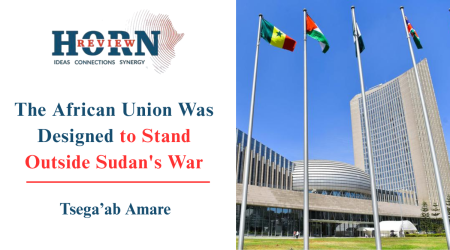
The African Union Was Designed to Stand Outside Sudan's War
Every time Sudan's war comes up in public discussion, mentioning...
2
Sep
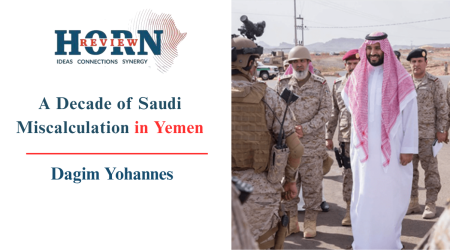
A Decade of Saudi Miscalculation in Yemen
On March 26, 2015, Mohammed bin Salman, then a thirty-year-old...
31
Aug
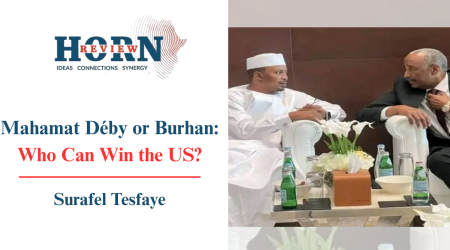
Mahamat Déby or Burhan: Who Can Win the US?
On August 20, 2026, Sudanese warplanes and drones pursued a...
27
Aug
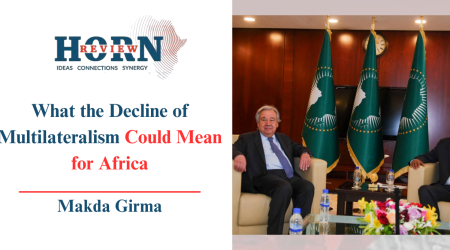
What the Decline of Multilateralism Could Mean for Africa
Multilateralism is weakening just as African states need it most....
19
Aug
Who Gets a Seat in Saudi Arabia’s Red Sea Security Order?
Saudi Arabia’s new maritime defence architecture exposes a contradiction at...
18
Aug
Asymmetric Attrition in Hormuz: Decoding the Escalation Against State Energy Assets
The attacks on ADNOC vessels in the Strait of Hormuz...
17
Aug
Egypt Skipped the Mecca Pact Because It Lacks the Leverage to Join
Egypt’s continued absence from the Mecca collective-defense pact reflects a...